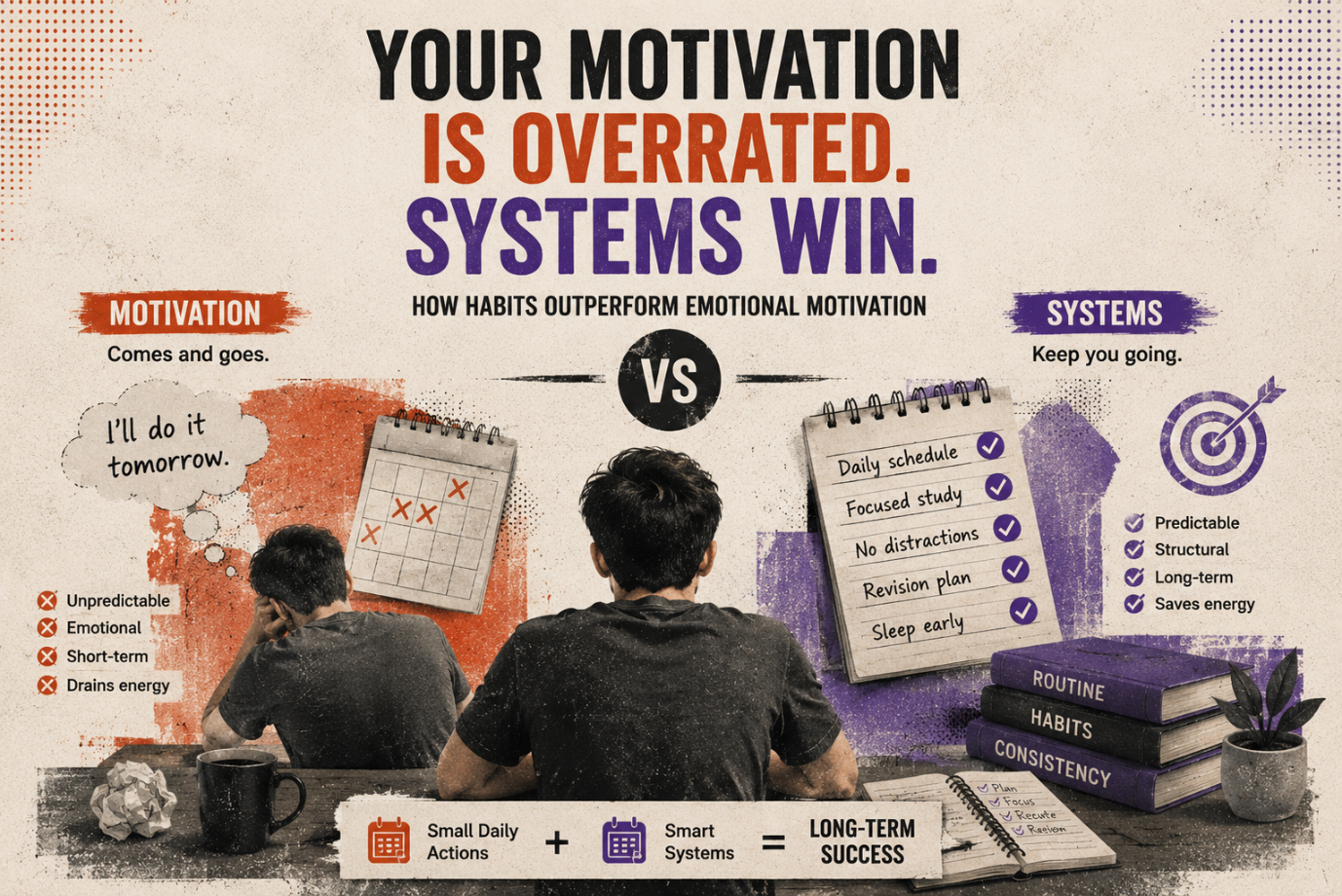
Most people think success comes from motivation.
They wait to feel inspired.
They wait to feel confident.
They wait for that perfect moment when everything finally "clicks."
And sometimes, motivation does appear.
You wake up energized, make a new plan, organize your desk, and promise yourself:
"This time I'll stay consistent."
But a few days later, the excitement fades.
Not because you're lazy.
Not because you lack discipline.
But because motivation was never meant to carry your entire life.
Systems were.
Motivation Is Temporary
Motivation is emotional.
And emotions change constantly.
Some days you feel focused and ambitious.
Other days you feel tired, distracted, or overwhelmed.
If your productivity depends entirely on how you feel, your progress will always be unstable.
That's why relying only on motivation creates cycles:
intense action followed by burnout and inconsistency—the same pattern behind
unfinished study plans
that collapse after one bad day.
Systems work differently.
A system doesn't ask:
"Do I feel motivated today?"
It asks:
"What action happens automatically now?"
That shift changes everything.
Habits Beat Intensity
A single burst of motivation feels powerful, but consistency matters far more than intensity.
Reading 10 pages every day is more effective than reading 100 pages once and stopping for weeks.
Studying consistently works better than last-minute cramming.
A short daily workout changes your body more than occasional extreme effort.
Real growth usually comes from small repeated actions.
The brain learns through repetition, not emotional excitement.
That's why habits outperform motivation:
they continue even on ordinary days. The same principle powers
spaced repetition—small, scheduled reviews that compound over months.
Systems Reduce Friction
One of the hardest parts of any task is starting.
Motivation tries to solve this with emotional energy.
Systems solve it with structure.
For example:
- Studying at the same time every day
- Keeping your workspace ready
- Planning tasks the night before
- Turning off distractions in advance
- Using a revision schedule instead of random studying
These systems remove unnecessary decisions.
You stop negotiating with yourself every morning.
And when something becomes automatic, consistency becomes easier. A revision timetable or a tool like Revu can tell you what to study next—so you don't rebuild the plan from scratch every morning.
Your Environment Matters More Than You Think
People often blame themselves for lacking willpower while ignoring their environment.
But behavior is heavily shaped by surroundings.
If your phone is next to you while studying, distraction becomes effortless.
If your room is chaotic, focus becomes harder.
If unhealthy habits are always easily available, avoiding them requires constant energy.
Good systems include environmental design.
They make positive habits easier and negative habits harder.
Sometimes productivity is not about becoming mentally stronger.
It's about creating an environment that supports the behavior you want—especially when
the attention economy
is engineered to pull you away from deep work.
Systems Work on Bad Days Too
Motivation works best on good days.
Systems matter on bad days.
When you're tired, stressed, or emotionally drained, you usually fall back to your routines.
That's why systems are powerful:
they protect progress from your changing emotions.
The students who succeed long-term are not always the most motivated.
They are the most consistent.
The writers who finish books are not always deeply inspired.
They simply continue writing even when inspiration disappears.
Success is often less about intense effort and more about reliable repetition.
Identity Comes From Repetition
Every repeated action teaches your brain something about who you are.
When you study regularly, you begin seeing yourself as someone who studies.
When you exercise consistently, you start identifying as a healthy person.
When you keep showing up, your identity slowly changes.
Motivation focuses on goals.
Systems shape identity.
And identity is what creates long-term behavior.
Final Thought
Motivation is not useless.
It can help you begin.
But systems are what keep you moving after the excitement fades.
Anyone can work hard for a day when they feel inspired.
The real difference comes from building habits that continue even when motivation disappears—whether that's a Pomodoro routine, a fixed study slot, or automated revision that runs without a motivational pep talk.
Because in the long run:
Motivation creates temporary action.
Systems create lasting change.