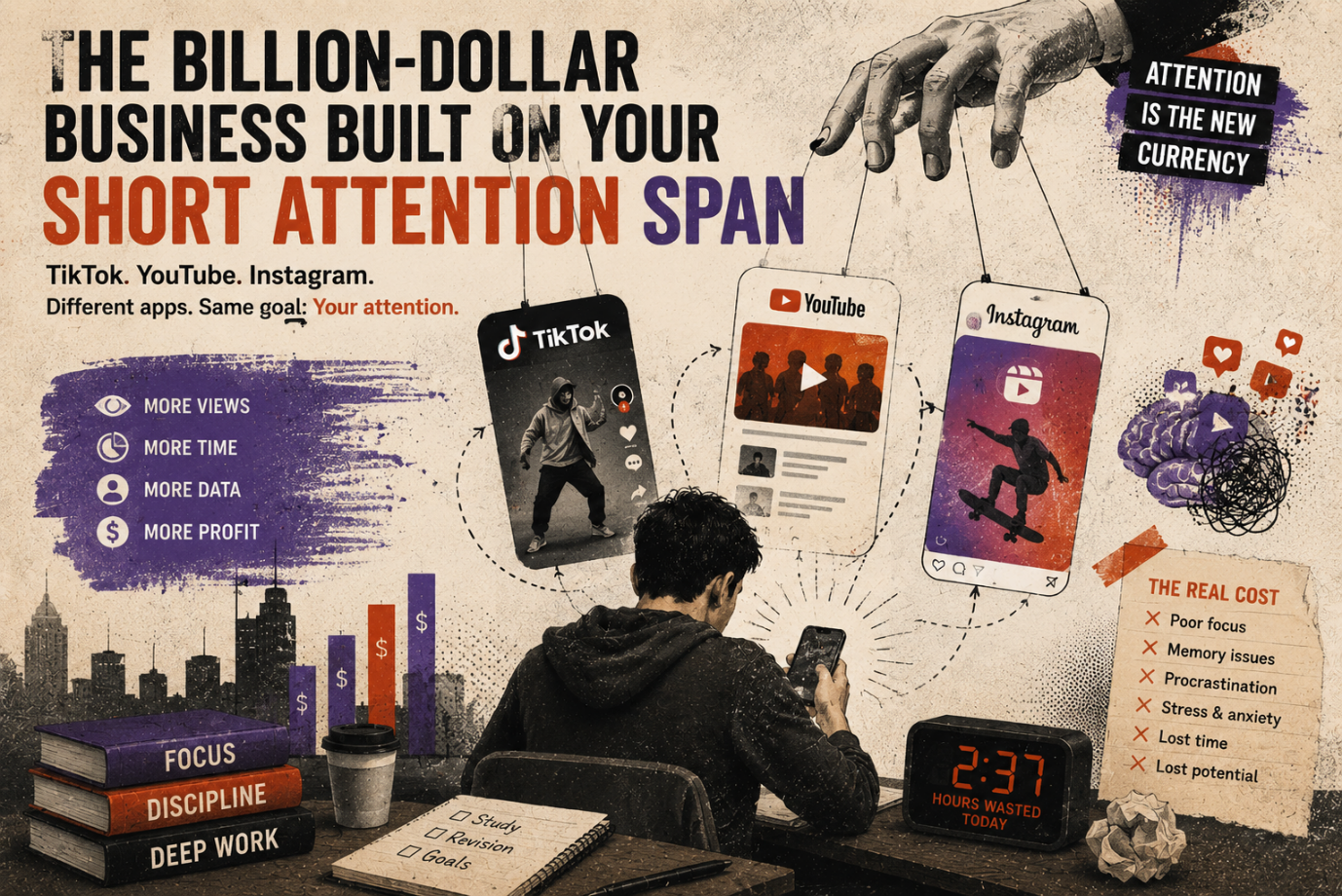
Every time you open TikTok, Instagram Reels, or YouTube Shorts, thousands of engineers, designers, and algorithms begin competing for one thing:
Your attention.
Not your money.
Not your loyalty.
Not even your happiness.
Just your next second.
Because in today's internet economy, attention is one of the most valuable resources on Earth.
And the biggest tech companies in the world are fighting aggressively to capture it.
The Attention Economy
Social media platforms are not really social networks anymore.
They are attention businesses.
The longer you stay on the app:
- the more ads you see,
- the more data they collect,
- and the more money they make.
That's why platforms are optimized to keep you scrolling for as long as possible.
Autoplay videos.
Notifications.
Personalized recommendations.
Short-form content loops.
None of these features are accidental.
They are carefully engineered systems designed to reduce the moment where you stop and think: "Should I close this app now?"
Why Short Videos Feel Impossible to Resist
Apps like TikTok changed the internet by perfecting something powerful: rapid dopamine delivery.
Every swipe offers uncertainty.
Maybe the next video will be funny.
Maybe emotional.
Maybe useful.
Maybe shocking.
Your brain starts anticipating rewards constantly.
Psychologists call this a "variable reward system" — the same mechanism used in slot machines. You never know what's coming next, so your brain keeps pulling the lever.
Swipe. Scroll. Refresh. Again and again.
That unpredictability is what makes short-form content incredibly addictive.
For a related look at dopamine and digital habits, see our guide on how dopamine detox became a student trend.
Your Brain Was Never Designed for This
Human attention evolved in environments very different from today's digital world.
Your brain was built to notice novelty and react quickly to stimulation. That helped humans survive.
But modern apps exploit those same instincts at massive scale.
Now your brain receives:
- hundreds of videos per hour,
- constant emotional stimulation,
- endless novelty,
- and near-zero silence.
Over time, this changes how focus feels.
Slow activities like studying, reading, or deep thinking begin feeling "boring" — not because they are bad, but because your brain becomes used to constant stimulation.
And that's where students are being affected the most.
What This Means for Students
Studying requires sustained attention.
But short-form platforms train the opposite behavior: rapid context switching.
A student might watch:
- a meme,
- then a productivity tip,
- then a football clip,
- then a motivational edit,
- then a cat video —
all within two minutes.
The brain constantly changes emotional states and attention patterns.
As a result, many students now struggle with:
- sitting still for long periods,
- reading without distraction,
- remembering information deeply,
- and focusing without checking their phone.
The issue is not intelligence.
It's attention fragmentation.
Deep learning also depends on memory—and fragmented focus makes retention harder. See why your brain deletes most of what you study when revision never gets the focus it needs.
The Most Dangerous Part: It Feels Productive
Not all distracting content looks distracting.
That's what makes modern platforms powerful.
A student may spend hours watching:
- "study motivation"
- self-improvement reels,
- productivity hacks,
- educational clips,
- "day in the life" videos,
and still avoid actual studying.
The brain mistakes consuming productivity content for making progress.
But watching content about studying is not the same as studying.
Information without action becomes entertainment.
Platforms Are Fighting a War for Your Time
TikTok, Instagram, and YouTube are competing against each other intensely.
And the battleground is your screen time.
If TikTok keeps you for 20 more minutes, YouTube loses.
If Instagram grabs your attention first, TikTok loses.
That's why algorithms are becoming more aggressive every year.
The better they understand your emotions, interests, fears, humor, and habits, the longer they can keep you engaged.
Your attention has become monetized.
And your focus is now a product.
So What Can Students Do?
The solution is not to quit the internet forever.
These platforms are useful tools when used intentionally.
The real challenge is learning to control technology before it controls your attention.
Small changes matter:
- keeping your phone away while studying,
- disabling unnecessary notifications,
- using screen-time limits,
- creating distraction-free study sessions,
- and practicing deep focus regularly.
Techniques like the Pomodoro method or beating study procrastination can help you rebuild focus in structured blocks.
Attention works like a muscle.
The more fragmented it becomes, the harder deep thinking feels.
But the more you train focus, the stronger it returns.
Final Thought
The biggest companies in the world are spending billions of dollars trying to shorten your attention span.
Because shorter attention often means longer scrolling.
And longer scrolling means more profit.
But students who learn to protect their attention gain something increasingly rare: the ability to think deeply in a distracted world.
And in the future, that ability may become one of the most valuable skills of all.