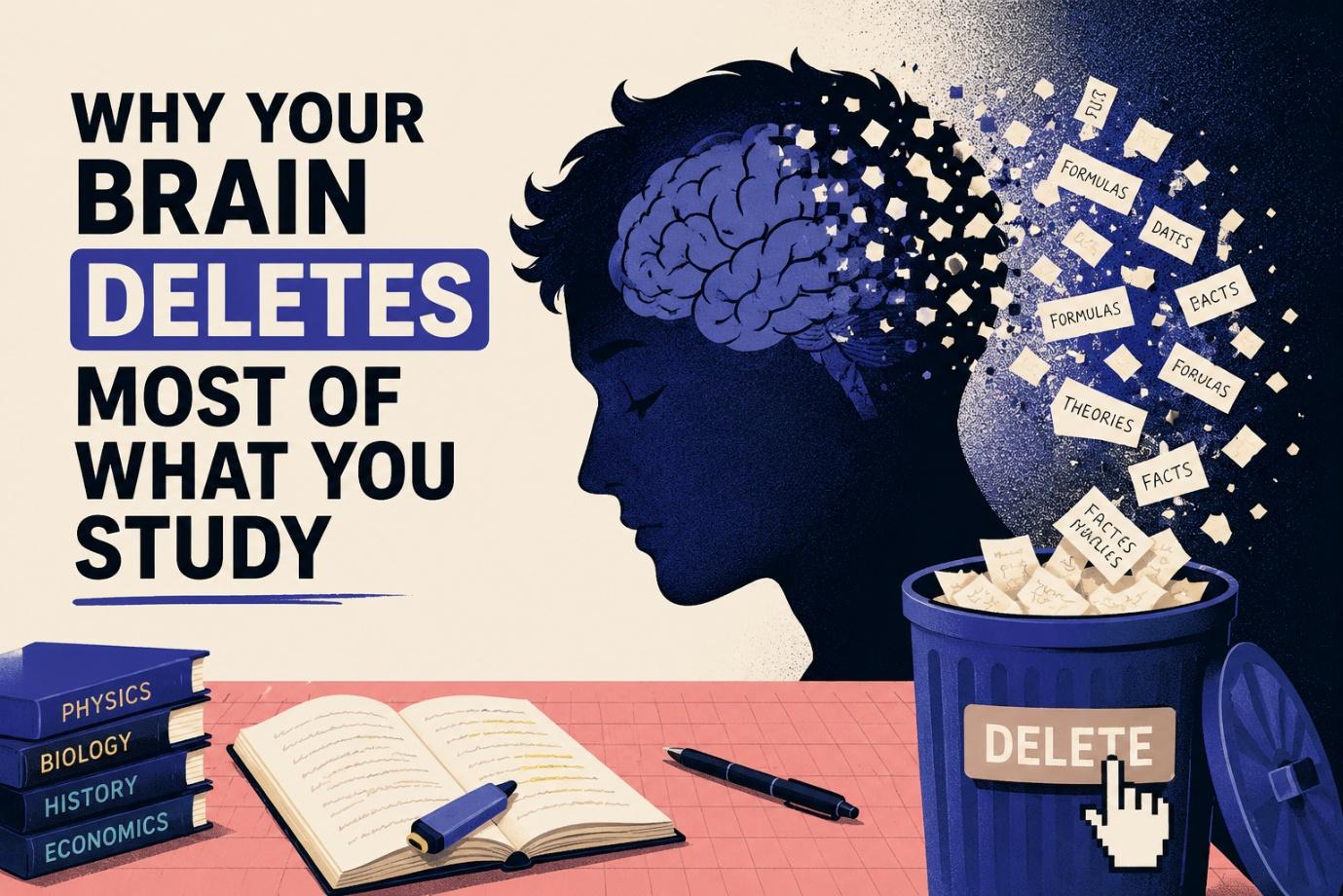
You spend four hours on a single chapter. You highlight key lines, write neat notes, watch explanation videos at double speed. You feel oddly productive.
Then, three days later, someone asks you a basic question from that chapter — and your brain draws a blank. Not a complete blank. You recognize it. You know you studied it. But the actual answer? Gone, as if your brain quietly dragged your hard work into the recycle bin while you were sleeping.
That's not far from what actually happened.
The Experiment That Revealed How Quickly We Forget
In the late 1800s, German psychologist Hermann Ebbinghaus set out to understand memory scientifically. The challenge was that existing studies were unreliable — people remembered things based on emotion, meaning, and prior experience, making it impossible to isolate memory itself.
So he created something deliberately boring: nonsense syllables. Words like BOK, YAT, and ZUF — carrying no meaning, no emotion, no associations. Then, in one of history's more unusual research decisions, he spent years memorizing thousands of these syllables himself.
What he discovered was striking. Forgetting doesn't happen gradually. It happens fast — sharply and early. Without revisiting new information, people lose a significant portion of it within days. Ebbinghaus mapped this pattern into what we now call the forgetting curve: learn something, watch retention drop steeply, and watch memory fade unless something intervenes.
Your brain leaks information by default.
Why Forgetting Is Actually a Feature
It's tempting to see this as a flaw. But forgetting serves a purpose.
Consider everything your brain encounters in a single day — every face, every advertisement, every background conversation, every notification, every fleeting thought. If your brain stored all of it with equal weight, it would become completely unusable. Like a phone with a hundred thousand screenshots and no search function.
Forgetting is your brain's filtering mechanism. It constantly evaluates: Is this worth keeping? Information that isn't repeatedly retrieved or reinforced gets quietly archived. This idea was later expanded by cognitive psychologist Robert Bjork, whose research showed that memory strength depends heavily on how often and how deliberately information is retrieved. Your brain holds onto what you prove, through repeated use, actually matters.
The Illusion of Learning
Here's where most students go wrong.
The common assumption is that learning happens when information enters the brain — when you read, highlight, or watch a lecture. But that's not when learning occurs. Learning happens when information is successfully retrieved. The act of pulling something out of memory is what strengthens it.
This is why so many study habits feel productive but aren't. Reading your notes feels like learning. Re-watching a lecture feels like learning. Highlighting feels like learning. But psychologists have a name for what's actually happening: the illusion of competence. You recognize information and mistake that familiarity for mastery. It's the mental equivalent of watching workout videos and assuming your muscles are growing.
The real work is retrieval.
Why Exams Feel Brutal Even When You've Studied
There's another layer to this. Even information that was encoded reasonably well can fail you under pressure. Stress hormones — particularly cortisol — can interfere with memory retrieval, which is why answers that seemed obvious at your desk suddenly vanish in an exam hall.
So students often face two compounding problems: information that was weakly encoded to begin with, and a high-stress environment that makes retrieval even harder. It's a punishing combination, and one that feels deeply unfair when you know you put in the hours.
How to Actually Beat the Forgetting Curve
The most effective learners don't try to fight forgetting. They use it.
The strategy is called spaced repetition: instead of reviewing material randomly, you revisit it at carefully timed intervals — just before your brain would otherwise let it go. Each review strengthens the memory further, and over time, the forgetting curve flattens. Retention becomes durable rather than fleeting.
This is why medical students, language learners, and competitive exam aspirants rely on tools like Anki. The logic is simple but powerful — instead of cramming and re-learning, you review at the right moment and make each study session count far more. See our guide to revision apps for medical students or how spaced repetition pairs with active recall for the full picture.
The Bigger Picture
Your brain isn't broken. It's efficient — perhaps ruthlessly so. Forgetting protects you from drowning in irrelevant information. The real problem is that most education systems teach students what to learn, but almost never teach them how memory actually works.
That gap is expensive. Students spend thousands of hours re-learning things they once already knew, never realizing the issue wasn't effort — it was strategy.
The students who understand how memory works don't just study harder. They study in a way that makes forgetting work for them instead of against them. And that quiet advantage compounds over time in ways that are hard to overstate.