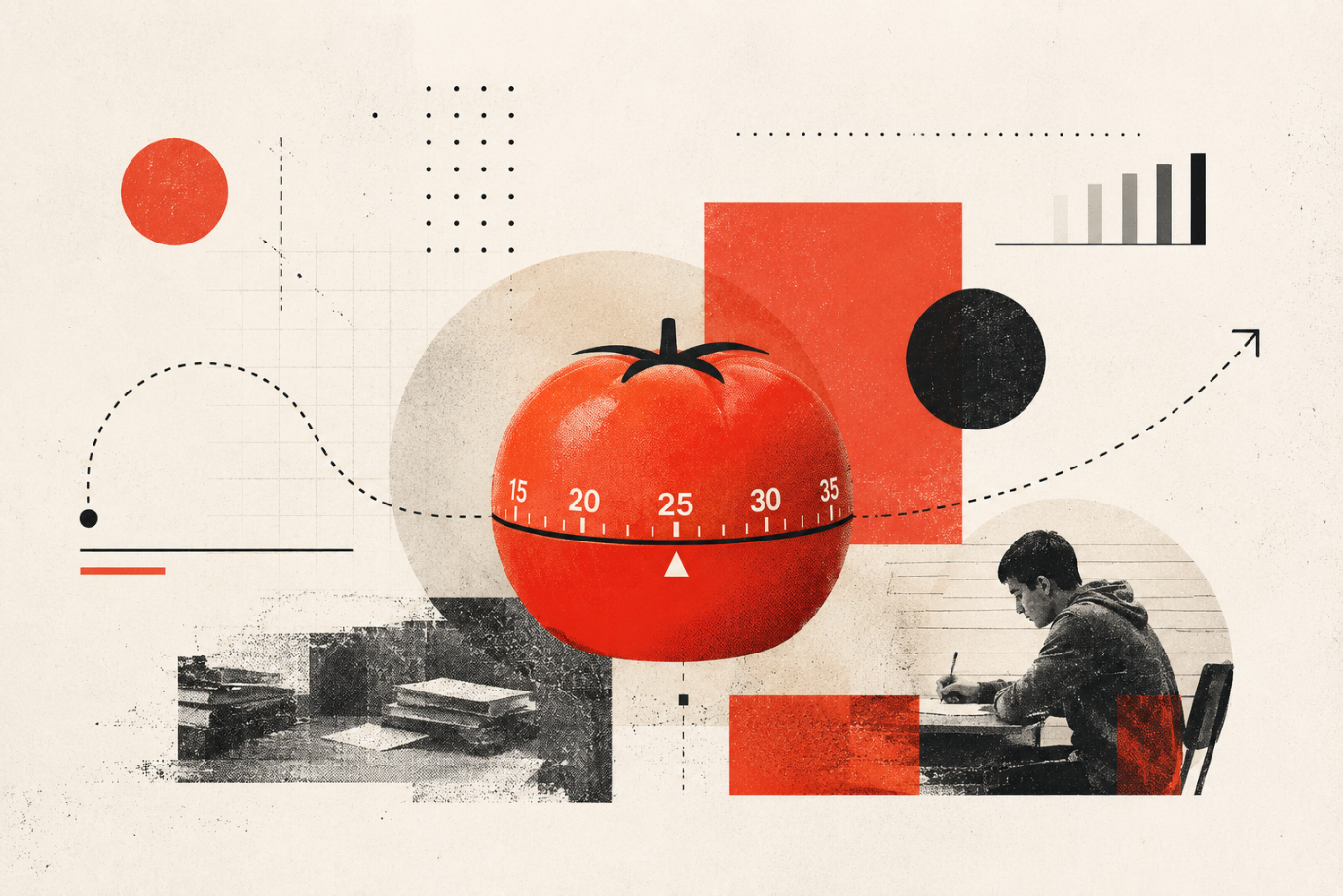
A student sits down at 9 AM with an ambitious plan.
Finish Biology revision.
Complete 3 chapters of Economics.
Solve 50 math problems.
Revise vocabulary.
By 9:17 AM… they’re watching productivity videos on YouTube.
By 10:00 AM… they’re reorganizing notes.
By 11:00 AM… they decide they’ll “start properly after lunch.”
Sound familiar?
This is exactly why the Pomodoro Technique became one of the most popular productivity systems in the world. And surprisingly… it started with a tomato.
The student who couldn’t focus
In the late 1980s, an overwhelmed university student in Italy was struggling to study.
His name was Francesco Cirillo.
Like most students:
- he felt distracted
- overwhelmed
- unable to focus for long periods
So he made a tiny deal with himself: “Can I focus for just 10 minutes?”
He used a tomato-shaped kitchen timer. Pomodoro means “tomato” in Italian.
Eventually, he found a better rhythm:
25 minutes of focused work → 5-minute break.
After 4 rounds → 15–30 minute longer break.
And that’s how the Pomodoro Technique was born.
Why this works better than “study all day”
Because your brain hates vague commitments.
“Study for 8 hours today.”
Feels painful. Feels endless. Feels exhausting. And your brain responds with procrastination.
But: “Study for just 25 minutes.”
Feels manageable. Low resistance. Easy to begin.
And starting is often the hardest part—something we explore in detail in how to stop procrastinating while studying.
Your brain loves finish lines
This is where Pomodoro gets interesting.
Your brain is far more motivated when:
- the task feels short
- the reward feels near
- progress feels visible
That’s why binge-watching Netflix feels easier than studying. Every episode gives you a clear ending. Studying often doesn’t.
Pomodoro artificially creates finish lines. And your brain loves that.
It reduces the biggest productivity killer: task paralysis
Students often procrastinate because tasks feel too big. Examples:
- “Revise organic chemistry”
- “Prepare for UPSC”
- “Study for finals”
These tasks are psychologically intimidating. But Pomodoro reframes them into:
- One 25-minute chemistry revision session
- One 25-minute current affairs revision block
- One 25-minute vocabulary session
Suddenly the mountain becomes climbable.
It prevents fake studying
You know this:
Laptop open.
Book open.
Phone nearby.
And somehow nothing gets done. You “study” for 4 hours. Actual focused learning? Maybe 45 minutes.
Pomodoro forces intentional focus.
Timer starts. One task. No switching. No fake productivity.
The break is the secret weapon
Most people think Pomodoro is about working harder. It’s actually about recovery.
Research shows structured breaks can reduce fatigue and help maintain concentration compared to self-regulated studying sessions.
That’s why marathon study sessions often collapse. Your attention has limits. Breaks help reset it.
Why Pomodoro fails for some students
Because they copy the 25/5 rule blindly. That’s not always ideal. Different tasks need different rhythms.
| Task type | Work | Break | Best for |
|---|---|---|---|
| Deep problem solving | 50 min | 10 min | Math, coding, derivations, essay drafting |
| Revision sessions | 25 min | 5 min | Flashcards, recall practice, spaced reviews |
| Reading-heavy tasks | 40 min | 10 min | Textbook chapters, long-form notes |
| Low attention-span days | 15 min | 5 min | Restarting focus, building the habit |
The goal isn’t to worship 25 minutes. The goal is sustainable focus.
Pair Pomodoro with an active recall routine and a revision timetable built on spaced repetition, and your study time stops leaking out through context switches.
The bigger lesson
Pomodoro became famous because it solved a universal student problem: starting feels hard.
And often… the secret to productivity isn’t motivation. It’s making tasks feel small enough to begin.
Sometimes all it takes is 25 focused minutes—and one tomato timer.