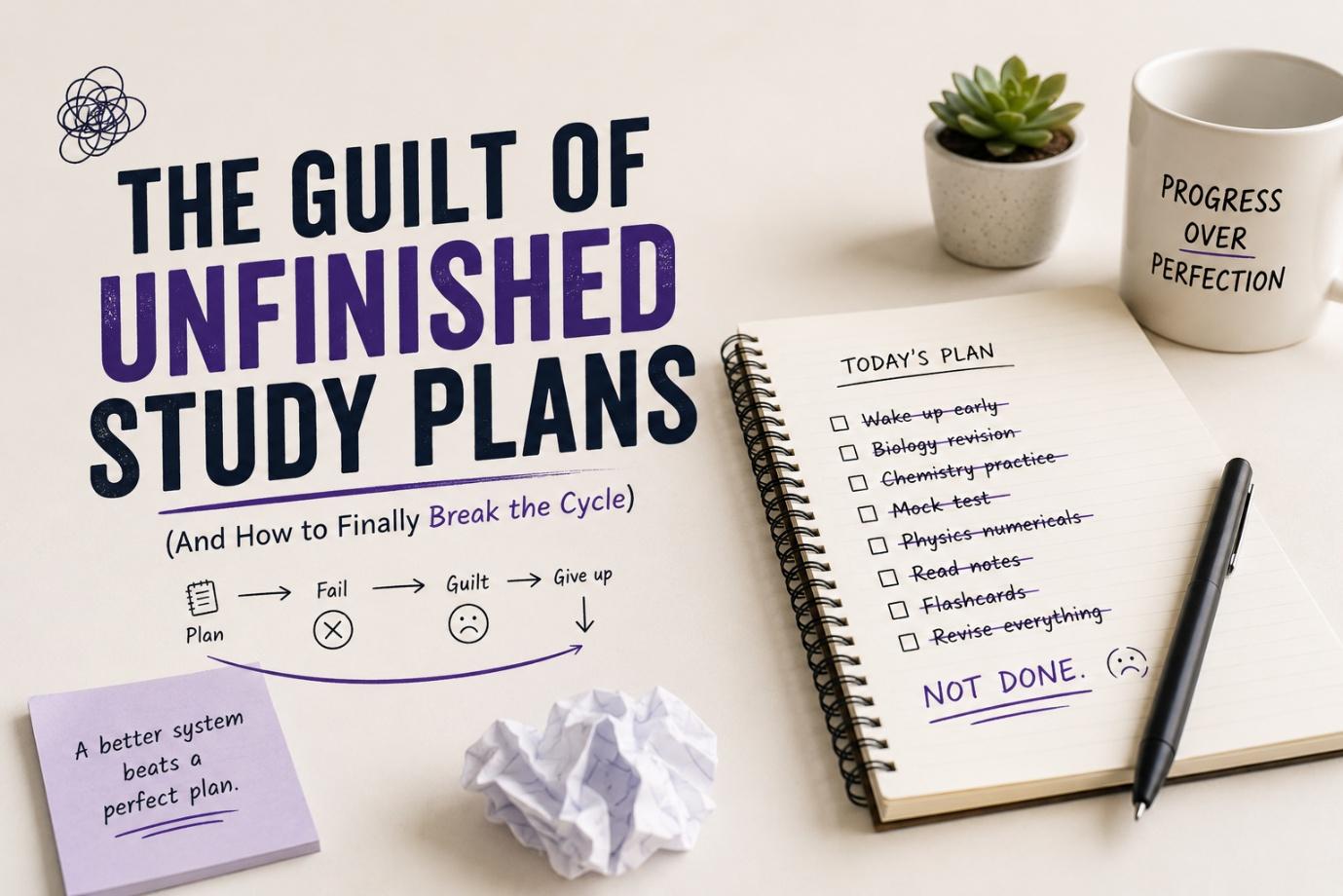
It usually starts with optimism.
"Tomorrow will be different."
You open your notebook.
You create the perfect schedule.
6:30 AM → Workout
7:00 AM → Biology revision
9:00 AM → Chemistry practice
11:00 AM → Mock test
2:00 PM → Revision
4:00 PM → Flashcards
8:00 PM → Finish entire syllabus
10:00 PM → Become academically unstoppable
This plan feels incredible.
For five minutes.
Then tomorrow arrives.
You wake up late.
One chapter takes longer than expected.
You feel tired.
Something unexpected happens.
By evening, your "perfect plan" is completely broken.
And then comes the worst part:
The guilt.
"Why am I like this?"
"Other students are more disciplined."
"I wasted another day."
"I'm falling behind."
And suddenly, one unfinished plan starts feeling like a personal failure.
But here's what most students don't realize:
Your study plan probably failed because it was designed for an imaginary version of you.
Not the real one.
The Fantasy Student Problem
Many students create schedules based on their ideal self.
The version of them that:
- Never gets tired
- Never gets distracted
- Never underestimates chapter difficulty
- Never needs breaks
- Never has bad days
Basically…a robot.
Real students aren't robots.
Real students:
- Get mentally exhausted
- Lose focus
- Need flexibility
- Have unpredictable days
And that's normal.
Why Overplanning Feels Productive
Planning gives your brain a dopamine hit.
You feel in control.
That's why color-coded timetables and perfect schedules can feel satisfying—even when you build them in a study planner app that looks flawless on screen.
But planning is not progress.
Sometimes students spend more time creating beautiful plans than actually studying.
Harsh...but true.
One Missed Task Becomes an Entire Lost Day
This is where things get dangerous.
You miss one task.
Then your brain says:
"Well, the day is ruined anyway."
So instead of completing 70% of your plan…
You complete 0%.
This all-or-nothing thinking destroys consistency—the same pattern that fuels study procrastination when shame makes you avoid the desk entirely.
A partially completed day is still a productive day.
Your Schedule Has No Margin for Reality
Most study plans fail because they assume everything goes perfectly.
They don't include:
- Breaks
- Buffer time
- Difficult chapters
- Low-energy days
- Unexpected interruptions
That's why your plan collapses after one delay. A science-backed revision timetable builds buffer zones and spaced review slots on purpose—so one late morning doesn't erase the whole week.
You're Probably Underestimating How Long Studying Takes
You tell yourself:
"I'll finish this chapter in 45 minutes."
Three hours later:
You're still making notes.
Students often underestimate workload, which creates unrealistic plans—and the guilt that follows when reality doesn't match the spreadsheet.
The Real Problem: You're Carrying Yesterday's Guilt Into Today
This is brutal.
You miss yesterday's targets.
Then you wake up feeling behind.
Then today feels heavier.
Then procrastination increases.
Then more guilt builds.
It becomes a cycle.
Miss work → feel guilty → avoid studying → miss more work
Breaking that loop starts with a smaller plan today—not a bigger apology to yesterday.
What Actually Works Instead?
1. Plan fewer tasks
Your daily plan should feel slightly easy.
That's sustainable.
2. Focus on priorities
Ask:
"What are the 2–3 tasks that truly matter today?"
Not 17 tasks.
3. Use flexible revision systems
Instead of manually rebuilding plans every time life happens, spaced repetition helps automate what needs attention—so you're revising at the right time, not re-drawing the same timetable from scratch.
Apps like Revu help students know what to revise next without rebuilding schedules daily.
4. Measure consistency, not perfection
A student who studies 3 hours daily for 6 months often beats someone doing chaotic 12-hour bursts—the same lesson behind why last-minute cramming costs more than it saves.
You Do Not Need a Perfect Study Plan
You need a study system that survives bad days.
Because bad days happen.
You'll oversleep.
You'll procrastinate sometimes.
You'll lose momentum occasionally.
That doesn't mean you're failing.
It means you're human.
And sometimes the most productive thing you can do after an unfinished study plan is very simple:
Stop feeling guilty.
And start again tomorrow.