The science of the perfect revision timetable: 2026 guide
Building a revision timetable for exams is often the most productive way to procrastinate: hours go into color-coded grids, then real life hits by Wednesday and the plan quietly dies.
In 2026, high-performing students still watch the clock—but they also manage cognitive load. A timetable that matches memory science beats one that only matches your highlighters. For a broader revision playbook, pair this guide with how to revise effectively and what spaced repetition is.

1. The reverse planning method
Most people plan forward from today. For exams, start from the exam date and work backward so non-negotiable milestones stay protected.
- The day before: Light review and confidence building—no brand-new topics.
- Three days before: A full past paper under timed conditions.
- Seven days before: A targeted “weak spot” intensive on gaps that still cost marks.
Backward planning makes it obvious when you are out of runway—before panic sets in.
2. Ditch subject-only blocks for interleaving
Blocking (“Monday is Biology”) feels satisfying, but for long-term memory it is often weaker than interleaving: mixing related subjects in one day—for example, ninety minutes of Biology, then a switch to Chemistry.
Switching forces a small “retrieval reset,” which strengthens discrimination between similar ideas. Your exam revision schedule should still respect energy (hard topics when you are fresh), but variety belongs in the same day, not only across the week.
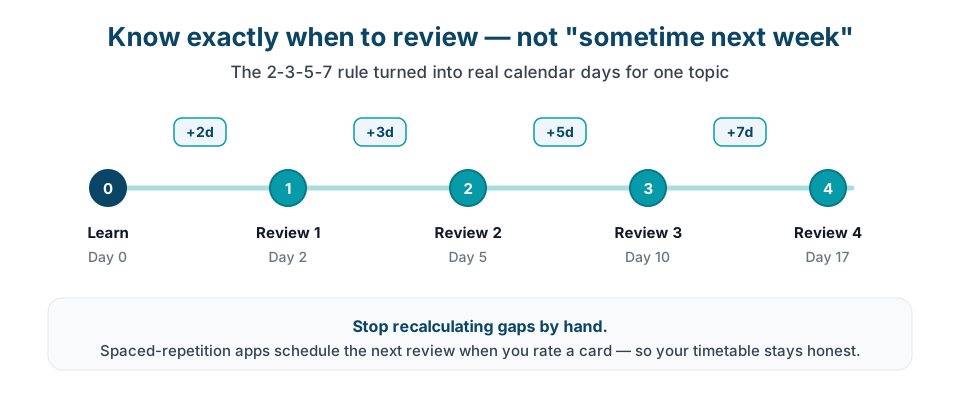
3. Implement the 2-3-5-7 rule (spaced repetition on your calendar)
To fight the forgetting curve, anchor your timetable on spaced repetition: revisit material at widening intervals instead of “once and done.”
- Review 1: 2 days after first learning.
- Review 2: 3 days after Review 1.
- Review 3: 5 days after Review 2.
- Review 4: 7 days after Review 3.
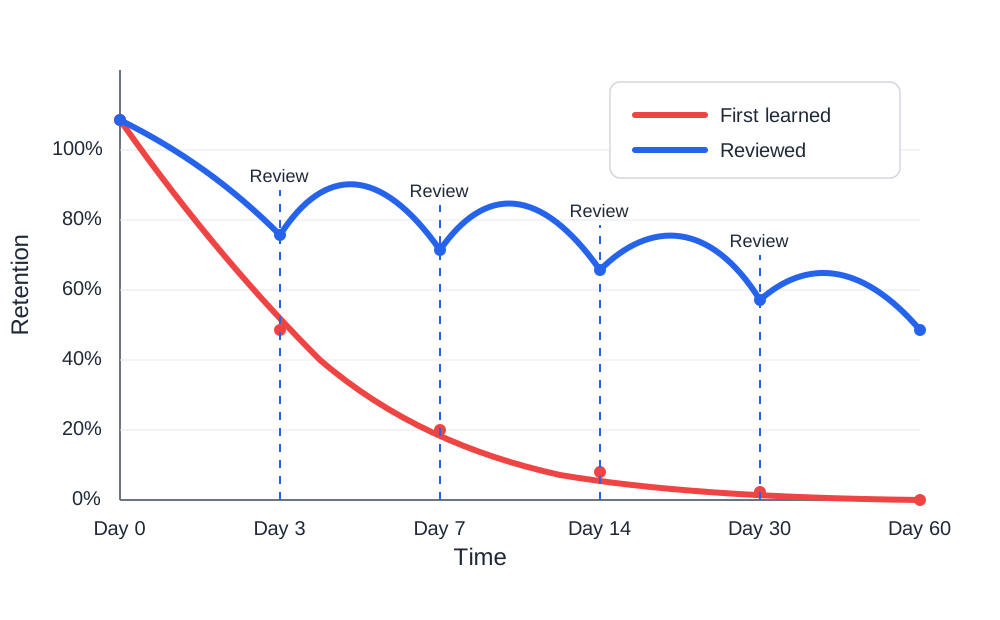
Pro tip: Apps like Revu can automate these review triggers so you are not manually recalculating gaps while you study. See also the best spaced repetition apps compared side by side.
4. Prioritize with a confidence rating (traffic lights)
Equal time for every chapter sounds fair; it is rarely optimal. Use a simple traffic-light split:
- Red: High-weight topics you do not understand yet—aim for roughly 50% of revision time.
- Amber: You know the ideas but still slip on questions—about 30%.
- Green: Mostly mastered—about 20%, mostly quick maintenance recalls so fluency does not decay.
5. Build buffer zones (the 80/20 rule)
If you schedule every minute from 8 a.m. to 8 p.m., one slow morning can collapse the whole week. Instead, plan only about 80% of your available study time as fixed blocks.
Leave roughly 20%—often a Saturday afternoon or Sunday morning—as a catch-up buffer. If you are on track, that time becomes recovery or optional stretch goals. If you fell behind, you still have a safety net without rewriting the entire revision timetable.
Sample daily structure: the “focus-flow” routine
This template ties time of day to cognitive demand: hardest work first, active recall mid-morning, exam-style practice after lunch, and a short nightly recap to consolidate.
| Time block | Activity | Why it works |
|---|---|---|
| 08:00–09:30 | Deep work (red topic) | Your brain is freshest for the hardest material. |
| 09:30–10:00 | Active break | Movement helps reset attention before the next block. |
| 10:00–11:30 | Active recall (amber topic) | Flashcards, blurting, or closed-book prompts beat passive re-reading. |
| 13:00–15:00 | Past paper practice | Matches afternoon exam energy and builds timing discipline. |
| 19:00–19:30 | Nightly recap | Five-minute summaries of what you studied today strengthen consolidation. |
Takeaway
A revision timetable for exams works when it is built backward from the test, mixes topics intelligently, bakes in spaced reviews, weights weak areas, and leaves slack for reality. That is less about perfect aesthetics—and more about a schedule your future self can actually follow.