Every few months, AI seems to cross another milestone.
It writes essays, generates code, creates artwork, solves complex math problems, and even passes professional exams.
It's no surprise that many students are asking:
"What skills will still matter if AI can do almost everything?"
The answer isn't memorization. It isn't typing faster. It isn't even knowing the right software.
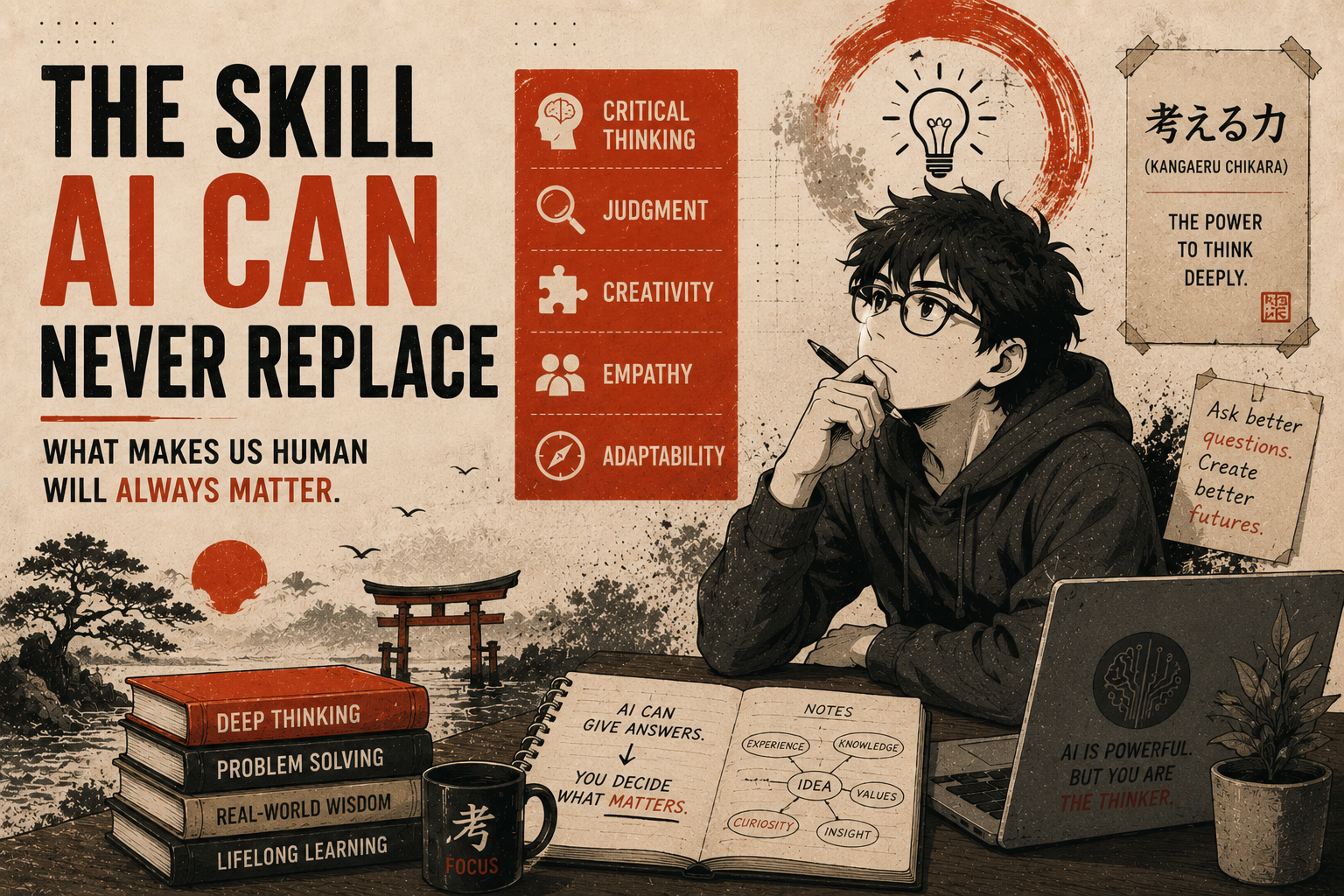
The one skill that will always matter is thinking—not simply having information, but knowing what to do with it.
AI Knows More Than Any Human
Ask an AI to explain quantum physics. Then ask it to summarize a 500-page book.
Translate a paragraph. Write a business proposal. Generate practice questions.
It can do all of this in seconds.
In terms of raw information, humans simply can't compete. And we don't need to.
Just as calculators replaced mental arithmetic for many tasks, AI is replacing the need to manually produce information. But calculators never replaced mathematicians. For the same reason, AI won't replace thinkers.
Information Is Cheap. Judgment Isn't.
Today, facts are everywhere.
Google made information searchable. AI makes information conversational.
The challenge is no longer finding answers. It's deciding whether those answers are correct.
Imagine asking AI for investment advice. Or a medical explanation. Or historical facts.
The response might sound confident. But confidence isn't the same as accuracy.
Someone still has to ask:
- Does this make sense?
- Is there evidence?
- What assumptions are being made?
- Could there be another explanation?
That's judgment. And judgment comes from understanding—not from copying answers.
The Difference Between Knowing and Understanding
Suppose AI solves a physics problem for you. You receive the correct answer.
But if the numbers change tomorrow, can you solve it yourself?
Many students mistake recognition for learning.
Reading an explanation feels productive. Watching a video feels productive. Even AI-generated notes feel productive.
But learning only happens when your brain actively retrieves, connects, and applies information. See active recall and retrieval practice for why that effort matters.
Understanding isn't something AI can download into your mind. You have to build it yourself.
The Skill Behind Every Great Idea
Every invention, scientific breakthrough, and business started with someone connecting ideas in a new way.
Creativity isn't magic. It's the ability to combine existing knowledge into something original.
A musician blends different influences. An engineer combines technologies. A doctor connects symptoms to find a diagnosis.
Even AI works by recognizing patterns from existing information. Humans do something different.
We imagine possibilities that don't yet exist.
The richer your knowledge, the richer your imagination becomes.
Memory Is Still Your Superpower
Some people argue that memory no longer matters because AI remembers everything.
But memory isn't just storage. It's the material your brain uses to think.
When solving a problem, your mind constantly pulls together concepts you've learned before.
Without that mental library, there's nothing to connect.
Imagine trying to write a novel after reading only one book. Or trying to invent something without understanding the field.
Memory fuels creativity—not because remembering facts is impressive, but because remembered knowledge becomes the building blocks of new ideas. Read why memory matters more than ever in an AI world.
AI Is a Tool, Not a Replacement
The best professionals won't compete with AI. They'll collaborate with it.
A programmer uses AI to write boilerplate code but still designs the system.
A lawyer uses AI to summarize documents but still makes legal arguments.
A doctor uses AI to analyze scans but still diagnoses the patient.
The same is true for students.
AI can explain a concept. Generate quizzes. Create flashcards. Summarize chapters. But it can't learn on your behalf. Only your brain can strengthen the neural connections that create lasting understanding.
The Students Who Will Thrive
The future doesn't belong to students who reject AI.
Nor to those who let AI do all the work.
It belongs to students who know when to use AI—and when to rely on their own thinking.
They ask better questions. They verify information. They connect ideas across subjects. They build knowledge instead of merely collecting answers.
Ironically, AI makes human thinking even more valuable. Because when everyone has access to the same information, the difference lies in how well you use it—whether you're using the Feynman Technique to test understanding or preparing for exams that evolve beyond copy-paste answers.
Final Thoughts
Every technological revolution changes the skills we value.
The internet made information abundant. AI makes information effortless.
But one thing hasn't changed.
Progress has always come from curious minds willing to question, analyze, experiment, and learn.
AI can generate answers. Only you can decide which ones are worth believing.
And that's a skill no technology can replace.