Most students think learning means reading more.
Highlighting more. Taking more notes. Watching one more video.
But what if the fastest way to learn something was to explain it?
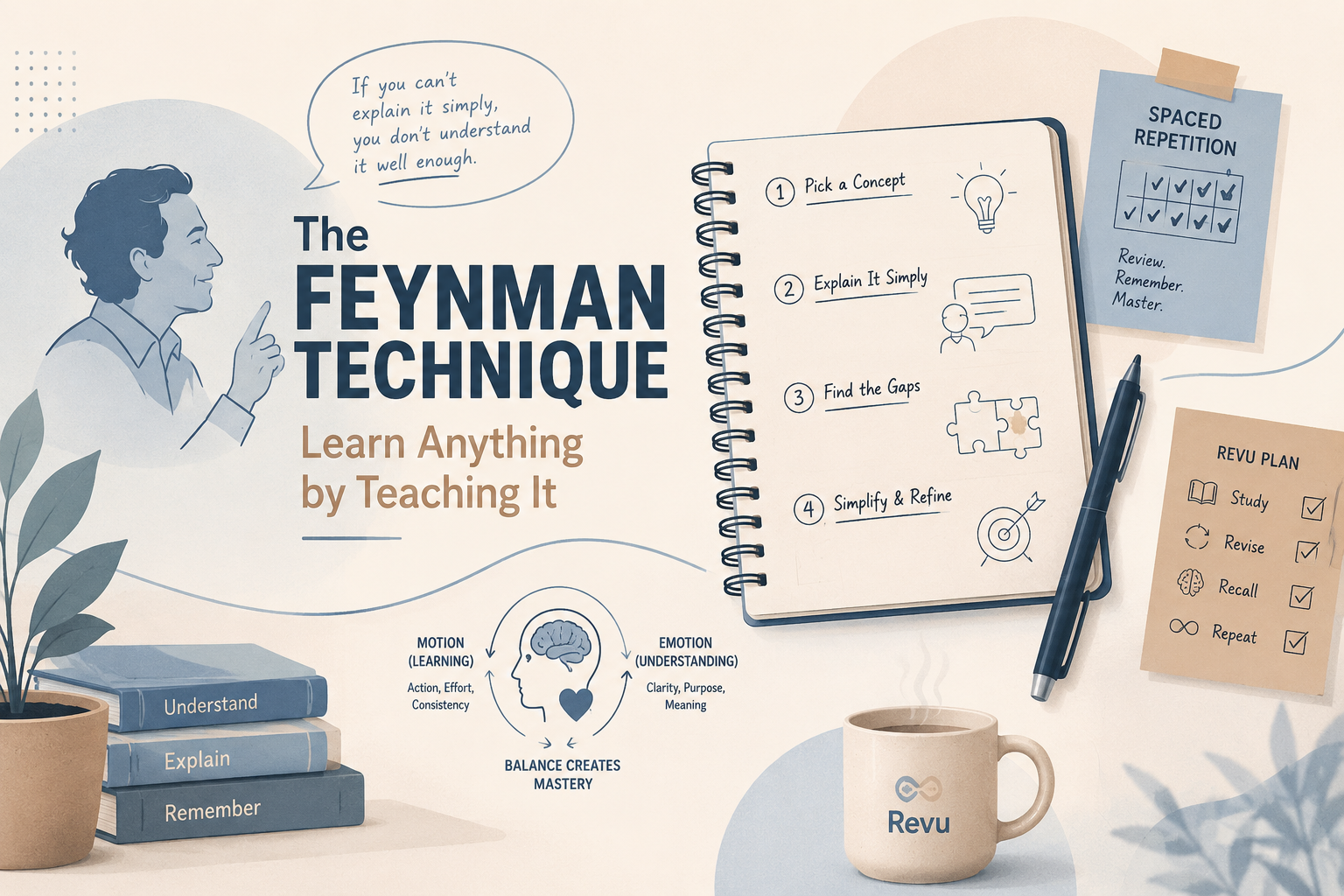
That's the idea behind the Feynman Technique—a deceptively simple learning method named after the legendary physicist Richard Feynman.
Feynman wasn't famous just because he was brilliant. He was famous because he could explain incredibly complex ideas in a way that almost anyone could understand.
His secret?
If you can't explain it simply, you probably don't understand it well enough.
Why We Mistake Familiarity for Understanding
Imagine reading a chapter on photosynthesis.
You recognize the terms. You understand the diagrams. The explanations seem clear.
You close the book feeling confident.
Then someone asks:
"Can you explain photosynthesis in your own words?"
Suddenly, your mind goes blank.
This is a common learning illusion.
Recognition feels like understanding.
But true understanding only appears when you try to retrieve and explain the information yourself. The Feynman Technique exposes these hidden gaps—and that's exactly why it works.
The Four Steps of the Feynman Technique
Step 1: Pick a Concept
Choose a topic you want to learn. It could be:
- Photosynthesis
- Newton's Laws
- Supply and Demand
- The French Revolution
- Probability
Write the topic at the top of a blank page.
Now pretend you're about to teach it to someone else.
Step 2: Explain It Like You're Teaching a Beginner
Write an explanation using simple language. Avoid jargon. Avoid copying textbook definitions.
Imagine you're explaining it to a friend, a younger sibling, or a complete beginner.
For example, instead of:
"Photosynthesis is the biochemical process through which plants convert light energy into chemical energy."
Try:
"Plants use sunlight to make their own food."
Simple explanations force real understanding. Complex language often hides confusion.
Step 3: Find the Gaps
This is where the magic happens.
As you explain, you'll notice moments where you hesitate, get stuck, use vague words, or realize you don't fully understand something.
These are not failures. They're valuable feedback.
Every gap reveals exactly what you need to learn next.
Go back to your notes, textbook, or video and study only the parts you couldn't explain.
Step 4: Simplify and Refine
Return to your explanation. Rewrite it. Make it shorter. Make it clearer.
Use examples, analogies, and everyday language.
The goal isn't to sound smart. The goal is to make the idea impossible to misunderstand.
The more clearly you can explain something, the more deeply you've learned it.
Why the Feynman Technique Works
The technique combines several principles from cognitive science.
1. Retrieval Practice
Instead of rereading information, you're pulling it from memory. This act of retrieval strengthens memory itself. The effort of remembering is what makes learning stick—see active recall for the full science.
2. Active Learning
Most students learn passively. The Feynman Technique forces engagement.
You're not consuming information. You're working with it.
3. Knowledge Gap Detection
Many study methods hide weaknesses. Teaching exposes them immediately.
You quickly discover what you know and what you only think you know.
4. Organization of Knowledge
Explaining requires structure. You must connect ideas logically.
This creates stronger mental models and deeper understanding.
An Example
Let's say you're studying gravity.
A textbook definition might be:
"Gravity is the force by which a planet or other body draws objects toward its center."
Using the Feynman Technique:
"Gravity is why things fall down. The Earth pulls everything toward it. Bigger objects have stronger gravity because they have more mass."
The second explanation is simpler.
And if you can't produce it yourself, you probably haven't fully understood the concept yet.
How to Use the Feynman Technique with Spaced Repetition
The Feynman Technique is excellent for understanding.
Spaced repetition is excellent for remembering. Together, they're incredibly powerful.
A practical workflow looks like this:
- Learn a new concept.
- Explain it using the Feynman Technique.
- Identify and fix gaps.
- Create revision questions from your explanation.
- Review those questions using spaced repetition.
Understanding builds the foundation. Review strengthens the memory. Both are necessary for long-term learning.
The Real Goal
The Feynman Technique isn't about becoming a teacher.
It's about revealing the truth: do you understand the idea, or do you simply recognize it?
The next time you finish a chapter, don't ask "Did I read it?" Ask "Could I teach it?"
Because learning doesn't happen when information enters your eyes.
It happens when ideas become clear enough to explain.
And when you can teach it simply, you've truly learned it.
Final Thought
Knowledge isn't measured by how much information you consume.
It's measured by how clearly you can explain what you've learned.
If you want to learn faster, remember longer, and understand more deeply: stop reading for a moment. Start teaching. Pair it with the study systems in systems that run without motivation and you'll have both understanding and consistency.