Most students study by reading.
They reread notes, highlight textbooks, and watch lectures multiple times.
It feels productive. After all, the information looks familiar.
But there's a problem.
Recognizing information isn't the same as remembering it.
And when exam day arrives, you're not tested on what looks familiar—you're tested on what you can recall.
This is where retrieval practice comes in. It's one of the most effective learning strategies ever studied, yet many students rarely use it.
What Is Retrieval Practice?
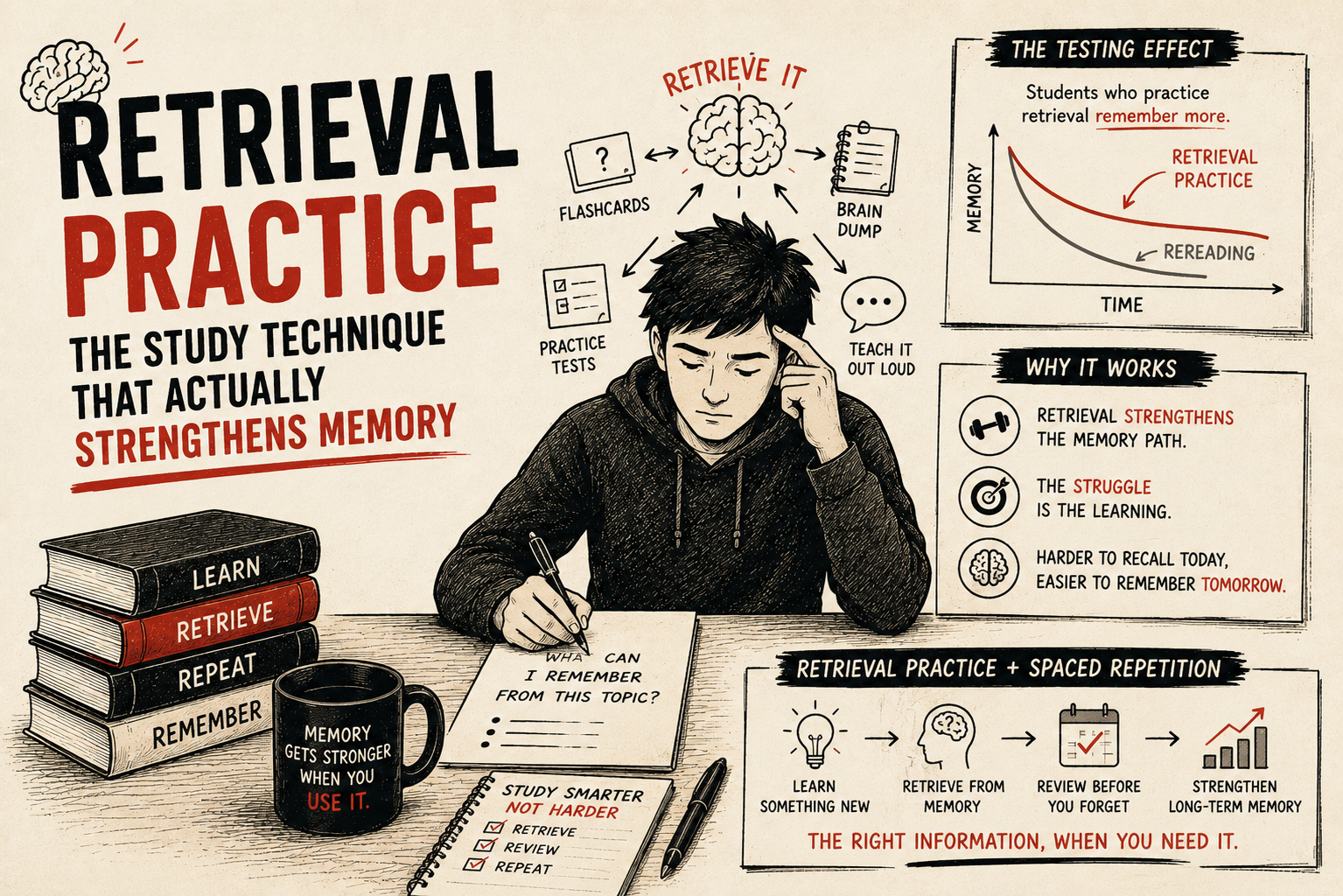
Retrieval practice is the act of recalling information from memory without looking at the answer.
Instead of reviewing information, you challenge your brain to bring it back.
Examples include:
- Answering practice questions
- Using flashcards
- Taking quizzes
- Explaining concepts from memory
- Writing down everything you remember about a topic
The goal isn't to expose yourself to information again. The goal is to retrieve it.
And that small difference changes how well you learn.
The Backpack Analogy
Think of your memory like a backpack.
Most students spend their study sessions putting information into the backpack. More notes. More videos. More reading.
But exams don't ask whether you can put information in.
They ask whether you can find the right information when you need it.
Retrieval practice trains exactly that skill.
Every time you recall an answer, you're strengthening your ability to access that information in the future—the same principle behind active recall.
Why Retrieval Strengthens Memory
Imagine a trail through a forest.
The first time you walk it, the path is difficult to see.
But every time you walk it again, the trail becomes clearer.
Eventually, finding your way becomes effortless.
Memories work similarly.
Each time you retrieve information, the pathway leading to that memory becomes stronger.
The act of remembering is not just a test of learning. It is part of the learning process itself.
In other words: memory grows stronger when you use it.
The Testing Effect
Researchers have consistently found that students who spend time retrieving information often remember more than students who spend the same amount of time reviewing information.
This phenomenon is known as the Testing Effect.
The surprising part is that tests don't improve learning because they're assessments. They improve learning because they force retrieval.
Every successful recall acts like a workout for your memory. The more you practice recalling information, the easier it becomes to access later—especially when you pair it with understanding the forgetting curve.
Simple Ways to Use Retrieval Practice
The good news is that retrieval practice doesn't require special tools or complicated systems.
1. Use Flashcards
Read a question. Hide the answer. Try to recall it before flipping the card.
The effort to remember is what makes the technique effective.
2. Take Practice Tests
Practice questions closely mimic the demands of real exams.
They help you identify weaknesses while strengthening memory.
3. Do a Brain Dump
Close your notes and write down everything you remember about a topic.
Then compare your answers to the source material. You'll quickly discover gaps in your understanding.
4. Teach What You Learned
Explaining a concept from memory is a powerful form of retrieval practice. Try the Feynman Technique if you want a structured way to teach it simply.
If you can teach it clearly, you probably understand it well.
Retrieval Practice and Spaced Repetition
Retrieval practice becomes even more powerful when combined with spaced repetition.
Think of them as answering two different questions:
Retrieval Practice: How should I review?
Spaced Repetition: When should I review?
Together they create a highly effective learning system:
- Learn something new.
- Retrieve it from memory.
- Review it before you forget.
- Retrieve it again.
- Increase the interval.
- Repeat.
Each successful retrieval strengthens the memory, while spacing prevents it from fading away. See what spaced repetition is and how knowledge behaves like a muscle that grows through repeated training.
The Real Goal of Studying
Many students measure progress by how many hours they study.
A better measure is how many times they've successfully retrieved information.
Because learning isn't about making information look familiar.
It's about making information accessible when you need it.
The techniques that feel easiest are not always the most effective. Retrieval practice feels challenging because it forces your brain to work. But that challenge is exactly what makes it so powerful.
Final Thought
The next time you sit down to study, resist the urge to reread your notes for the third time.
Close the book. Ask yourself a question. Try to answer it from memory.
Because your brain doesn't learn best when it's simply taking in information.
It learns best when it's bringing information back out.
And every successful retrieval is another step toward lasting learning.