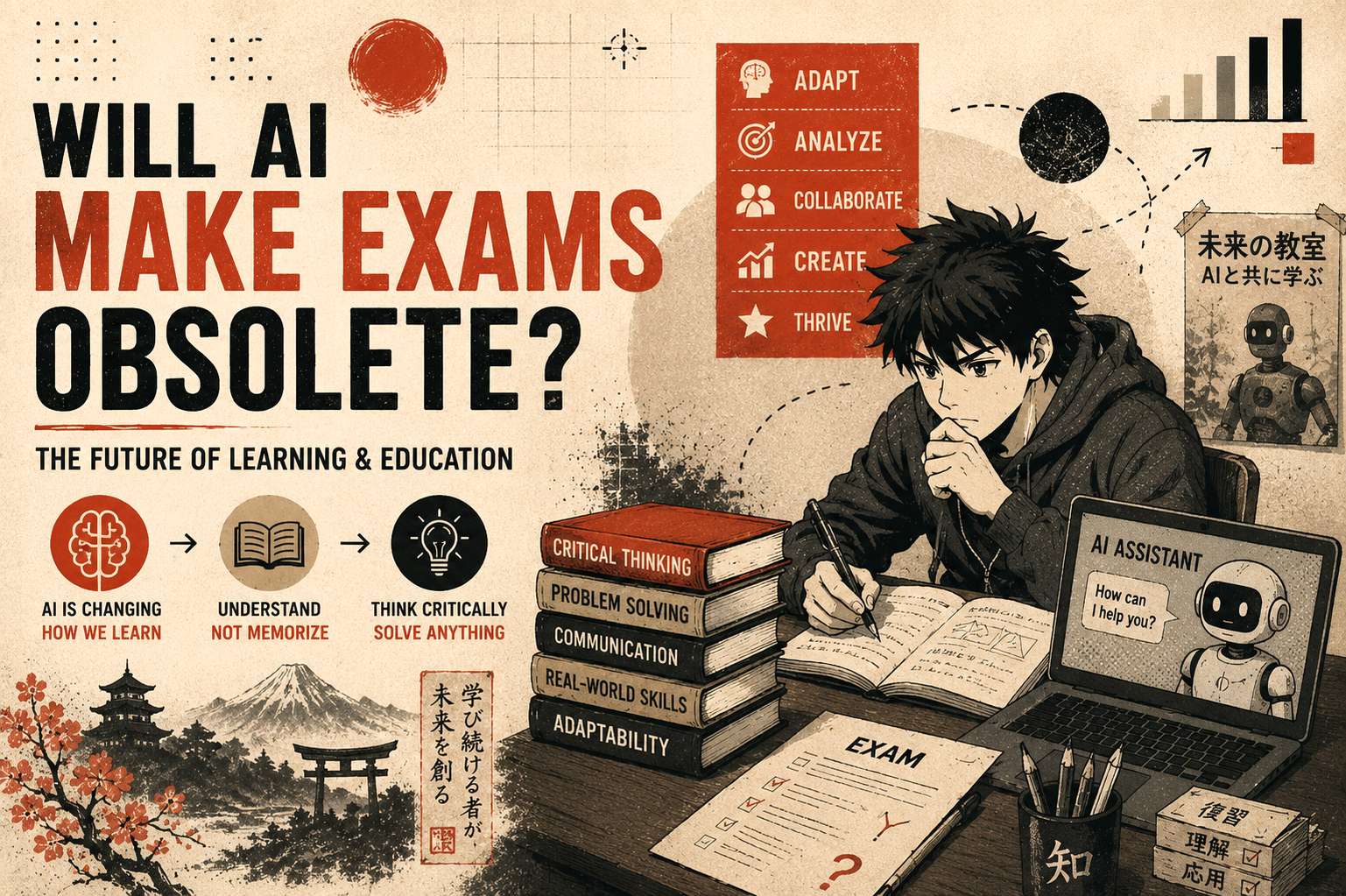
Students can now solve calculus problems, write essays, summarize textbooks, and even generate code in seconds using AI. If artificial intelligence can answer almost every exam question, are exams becoming meaningless?
It's a question schools, universities, employers, and students are all asking.
The answer isn't as simple as "yes" or "no."
AI isn't making learning obsolete. It's forcing us to rethink what exams are actually designed to measure.
The Original Purpose of Exams
Exams were never meant to reward memorization alone.
Ideally, they were designed to answer three questions:
- Did the student understand the material?
- Can they apply what they've learned?
- Can they solve problems independently?
But over time, many exams slowly became tests of memory rather than understanding. Students crammed facts the night before, reproduced them during the exam, and forgot most of them within days.
Psychologists have known this for over a century through the forgetting curve—without revision, we lose much of what we learn surprisingly quickly. Now AI has exposed an even bigger flaw.
AI Can Already Pass Many Exams
Modern AI models can:
- Write essays
- Solve math problems
- Explain scientific concepts
- Translate languages
- Debug code
- Generate presentations
- Answer multiple-choice questions
In many standardized tests, AI performs at or above the level of the average student.
If an exam simply asks students to reproduce information, AI can usually do it faster—and often better.
This creates an uncomfortable question:
If a machine can complete the assessment, what exactly is the assessment measuring?
Memorization Is Becoming Less Valuable
History offers an interesting comparison.
People once memorized hundreds of phone numbers. Today, almost nobody does. Not because memory became worse—but because smartphones became better.
The same thing may happen with factual recall.
When information is instantly accessible through AI, the value shifts from remembering facts to knowing:
- which questions to ask,
- how to verify information,
- how to combine ideas,
- and how to think critically.
Knowledge isn't disappearing. The skills surrounding knowledge are simply becoming more important.
The Exams That Will Survive
Not all exams are equally vulnerable.
An online multiple-choice test taken at home? AI can probably complete it.
An essay written without supervision? AI can certainly help.
But many forms of assessment remain difficult to automate. For example:
- oral examinations
- practical laboratory work
- design projects
- research presentations
- group collaboration
- real-world problem solving
These evaluate reasoning, communication, creativity, and decision-making—areas where the process often matters as much as the final answer.
Instead of asking "What is the correct answer?", educators may increasingly ask "How did you arrive at it?"
AI Changes What It Means to Study
Ironically, AI may reduce the importance of studying for exams while increasing the importance of actually learning.
Students who blindly copy AI-generated answers often struggle when asked follow-up questions.
They recognize the output but don't truly understand it.
This creates what psychologists call an illusion of competence—the feeling that you know something because you've seen it explained, when in reality you haven't practiced retrieving or applying the knowledge yourself. See active recall and retrieval practice for why that gap matters.
Learning still requires effort. AI can explain. It cannot absorb the information for you.
Memory Still Matters
Some argue that if AI remembers everything, humans no longer need to.
That sounds reasonable until you consider how thinking actually works.
Creativity depends on connecting ideas already stored in your brain. Problem solving depends on having knowledge readily available. You can't critically evaluate AI's answer if you have no understanding of the subject yourself.
Memory isn't just about passing exams. It's the foundation of reasoning. Read why memory matters more than ever in an AI world.
The better your mental library, the more effectively you can question, combine, and improve AI's suggestions.
The Future of Exams
Rather than disappearing, exams will probably evolve.
Future assessments may focus less on recalling information and more on:
- applying concepts to unfamiliar situations,
- evaluating AI-generated responses,
- collaborating with AI responsibly,
- defending reasoning,
- and solving open-ended problems.
In other words, AI may become part of the exam instead of something educators try to eliminate. Just as calculators eventually became accepted in mathematics, AI could become another educational tool—provided students first understand the fundamentals.
The Bigger Question
Perhaps the real question isn't whether AI will replace exams.
It's whether exams still measure the skills society actually values.
If education continues to reward memorization while the world rewards creativity, adaptability, and critical thinking, the problem isn't AI. It's the exam itself.
Final Thoughts
AI isn't making learning obsolete. It's making shallow learning easier to fake.
Students who rely entirely on AI may score well on some assessments but struggle to solve unfamiliar problems independently. Those who use AI as a tutor rather than a substitute can learn faster than ever before.
The future belongs neither to students who memorize everything nor to those who outsource all thinking to machines. It belongs to those who understand deeply, remember what matters, and know how to work intelligently alongside AI.
Because even in the age of artificial intelligence, the most powerful computer you'll ever own is still your brain—and building real exam confidence still starts with preparation you can trust under pressure.