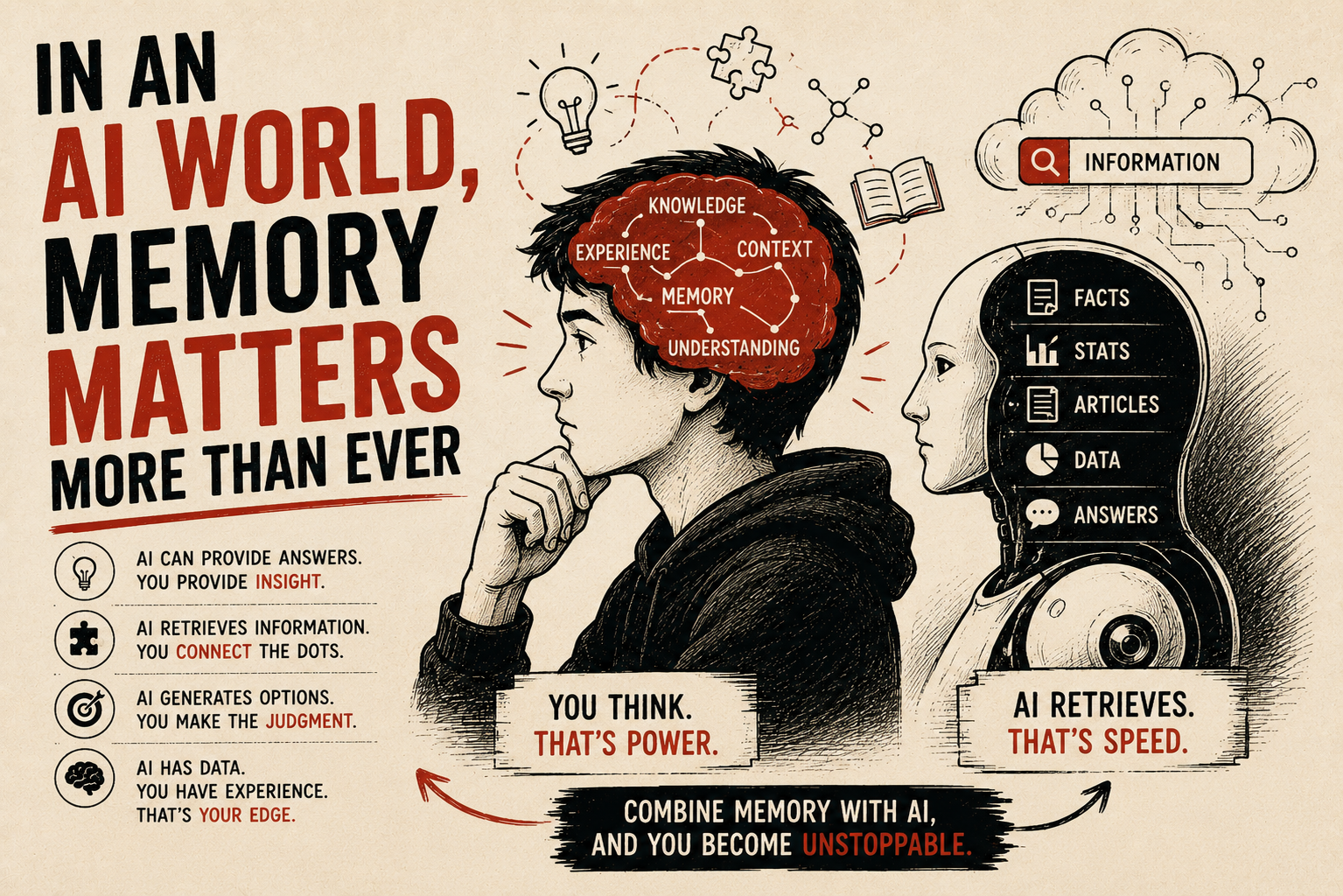
AI can answer almost any question.
But it can't think for you.
That distinction is about to become the most valuable skill of the next decade.
A few years ago, remembering facts was a competitive advantage. Today? You can ask ChatGPT. Need the capital of Kazakhstan? Done. Need to explain quantum mechanics? Done. Need to write Python code? Done.
Information has become almost free.
Which makes many students wonder: "If AI remembers everything, why should I?"
It's a fair question.
The answer is surprisingly simple.
Because intelligence isn't having access to information. It's knowing what to do with it.
AI Is Your Library, Not Your Brain
Imagine walking into the world's largest library. Every book ever written is there.
Would that automatically make you smarter?
Of course not.
You still need to know:
- Which questions to ask.
- Which answers are correct.
- How different ideas connect.
- When one concept applies and another doesn't.
AI is like that library. It gives you access. It doesn't give you understanding.
You Can't Connect Ideas You Don't Remember
Every breakthrough begins with connecting existing ideas.
Newton connected falling apples with the motion of the moon. Darwin connected observations from nature into evolution. Steve Jobs connected technology with design.
None of these ideas appeared out of nowhere. They came from minds filled with knowledge.
Your brain can't connect information it doesn't have.
If every idea lives only inside ChatGPT, there's nothing for your mind to combine. Creativity isn't generated from Google searches. It's generated from memory.
Thinking Depends on Memory
Most people imagine thinking as something separate from remembering.
In reality, they're deeply connected.
When you solve a math problem, your brain retrieves formulas.
When you write an essay, it retrieves vocabulary, examples, and structure.
When a doctor diagnoses a patient, they retrieve years of medical knowledge.
Thinking isn't magic. It's memory in action.
Without memory, reasoning slows down because every thought requires another search. That's why retrieval practice still matters—even when AI can look things up instantly.
AI Makes Knowledge More Valuable—Not Less
This sounds backwards. Shouldn't AI make knowledge less important?
Actually, the opposite happens.
When everyone has access to the same information, the advantage shifts to people who can use it best.
The calculator didn't eliminate mathematicians. Google didn't eliminate researchers. GPS didn't eliminate good drivers. Each technology raised the value of deeper understanding.
AI will do the same.
Outsourcing Everything Comes at a Cost
Imagine relying on GPS for ten years.
Eventually, you stop learning routes. You know how to follow directions. You don't know the city.
The same thing happens with AI.
If every answer comes instantly, your brain gets fewer opportunities to retrieve knowledge. And retrieval is what strengthens memory—as we explain in your brain has a save button.
Convenience is wonderful. Dependence is dangerous.
The Best Professionals Will Work With AI
The future won't belong to people who refuse AI.
Nor will it belong to people who blindly copy its answers.
It will belong to people who combine both.
They'll use AI to retrieve information quickly—but they'll rely on their own knowledge to ask better questions, spot mistakes, challenge assumptions, and make decisions.
AI becomes a multiplier. Not a replacement.
Students Need a Different Goal
For years, education focused on memorizing facts. Then the internet arrived. Now AI has arrived.
The goal is no longer memorization for its own sake.
The goal is building a mental model of the world.
Facts become useful because they help you think. Memory becomes valuable because it allows ideas to interact. Knowledge becomes powerful because it stays with you—even when the internet doesn't.
Tools like spaced repetition help you keep the knowledge that actually matters—not every random fact, but the ideas you need to think with.
The New Competitive Advantage
In the age of AI, everyone can get answers.
Not everyone can recognize a brilliant answer.
Not everyone can challenge a wrong one.
Not everyone can ask the question that unlocks a breakthrough.
Those skills come from understanding. And understanding comes from memory.
Don't Compete With AI
You'll lose. AI will always retrieve information faster than you.
Instead, develop what AI depends on:
- Curiosity.
- Judgment.
- Creativity.
- Critical thinking.
- And the knowledge stored inside your own mind.
Because AI can retrieve information. Only you can make it meaningful.
Final Thought
The future isn't "humans versus AI." It's humans with AI.
The people who thrive won't be the ones who remember the most facts. They'll be the ones who remember enough to think deeply, connect ideas, ask better questions, and use AI as a tool—not a substitute.
In an AI world, memory isn't becoming obsolete. It's becoming your unfair advantage—especially when you treat it like knowledge as a muscle that grows through practice, not passive storage.