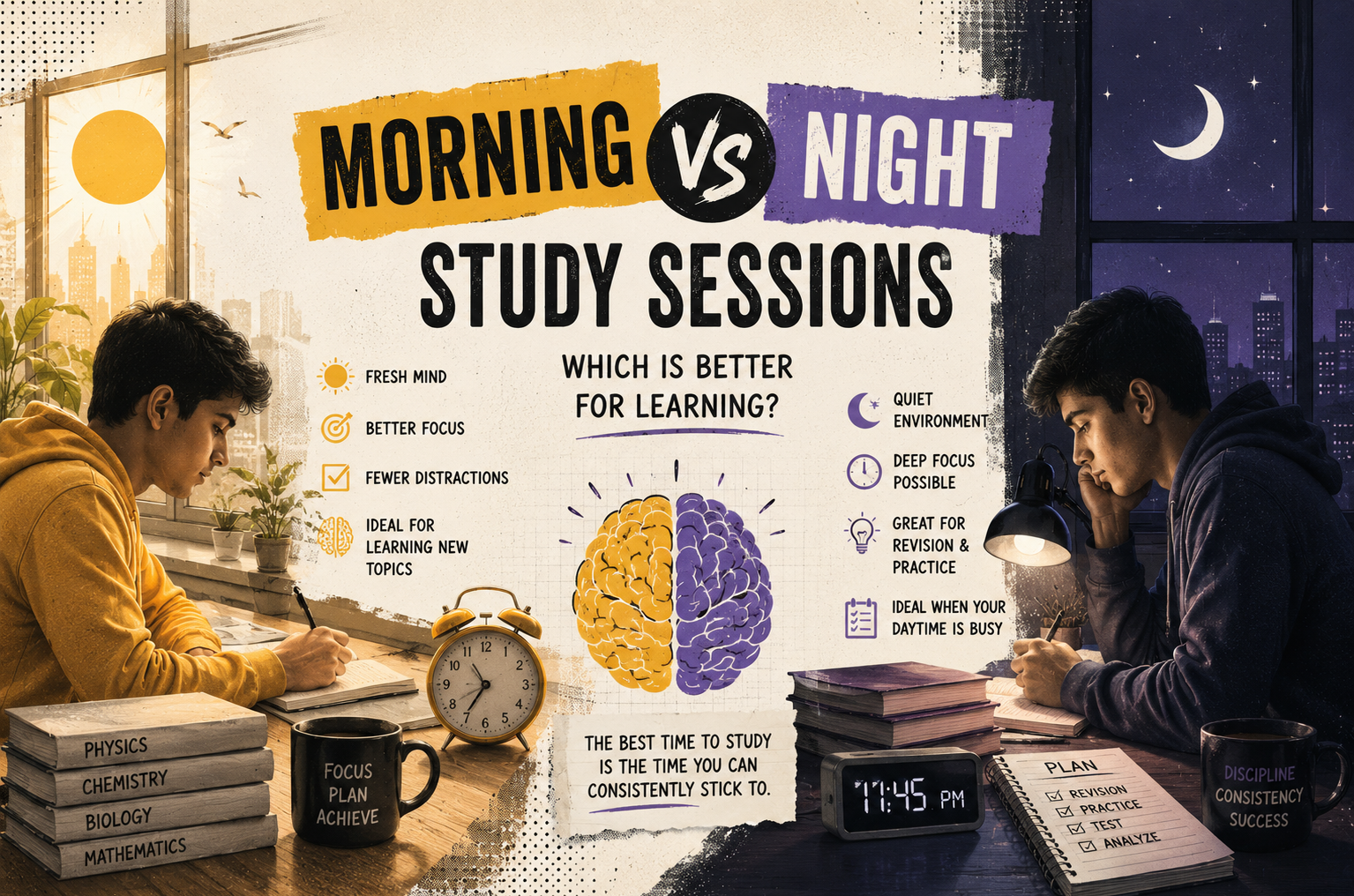
Every exam season, the debate begins again.
One student proudly posts a sunrise photo with coffee and textbooks.
Another shares a screenshot taken at 2:17 a.m., claiming that's when their brain finally "wakes up."
Both insist they've discovered the secret.
So… is it better to study in the morning or at night?
The answer isn't as simple as choosing one over the other.
In fact, research suggests that the best study time depends on what you're studying, your body's natural rhythm, and how consistently you stick to a routine.
Let's explore what science says.
Why There's No Universal "Best" Time to Study
If there were one perfect study schedule, every top student would follow it. But they don't.
Some wake up at 5 a.m. Others study until midnight.
The reason is simple. Humans have different circadian rhythms—our internal biological clocks that influence alertness, concentration, and energy throughout the day.
Some people naturally feel sharper early in the morning. Others become mentally alert later in the evening.
Understanding your rhythm is often more important than copying someone else's timetable.
The Case for Morning Study
Morning study has earned a reputation for productivity—and for good reason.
After a full night's sleep, your brain has had time to consolidate yesterday's learning. For many people, attention is higher and distractions are lower during the early hours.
Morning study is particularly effective for:
- Learning brand-new concepts
- Solving analytical problems
- Reading difficult chapters
- Writing essays or assignments
- Planning your study schedule
There's also another advantage. Most unexpected distractions—phone calls, social media, errands, visitors—haven't begun yet. Your mind is often at its freshest.
The Advantages of Night Study
Night owls often feel misunderstood. Yet many genuinely think more clearly after sunset.
The environment becomes quieter. Notifications slow down. The pressure of the day disappears.
For naturally late chronotypes, this creates an ideal environment for focused work.
Night study can be excellent for:
- Revision
- Creative thinking
- Long reading sessions
- Practice questions
- Deep focus when the world is quiet
The key word is naturally. If you're forcing yourself to stay awake despite feeling exhausted, you're unlikely to retain much.
What Does Science Say?
Researchers generally agree on a few important points.
Your ability to learn depends less on the clock and more on:
- Sleep quality
- Consistency
- Alertness
- Attention
- Regular revision
Someone studying for two focused hours every morning is likely to outperform someone who studies randomly at different times each day.
Likewise, a consistent night learner often performs better than someone constantly switching schedules.
Your brain loves routines.
The Hidden Role of Sleep
Here's something many students overlook. Learning doesn't end when you close your textbook.
During sleep, your brain strengthens newly formed memories through a process called memory consolidation—as explained in the science behind long-term memory.
This means both morning and night study benefit from sleep—but in different ways.
Morning Learners
You wake up with a refreshed brain that has already organized yesterday's learning.
Night Learners
You study, then soon afterwards go to sleep, giving your brain an opportunity to consolidate the material. See why sleep might be your best study tool.
In both cases, sleep plays a crucial role. Skipping it removes one of the brain's most important learning tools.
When Morning Might Be Better
Morning sessions are often ideal if you need to:
- Learn difficult concepts
- Memorize new information
- Prepare for morning exams
- Avoid distractions
- Build consistent habits
Many students also find it easier to stick to morning routines because fewer unexpected events interrupt them.
When Night Might Be Better
Night study can be a great choice if:
- You're naturally more alert in the evening.
- Your daytime schedule is busy.
- You need long periods of uninterrupted focus.
- You prefer quiet environments.
- You're mainly revising rather than learning from scratch.
Again, consistency matters more than the time itself.
The Biggest Mistake Students Make
The real problem isn't choosing morning or night. It's constantly switching.
Monday: wake up at 5 a.m. Tuesday: study until 2 a.m. Wednesday: skip studying entirely. Thursday: promise to restart tomorrow.
Your brain never adapts.
A stable routine is far more valuable than the "perfect" schedule.
Can You Mix Both?
Absolutely. Many successful students naturally divide their study sessions.
For example:
Morning
- Learn new chapters
- Watch lectures
- Solve conceptual questions
Evening
- Revise
- Practice recall
- Solve mock tests
- Plan tomorrow
This combines the strengths of both periods while avoiding extremely long study sessions—especially when you know when a study session has expired.
Listen to Your Chronotype
Psychologists use the term chronotype to describe your natural preference for sleeping and waking.
Some people are "larks." Others are "owls."
Neither is inherently smarter.
The goal isn't to become someone else. It's to study when you are naturally most alert whenever possible.
The Best Study Schedule Is the One You Can Repeat
Imagine two students.
Student A
Studies every morning from 7–9 a.m. Misses very few sessions.
Student B
Keeps searching for the "perfect" timetable. Studies at random hours. Frequently skips sessions.
Who improves more? Almost always, Student A.
Consistency beats optimization. Every single time.
Final Thoughts
The question isn't: "Should I study in the morning or at night?"
A better question is: "When is my brain most focused—and can I consistently study at that time?"
Morning learners benefit from fresh attention and fewer distractions.
Night learners benefit from quiet environments and uninterrupted focus.
Both approaches can produce excellent results when combined with enough sleep, active recall, and spaced repetition.
Because in the end, your success won't be determined by the hands on a clock.
It will be determined by how often you show up, how effectively you study, and how consistently you revisit what you've learned.
The best study time isn't morning. It isn't night.
It's the time you'll actually stick to.