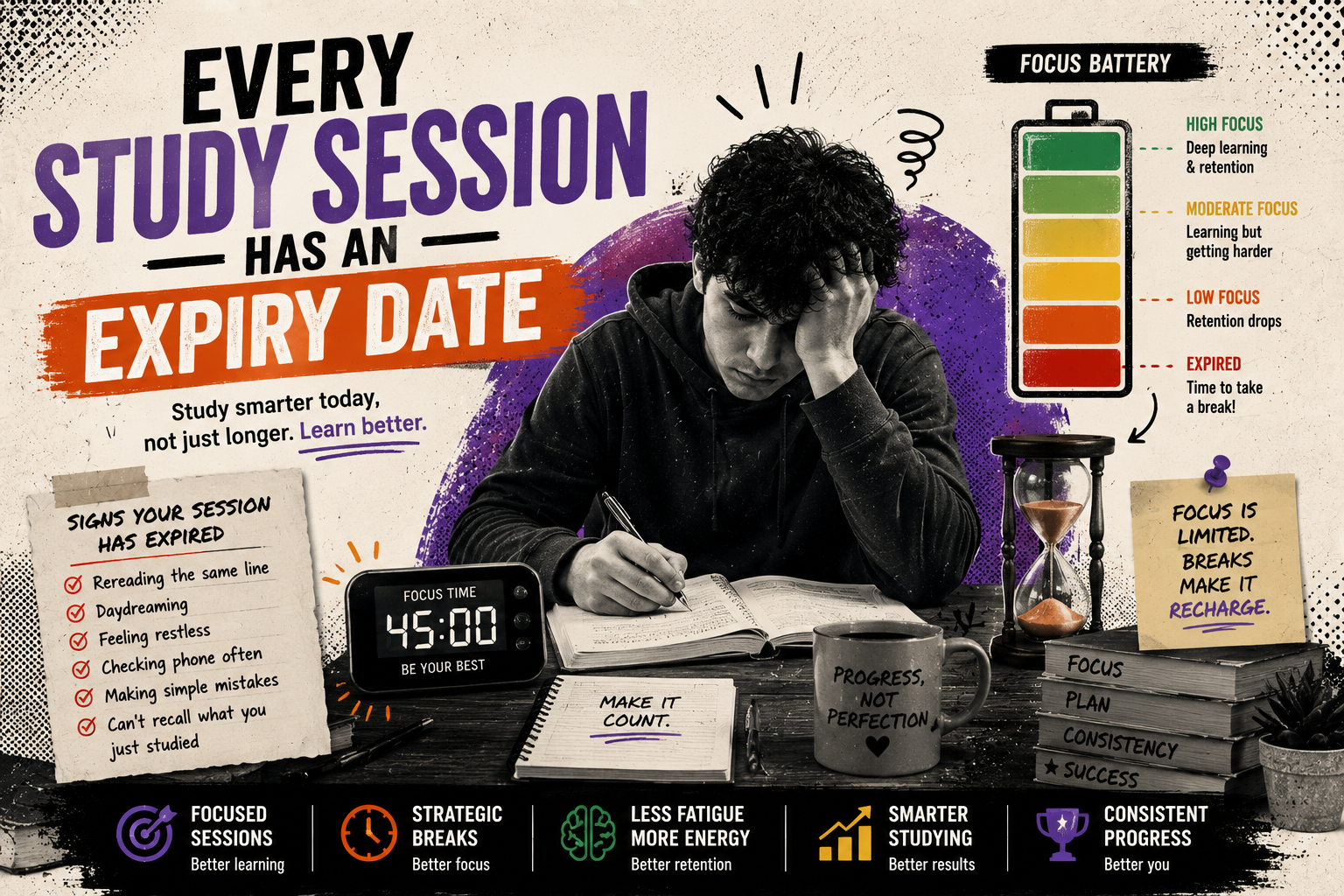
Have you ever sat down to study with the best intentions, only to find yourself reading the same paragraph over and over after an hour? Your eyes are on the page, but your mind is somewhere else. It feels like you're studying, but very little information is actually sticking.
The truth is simple: every study session has an expiry date.
Just like a phone battery slowly drains with use, our brains have a limited capacity for focused attention. No matter how motivated we are, concentration doesn't last forever.
Understanding this concept can completely change the way you learn and help you study smarter instead of longer.
Why Focus Doesn't Last Forever
Many students believe that studying for five or six hours straight is a sign of dedication. While effort is important, research shows that our brains aren't designed for endless periods of intense focus.
As we study, our mental energy gradually decreases. Information processing becomes slower, distractions become more tempting, and retention drops.
This is often called cognitive fatigue—the mental exhaustion that comes from prolonged concentration. It's closely related to the working memory limits described in cognitive load theory.
The problem is that most people don't notice when their study session has expired. They continue sitting at their desks, believing they're being productive, when in reality they're simply spending time without absorbing much information.
The Signs Your Study Session Has Expired
Your brain usually gives clear signals when it's reaching its limit:
- Reading the same sentence multiple times
- Daydreaming frequently
- Feeling restless or frustrated
- Checking your phone more often
- Making simple mistakes
- Struggling to recall information you just studied
If these signs appear, it doesn't mean you're lazy or incapable. It simply means your brain needs a reset.
Quality Beats Quantity
Imagine filling a glass with water. Once it's full, pouring more water doesn't help—it just spills over.
Learning works in a similar way. After a certain point, adding more study time doesn't necessarily increase understanding. In fact, it can reduce efficiency.
A focused 45-minute study session often produces better results than two hours of distracted studying.
The goal isn't to spend the most time studying; it's to make the time you spend count. Top-performing students understand this. They prioritize concentration and retention rather than measuring success by the number of hours spent at a desk.
The Power of Strategic Breaks
One of the easiest ways to extend your learning capacity is by taking breaks before your focus completely disappears.
Techniques like the Pomodoro Method recommend studying for 25–50 minutes followed by a short break. For longer blocks, some students prefer Animedoro sessions. These pauses allow the brain to recover and process information.
During breaks, avoid activities that overload your mind further. Instead, try:
- Taking a short walk
- Stretching
- Drinking water
- Looking away from screens
- Practicing deep breathing
Even a five-minute reset can significantly improve your next study session.
Work With Your Brain, Not Against It
Everyone has different attention limits. Some people can focus intensely for 30 minutes, while others can maintain concentration for over an hour.
The key is to identify your personal expiry date.
For the next few study sessions, pay attention to when your concentration starts dropping. Notice the point where learning becomes difficult and distractions increase.
Once you know your limit, structure your study schedule around it. Instead of forcing yourself to study nonstop, create focused sessions followed by meaningful breaks. You'll often learn more in less time.
Learning Is a Marathon, Not a Sprint
Many students fall into the trap of believing that longer study sessions equal better results. This mindset often leads to burnout, stress, and disappointment.
Real learning happens through consistency. Small, focused sessions repeated over days and weeks are far more effective than occasional marathon study sessions—see why cramming costs you more in the long run.
Think of studying like exercise. You wouldn't expect to become fit from one exhausting workout. Progress comes from showing up regularly, recovering properly, and staying consistent. The same principle applies to learning—and sleep is part of that recovery.
Final Thoughts
The next time you sit down to study, remember that your focus is not unlimited. Every study session has an expiry date, and that's completely normal.
Rather than fighting against your brain's natural limits, learn to recognize them. Take breaks, study in focused intervals, and prioritize quality over quantity.
Success isn't about how long you study. It's about how effectively you use the time you have.
Because sometimes, the smartest thing you can do isn't studying longer—it's knowing when to stop. Then let spaced repetition handle the reviews so your focused sessions actually stick.