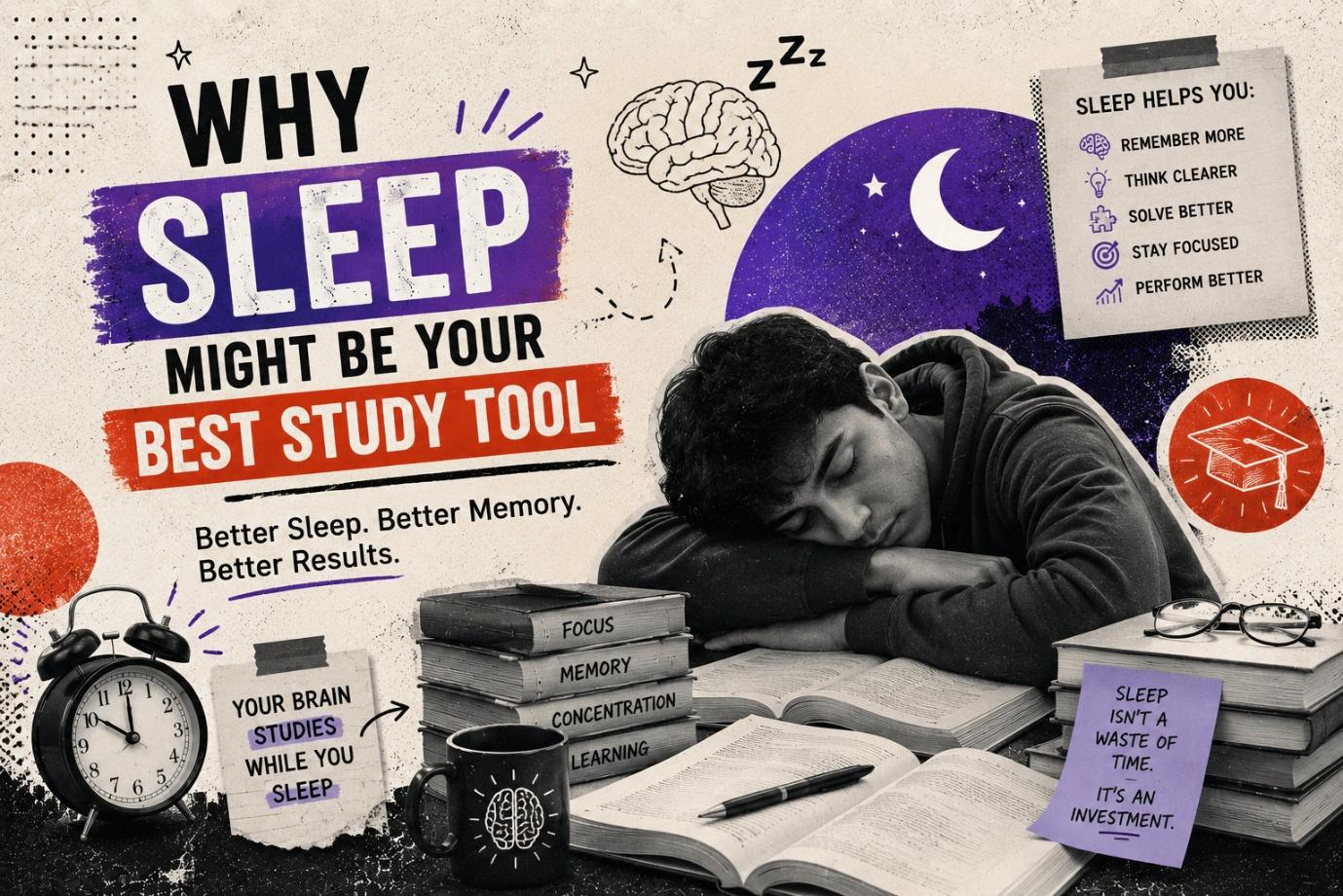
Most students treat sleep like an obstacle.
Exams coming up? Sleep less.
Big syllabus? Stay up late.
Need more study hours? Pull an all-nighter.
It feels productive.
But here's the irony:
Cutting sleep to study more often makes you remember less.
If you're revising for exams, trying to improve memory retention, or struggling to recall what you studied yesterday, sleep may be one of the most powerful study tools you're ignoring.
And science strongly supports this.
Your Brain Doesn't Finish Learning While You Study
When you study something new, your brain initially stores that information in short-term memory.
But it doesn't stay there automatically.
For long-term retention, your brain needs to strengthen those memories through a process called memory consolidation.
This happens largely during sleep.
While you sleep:
- Your brain processes what you learned during the day
- Important information gets transferred into long-term memory
- Weak memories are either strengthened or discarded
- Neural connections become more stable
Think of studying as saving a document.
Sleep is what actually clicks "save permanently."
Without enough sleep, that process gets interrupted—the same reason passive re-reading feels familiar but doesn't stick for long.
Sleep Improves Recall During Exams
Have you ever studied something thoroughly but completely blanked out during an exam?
Sleep deprivation may be part of the problem.
Lack of sleep affects:
- Focus
- Attention span
- Problem-solving
- Decision-making
- Recall speed
Research has shown that sleep-deprived students perform worse on tests—even when they spend more time studying.
In simple terms:
often beats
12 exhausted hours + no sleep
REM Sleep Helps With Creativity and Problem Solving
Not all sleep is the same.
REM sleep (Rapid Eye Movement sleep) plays a major role in:
- Connecting ideas
- Solving problems
- Understanding concepts deeply
- Improving creativity
This is especially useful for subjects like:
- Math
- Physics
- Medicine
- Essay writing
- Coding
Sometimes the answer feels clearer the morning after because your brain literally worked on it overnight.
All-Nighters Hurt More Than They Help
Students often glorify all-nighters.
But they usually cause:
- Brain fog
- Poor concentration
- Lower retention
- Mood swings
- Higher stress
Even one night of poor sleep can significantly reduce cognitive performance.
You may feel productive because you spent more hours with your books. That doesn't mean those hours were effective—the same trap behind last-minute cramming that costs more than it saves.
The Best Time to Sleep After Studying
A useful technique is reviewing difficult material shortly before sleep.
Why?
Because your brain is more likely to consolidate recently studied information.
Try this:
- Revise difficult topics in the evening
- Avoid social media before bed
- Sleep on time
- Quickly review the topic again next morning
This combination can dramatically improve retention.
Spaced Repetition + Sleep = Powerful Combination
Sleep alone won't solve poor study habits.
But paired with spaced repetition, it becomes extremely effective.
Spaced repetition helps you review information before forgetting it.
Sleep helps lock that information into long-term memory.
Together:
Study → Revise → Sleep → Recall → Repeat
This is why many students use apps like Revu to schedule revision sessions while protecting time for proper rest.
How Much Sleep Do Students Actually Need?
Most adults need 7–9 hours of sleep.
Teenagers may need even more.
If you're regularly sleeping 4–5 hours during exam season, your memory is likely suffering.
Consistency matters too.
Sleeping 8 hours one day and 3 hours the next creates poor learning conditions.
How to Sleep Better During Exams
1. Stop caffeine late at night
Avoid coffee or energy drinks 6–8 hours before bed.
2. Don't study in bed
Train your brain to associate bed with sleep.
3. Reduce screen exposure
Blue light can disrupt melatonin production.
4. Use revision planning tools
Avoid last-minute cramming by planning revisions earlier with a science-backed revision timetable or a study planner app—so you're not rebuilding your entire schedule at midnight.
5. Keep a fixed sleep schedule
Your brain performs better with routine.
Final Thoughts
Students often search for:
- Better notes
- Better productivity hacks
- Better revision methods
But ignore one of the most powerful tools available for free:
Sleep.
Sometimes studying smarter means closing your laptop and going to bed.
Your future exam score may thank you for it.