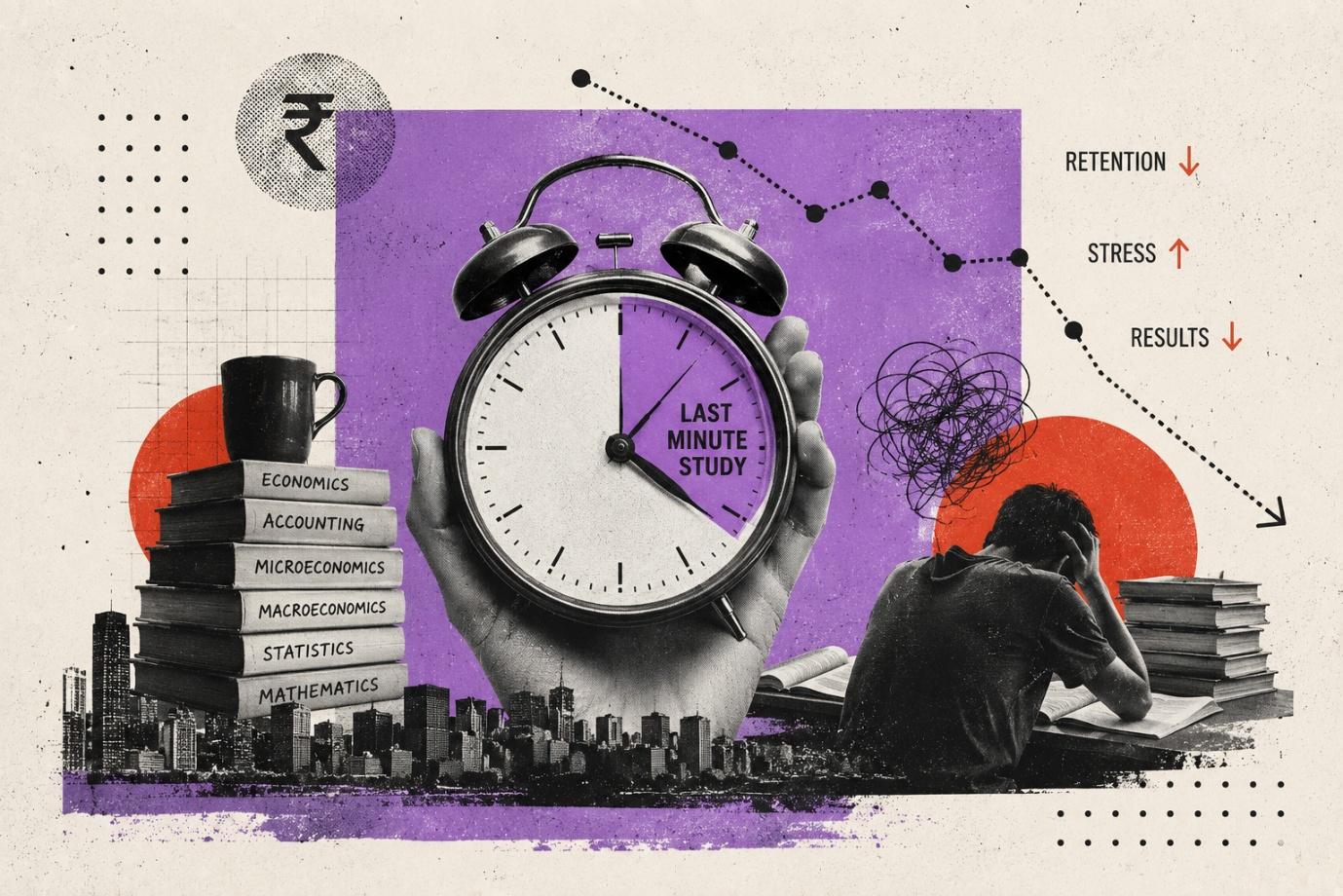
Every exam season, the same story plays out.
Libraries stay open till midnight. Coffee sales spike. Students create ambitious “12-hour study plans.” Telegram groups suddenly become active. YouTube fills up with videos titled:
“Complete Organic Chemistry in 6 hours.”
“UPSC revision marathon.”
“Entire semester syllabus one night before exam.”
And somehow, this behaviour feels rational.
After all, why revise for months when you can simply study hard at the end?
Except… this model has terrible economics. Let’s explain.
Student A: The Sprinter
Studies irregularly for 3 months.
Skims notes occasionally. Watches lectures. Feels “productive.”
Then exam week arrives. Panic.
Now they pull 10-hour study days trying to revise everything at once.
The problem? A huge chunk of what they studied earlier is already gone.
Psychologist Hermann Ebbinghaus showed this over a century ago through what we now call the forgetting curve. Without revision, people forget information rapidly after learning it.
In many cases:
- Day 1 → major drop
- Week 1 → even more forgetting
- Month 1 → most details disappear
Which means Student A isn’t just revising. They’re relearning.
And relearning is expensive.
Student B: The Investor
Learns a topic today. Reviews it after:
- 1 day
- 3 days
- 7 days
- 21 days
Each revision session becomes shorter because the brain strengthens retrieval pathways.
Instead of spending 10 hours relearning before exams… they spend 20–30 minute review sessions spread across time.
This is basically compound interest for memory. Small investments today reduce massive costs later. (See our deep dive on what spaced repetition is and the 2-3-5-7 review rhythm.)
The hidden cost of procrastinated revision
Let’s quantify it. Suppose you study Biology for 100 hours over 3 months.
If you forget 60% of it due to poor revision habits: that’s effectively 60 wasted hours.
Now multiply that across:
- Physics
- Chemistry
- History
- Current affairs
- Vocabulary
- Optional subjects
Suddenly students aren’t just losing marks. They’re losing hundreds of hours.
That’s a productivity disaster.
Why students still choose this bad model
Because last-minute studying offers immediate psychological rewards.
It feels efficient. You can delay discomfort. Your future self handles the problem.
Economists call this present bias—we prioritize short-term comfort over long-term outcomes.
The same reason people:
- avoid saving money
- delay workouts
- procrastinate taxes
Students delay revision because future forgetting feels invisible—until exam week arrives. Then the bill comes due. With interest. (If this sounds familiar, our guide on how to stop procrastinating while studying has six concrete tactics that actually work.)
Why cramming sometimes “works”
Now here’s the confusing part. Cramming occasionally helps students survive exams. Why?
Because many exams reward short-term recall. You only need information to survive:
- tomorrow’s paper
- next week’s test
- this semester’s finals
Your brain can brute-force temporary retention.
But ask students three months later? Most remember almost nothing.
That’s why many medical aspirants forget biology chapters. Why language learners forget vocabulary. Why engineering students forget formulas after semester exams.
The system often rewards short-term memory hacks. Real learning suffers.
The coaching industry quietly understands this
Why do top coaching institutes obsess over:
- revision schedules
- mock tests
- repeated practice
- weekly tests
Because they know repetition drives retention.
Not motivation. Not aesthetics. Not pretty notes. Retention wins.
The rise of revision infrastructure
This is why products focused on revision are growing. Flashcards. Reminder systems. Spaced repetition tools.
Because students are realizing something simple:
The problem isn’t learning new things. The problem is remembering old things.
And that’s where most academic effort leaks away.
The takeaway
Last-minute studying feels cheap. But it’s actually one of the most expensive academic habits students have.
You pay through:
- stress
- burnout
- forgotten concepts
- repeated effort
- lower confidence
Smart students don’t just study harder. They reduce forgetting.
Because the best learners understand one thing: the cheapest hour of studying is the one you never have to repeat.