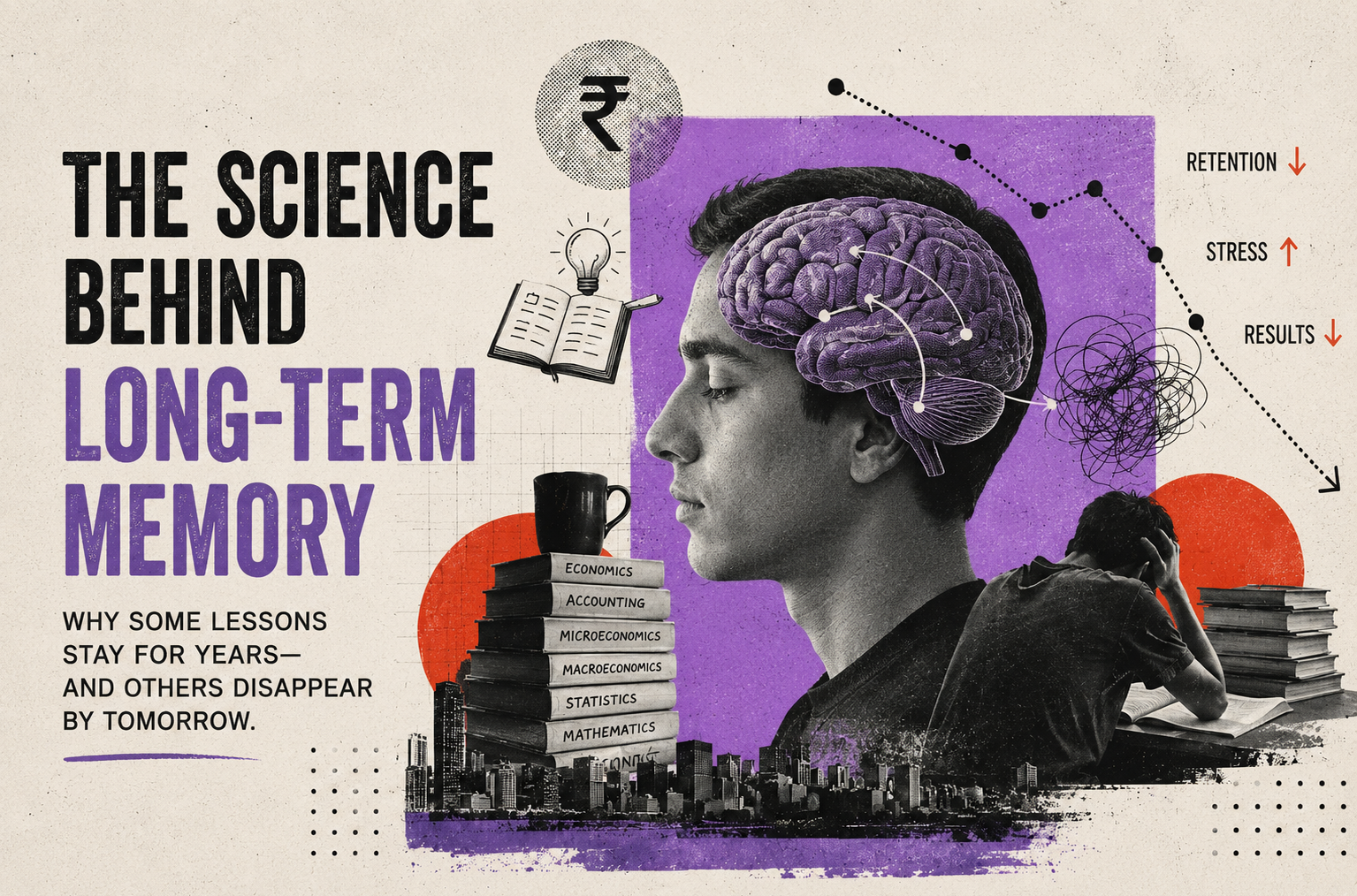
You spend three hours studying.
The next morning, everything feels familiar.
A week later, half of it is gone.
A month later, you can barely remember opening the textbook.
If this sounds familiar, you're not alone. Forgetting isn't a sign that you're a bad student—it's simply how the human brain works.
The good news is that scientists have spent decades understanding how memories are created, stored, strengthened, and retrieved. Their discoveries have transformed our understanding of learning, revealing that long-term memory isn't about intelligence or talent. It's about using your brain the way it was designed to learn.
Let's explore the fascinating science behind long-term memory—and how you can use it to remember more with less effort.
Your Brain Was Never Designed to Remember Everything
Imagine recording every conversation you've ever had, every face you've seen, and every sentence you've read.
Your brain would quickly become overwhelmed.
Instead, it acts as an efficient filter.
Every second, your senses collect enormous amounts of information, but only a tiny fraction makes it into long-term memory. Your brain constantly asks one question: "Will I need this information again?"
If the answer appears to be no, it quietly lets it fade away.
This is why you can remember your childhood home but forget what you had for lunch last Tuesday.
Long-term memory isn't about storing everything—it's about storing what matters.
Step 1: Encoding — Turning Information Into Memory
Every memory begins with encoding.
Encoding is the process of transforming what you see, hear, or read into a form your brain can store.
But simply looking at information isn't enough.
Compare these two situations:
Student A
Reads the same chapter three times. Highlights important sentences. Closes the book.
Student B
Reads once. Explains the concept in their own words. Solves practice questions. Connects the topic to something they already know.
Who remembers more next week? Almost always, Student B.
Why? Because deeper processing creates stronger encoding.
Your brain remembers meaning far better than repetition.
Step 2: Consolidation — Where Sleep Does the Heavy Lifting
Many students believe learning ends when they close their notebook. In reality, one of the most important parts happens afterwards.
While you sleep, your brain begins memory consolidation.
Think of your brain as a librarian.
During the day, books arrive in messy piles. At night, the librarian organizes them, labels them, and places them on the correct shelves.
Without this process, many new memories remain fragile.
Research consistently shows that adequate sleep improves memory, learning, and recall, while sleep deprivation significantly reduces them—see why sleep might be your best study tool.
Studying until 3 a.m. may help you finish the syllabus—but sleeping well helps you actually remember it.
Step 3: Retrieval — The Secret Most Students Ignore
Here's something surprising. Every time you successfully recall information, you make that memory stronger.
This is called retrieval practice.
Most students spend hours putting information into their brains. Very few spend enough time pulling it out.
Consider two revision methods.
Method 1
Read your notes five times.
Method 2
Close the notebook. Write down everything you remember. Check what you missed. Repeat.
Although Method 2 feels more difficult, it's dramatically more effective.
Struggling to remember is not a sign of failure. It's often the moment learning actually happens.
Why We Forget So Quickly
In the late 19th century, psychologist Hermann Ebbinghaus conducted groundbreaking experiments on memory.
He discovered what is now known as the Forgetting Curve.
The results were striking. Without review, people forget a large portion of newly learned information within days.
This isn't because memory is broken. It's because your brain assumes unused information isn't important.
Every successful review tells your brain: "Keep this. I'll need it again."
Each review slows forgetting and strengthens the memory.
Why Spaced Repetition Works
Many students revise like this:
Study a chapter. Ignore it for three weeks. Panic before the exam. Cram everything again.
The brain dislikes this approach.
Instead, researchers recommend spaced repetition.
Rather than reviewing once, you revisit information just before you're likely to forget it.
For example:
- Day 1
- Day 3
- Day 7
- Day 15
- Day 30
- Day 90
Each review takes less time than the previous one, yet the memory becomes increasingly stable.
This is one of the most well-supported learning strategies in cognitive science.
Active Recall: The Missing Ingredient
Spaced repetition becomes even more powerful when combined with active recall.
Instead of rereading your notes, ask yourself questions like:
- What are the main causes?
- Can I explain this concept without looking?
- Could I teach this to someone else?
- What did I forget?
Your brain treats successful retrieval as evidence that the information is valuable.
Over time, recall becomes faster, easier, and more accurate.
The Role of Emotion and Meaning
Have you ever wondered why you remember embarrassing moments from years ago but forget yesterday's chemistry formula?
Emotion acts like a highlighter for memory.
Information connected to curiosity, surprise, humor, or personal meaning is far more likely to be remembered.
This is why creating stories, analogies, diagrams, or real-world examples helps learning—as in the Feynman technique.
Facts become memorable when they become meaningful.
Can You Improve Your Memory?
Absolutely. Long-term memory isn't a fixed talent you're born with. It's a skill that improves with practice and the right strategies.
The strongest learners typically follow a simple pattern:
- Learn actively instead of passively.
- Review before forgetting.
- Test themselves regularly.
- Sleep enough.
- Stay consistent rather than cramming.
These habits don't require extraordinary intelligence. They simply work with the way the brain naturally learns.
A Better Way to Study
Many students judge a study session by how long they sat at the desk.
A better question is: "Will I still remember this next month?"
Long-term learning isn't built in marathon study sessions.
It's built through repeated retrieval, well-timed revision, and consistent reinforcement—like pressing Save on what you learn.
That's why modern study systems increasingly focus on reminders, revision schedules, and scientifically timed reviews instead of endless rereading.
When your study plan is designed around how memory actually works, remembering becomes much less about effort—and much more about strategy.
Final Thoughts
Your brain isn't trying to make you forget. It's trying to be efficient.
Every day, it decides what deserves a permanent place in memory and what can safely disappear.
The more often you retrieve information, revisit it over time, connect it to existing knowledge, and give your brain time to consolidate it during sleep, the more likely it is to stay with you for years—not just until the next exam.
Learning isn't complete when you finish reading.
Learning is complete when you can still remember it long after the book is closed.