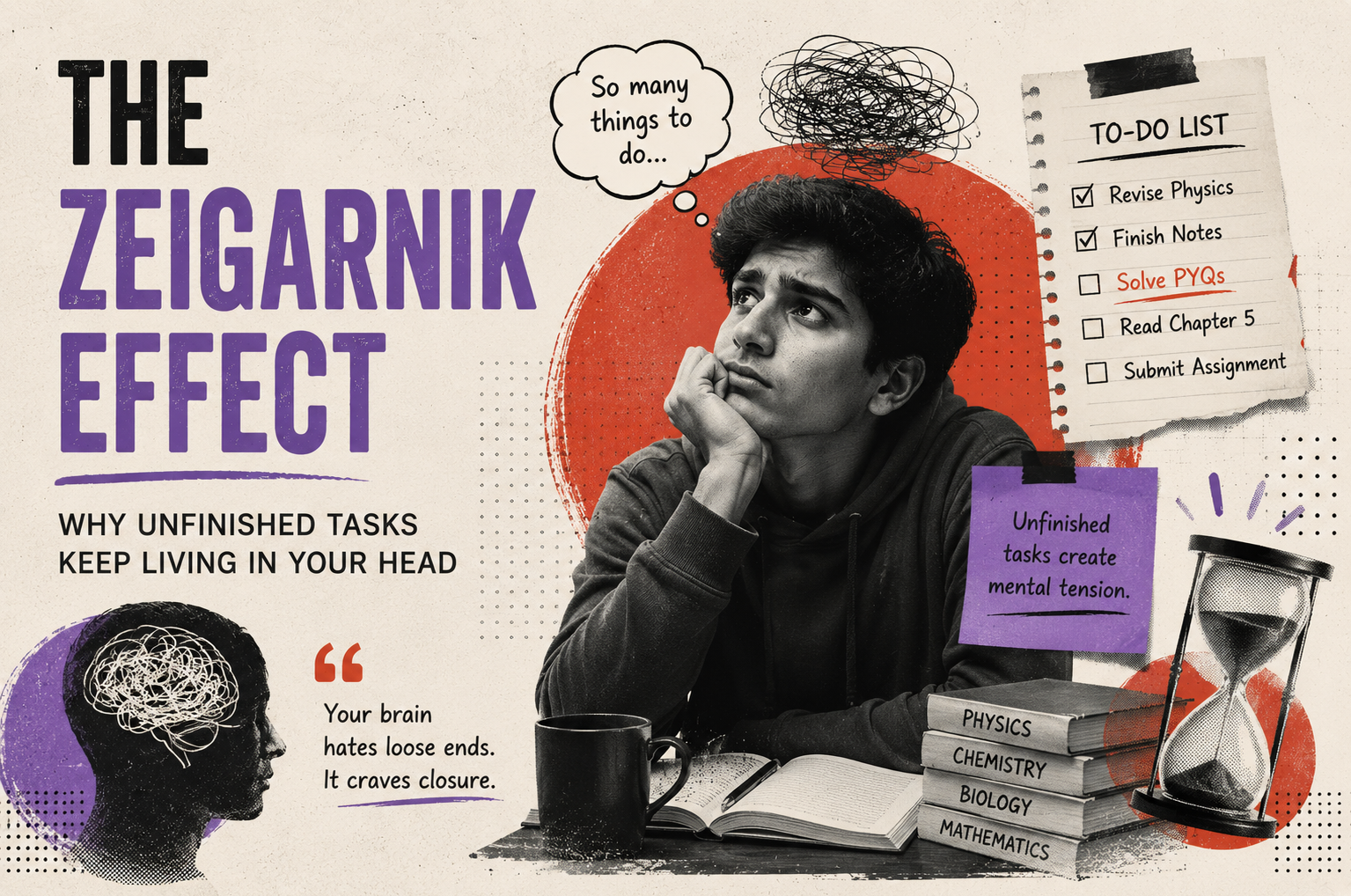
Ever wondered why you can't stop thinking about unfinished work, but easily forget things you've already completed? The answer lies in a fascinating psychological phenomenon called the Zeigarnik Effect.
You finally sit down to study.
Five minutes later, your brain reminds you that you haven't replied to an email.
Then you remember the assignment that's due next week.
Suddenly, you're thinking about the laundry, that unfinished conversation with a friend, and the chapter you meant to revise yesterday.
None of these thoughts were important a moment ago. So why did your brain decide now was the perfect time to bring them up?
Psychologists have an answer.
It's called the Zeigarnik Effect—the tendency for unfinished tasks to occupy our minds far more than completed ones.
Surprisingly, this "bug" in our brain can become one of the most powerful tools for learning and productivity.
Let's explore why.
It All Started in a Café
In the 1920s, Russian psychologist Bluma Zeigarnik noticed something curious while sitting in a café.
The waiters could effortlessly remember large numbers of unpaid orders.
But the moment customers settled their bills, those same orders seemed to vanish from memory.
Why? Once the task was completed, the brain no longer needed to actively keep it available.
Intrigued, Zeigarnik conducted experiments.
Participants were asked to complete several simple tasks like puzzles and crafts. Some were allowed to finish. Others were interrupted halfway through.
Later, participants remembered the interrupted tasks significantly better than the completed ones.
This became known as the Zeigarnik Effect.
Why Your Brain Hates Loose Ends
Imagine opening twenty tabs in your web browser.
Even if you're only reading one, the others remain open in the background.
Your brain behaves similarly.
Every unfinished task creates what psychologists call cognitive tension.
Until the task reaches a meaningful stopping point, your brain keeps it active.
This is why you might:
- Remember an unfinished Netflix episode.
- Think about an email you forgot to send.
- Replay an awkward conversation all day.
- Keep thinking about tomorrow's exam.
The brain dislikes uncertainty. Completion releases the tension.
Why Students Feel Overwhelmed
Many students believe they're stressed because they have too much work.
Often, it's because they have too many unfinished tasks.
Consider this list:
- Revise Biology
- Complete Chemistry notes
- Solve Physics PYQs
- Practice Vocabulary
- Finish Mathematics worksheet
Each unfinished task quietly competes for your attention.
Even while studying Biology, your brain whispers: "Don't forget Physics."
The result? Mental clutter—not because you're studying, but because your brain is trying to keep everything alive.
The Hidden Reason Procrastination Feels So Draining
Procrastination isn't relaxing. It's mentally expensive.
When you postpone work, the task doesn't disappear. Instead, your brain continues to remind you about it.
This creates background stress throughout the day.
Ironically, people often feel relieved the moment they simply begin a task.
Not because it's finished. Because the uncertainty has been reduced.
Starting matters more than we think.
How the Zeigarnik Effect Can Improve Studying
Here's where things become interesting. You can deliberately use this psychological effect to remember more.
1. Stop in the Middle of a Study Session
Instead of always finishing a chapter, occasionally stop after an important concept.
When you return later, your brain naturally wants closure.
Writers have used this technique for decades. Many intentionally stop writing mid-sentence, making it easier to resume the next day. Students can do the same—especially when paired with knowing when a study session has expired.
2. End Every Session with a Question
Instead of ending with "Done," end with: "How exactly does the kidney regulate blood pressure?"
Your brain will continue processing the question, even when you're away from your desk.
This makes your next study session easier to begin.
3. Break Large Goals into Small Tasks
Compare these two plans.
Plan A: Study Organic Chemistry.
Plan B: Finish Alcohols · Solve 20 questions · Revise reactions · Make summary notes.
Smaller tasks provide frequent moments of completion, reducing cognitive overload while maintaining momentum.
4. Use Checklists
Every completed checkbox signals closure to your brain.
That's one reason crossing items off a list feels so satisfying.
You're not just organizing work. You're reducing mental tension.
The Connection with Memory
Interestingly, the Zeigarnik Effect doesn't guarantee learning. It simply keeps information mentally active.
To convert that attention into long-term memory, you still need effective learning strategies.
This is where techniques like:
become essential.
Think of the Zeigarnik Effect as opening the door. The actual learning happens when you repeatedly retrieve and revisit the information over time.
Can the Zeigarnik Effect Become a Problem?
Yes. Modern life is filled with unfinished loops.
Unread notifications. Half-written emails. Books you never finished. Open browser tabs. Assignments. Social media.
Each creates a tiny amount of cognitive tension.
Individually, they're harmless. Collectively, they can become mentally exhausting.
That's why many productivity experts recommend reducing "open loops" by:
- Writing tasks down.
- Planning tomorrow before sleeping.
- Keeping a single to-do list.
- Finishing small tasks immediately when possible.
External systems free your brain from having to remember everything itself.
The Psychology Behind Cliffhangers
Ever wondered why TV shows end just before something important happens? Or why you immediately want to watch the next episode?
That's the Zeigarnik Effect at work.
An unfinished story creates tension. Your brain wants closure.
The same principle explains why mystery novels, puzzles, and escape rooms are so engaging.
Humans are naturally driven to complete incomplete information.
A Better Way to Use Your Brain
Many students fight against their psychology. A better approach is to work with it.
Instead of relying entirely on motivation, design study sessions that naturally pull you back.
Leave a question unanswered. Pause at an interesting concept. Create clear next steps.
The less friction there is to restarting, the more consistent you'll become.
Final Thoughts
The Zeigarnik Effect reveals something fascinating about the human mind.
Your brain isn't constantly reminding you about unfinished work to annoy you. It's trying to help.
It keeps incomplete tasks active because, throughout human history, forgetting unfinished work could have been costly.
Understanding this changes how we think about productivity.
Sometimes, the hardest part isn't finishing. It's simply starting.
Once you begin, your brain often does the rest—quietly nudging you toward completion.
Rather than seeing unfinished tasks as a source of stress, you can turn them into a powerful force that keeps you learning, revising, and moving forward.