Imagine preparing for an exam…
Except there are no printed question papers. No answer sheets. No multiple-choice questions.
Instead, you stand before a teacher who asks you to recite an entire book from memory.
One mistake. One forgotten line. And years of study could be questioned.
For most of human history, this was what an examination looked like.
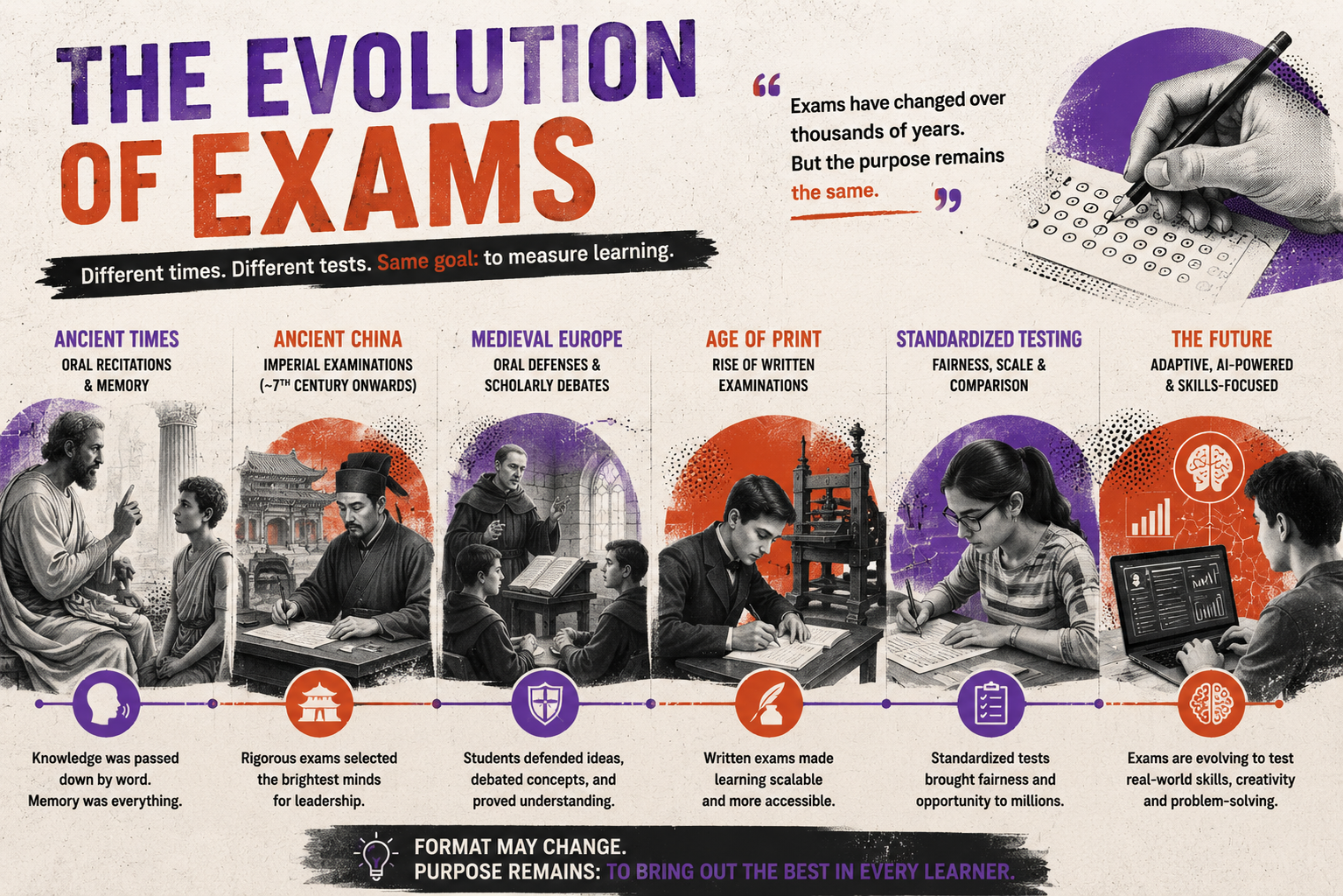
The exams we know today—written papers, standardized tests, online quizzes—are surprisingly modern inventions. Over thousands of years, examinations have evolved alongside civilization itself.
Exams have never simply measured knowledge. They've reflected what society believed was worth learning.
Before Schools, Learning Was Oral
Long before universities existed, knowledge was passed from one generation to the next through speech.
Stories. Poems. Religious teachings. Laws. Everything had to be remembered.
Since writing materials were scarce, memory became the foundation of education.
Students proved their learning not by writing answers but by speaking them aloud.
Accuracy mattered because memory preserved culture itself.
In many ancient civilizations, forgetting wasn't just a personal mistake. It meant losing history—the same imperative that drove medieval scholars to memorize entire books.
The First Formal Examinations
One of history's earliest large-scale examination systems emerged in ancient China.
Beginning more than a thousand years ago, the Imperial Examination system selected government officials through rigorous testing. Candidates spent years mastering philosophy, literature, poetry, history, and governance.
The exams were incredibly demanding. Some lasted several days.
Others required candidates to remain isolated in tiny examination cells while writing essays.
Passing these examinations could transform someone's entire life.
A farmer's son could become one of the empire's highest-ranking officials.
For perhaps the first time in history, education became a path to opportunity rather than inheritance.
Medieval Universities Changed Everything
As universities spread across Europe during the Middle Ages, examinations became more structured.
Students didn't simply memorize books. They defended ideas.
Professors questioned them in public debates.
These oral examinations tested reasoning as much as memory.
Could you explain an argument? Could you defend your conclusions? Could you respond to criticism?
Knowledge wasn't just about remembering facts. It was about demonstrating understanding.
The Rise of Written Exams
The invention of the printing press changed education forever.
Books became cheaper. Literacy expanded. Schools grew larger.
Soon, oral examinations became difficult to manage.
Written exams offered a practical solution.
Teachers could evaluate hundreds of students more efficiently.
Students could solve problems, write essays, and demonstrate their thinking without speaking aloud.
By the nineteenth century, written examinations had become the standard in many parts of the world.
The Age of Standardized Testing
As education expanded globally, governments needed ways to compare millions of students fairly.
Standardized examinations emerged. Every student answered the same questions. Everyone followed the same rules.
The goal was consistency.
These exams made large-scale education possible.
But they also introduced new debates.
Do standardized tests truly measure intelligence? Or do they simply measure how well someone performs under pressure?
The discussion continues today.
What Exams Actually Measure
Many students believe exams measure memory. In reality, they measure much more.
A good examination evaluates several abilities:
- Understanding concepts
- Applying knowledge
- Solving unfamiliar problems
- Thinking critically
- Managing time
- Communicating ideas clearly
Remembering information is only one part of success. Knowing when and how to use it is often more important.
How Learning Science Is Changing Exams
Modern research into memory has transformed the way educators think about assessment.
Scientists now know that repeatedly retrieving information strengthens long-term memory. This is called retrieval practice.
Ironically, taking tests can improve learning—not just measure it. Researchers call this the testing effect.
Every time we force ourselves to recall information without looking at our notes, we strengthen the neural pathways associated with that knowledge.
Exams can become learning tools—not just evaluation tools.
The Future of Exams
Education is changing rapidly.
Artificial intelligence can answer factual questions within seconds. Search engines place almost unlimited information at our fingertips.
As facts become easier to access, examinations are beginning to focus less on memorization and more on reasoning—as explored in will AI make exams obsolete?
Future exams may increasingly assess:
- Critical thinking
- Creativity
- Collaboration
- Problem-solving
- Real-world application
The question is no longer, "Can you remember this?" It's becoming, "Can you use what you know?"
What Students Can Learn
The history of exams teaches an important lesson. Every generation has changed how students are tested.
But one thing has remained constant. Deep understanding always outperforms shallow memorization.
Whether you're preparing for a school exam, a university entrance test, or a professional certification, your goal shouldn't be to memorize as much as possible.
Instead:
- Understand concepts deeply.
- Practice retrieving information.
- Connect ideas together.
- Solve unfamiliar problems.
- Review consistently over time using spaced repetition.
The best students don't simply prepare for exams. They prepare to think.
Final Thoughts
From oral recitations in ancient civilizations to AI-assisted classrooms, examinations have continuously evolved alongside human knowledge.
The format has changed. The tools have changed. The questions have changed.
But the purpose remains remarkably similar.
Every exam asks the same fundamental question: What have you truly learned?
Perhaps the future of education won't be about eliminating exams. It will be about designing better ones.
The best exams don't reward the student who remembers the most—they reward the student who understands the deepest.