Imagine walking into a library…
…and finding only twenty books.
Not twenty thousand. Not twenty million. Just twenty.
Now imagine one of those books costs more than a house.
You can't borrow it. You can't photocopy it. You can't search it online.
If you wanted its knowledge, there was only one option.
You had to carry the book inside your mind.
For medieval scholars, memorization wasn't an impressive party trick. It was survival.
Long before search engines, cloud storage, and even the printing press, memory was one of the most valuable skills a person could possess.
Their techniques may seem extraordinary today, but modern neuroscience suggests they understood something we've largely forgotten: the brain remembers best when knowledge is actively built—not passively consumed.
A World Without Google
Today, almost every piece of information is only a few taps away.
Need a formula? Search it. Need a quote? Google it. Need directions? Open Maps.
Modern technology has become an extension of our memory.
But medieval scholars lived in a completely different world.
Books were handwritten by scribes. Creating a single manuscript could take months—or even years.
Because every copy was made by hand, books were incredibly rare and expensive. Most universities owned only small collections, and many students never possessed a book of their own.
Knowledge wasn't something you could carry in a backpack. It had to be carried in your mind.
Why Memory Was More Valuable Than Books
In medieval Europe, education relied heavily on memorization.
Students studying law, medicine, philosophy, or theology often committed enormous amounts of material to memory. Some memorized entire collections of religious texts. Others knew long passages from Aristotle or Roman law by heart.
This wasn't simply because teachers demanded it. It was because memory made knowledge portable.
A scholar who remembered hundreds of pages could teach anywhere, debate anyone, and continue learning even without access to a library.
In many ways, memory was the medieval version of cloud storage.
The Memory Palace
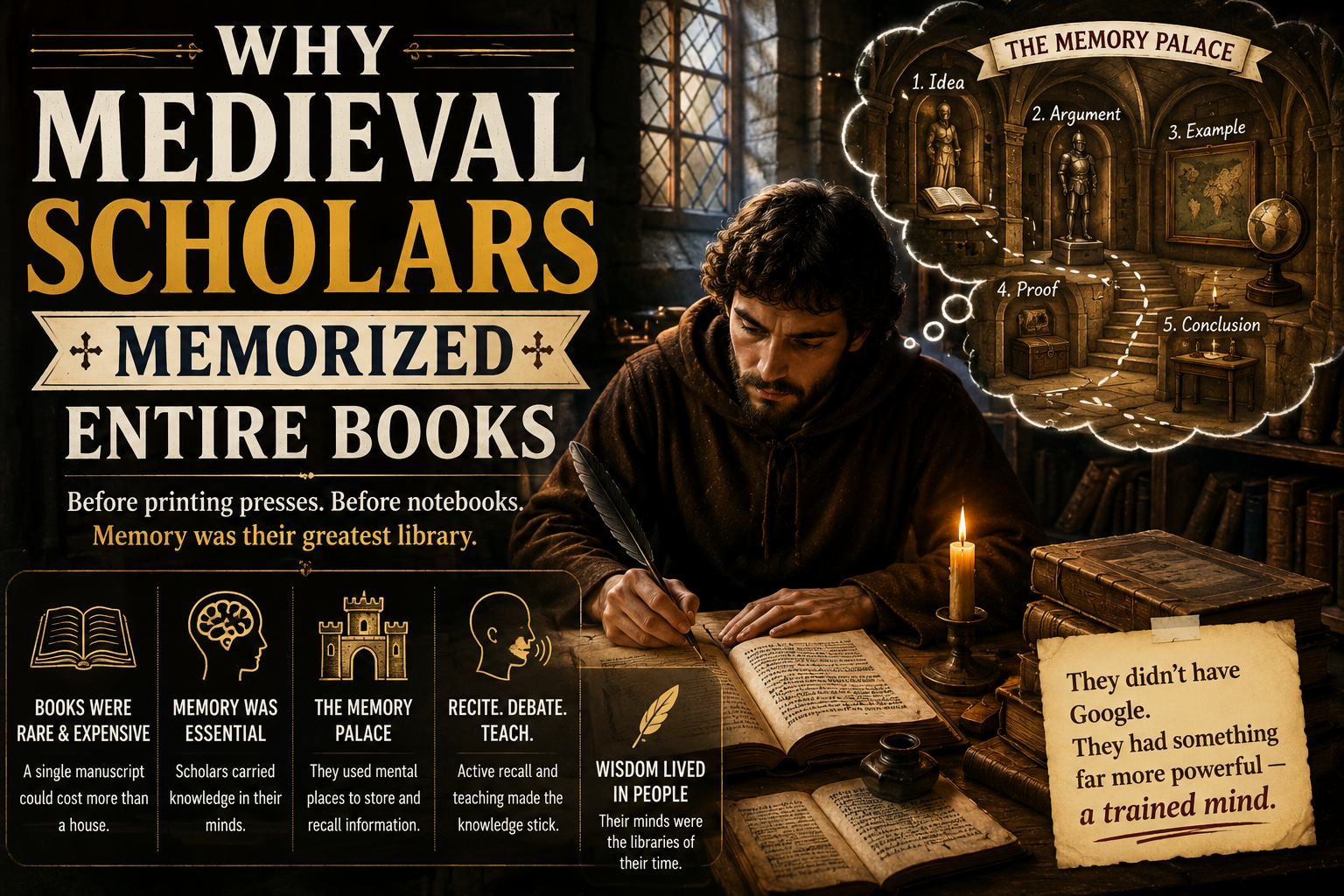
One of the most powerful techniques medieval scholars inherited from the ancient Greeks and Romans was the Method of Loci, better known today as the Memory Palace.
The idea was surprisingly simple.
Imagine a place you know well. Perhaps your home. Your school. Or your walk to work.
Now imagine placing pieces of information at different locations along that route.
When you mentally walk through that place later, each location reminds you of the information stored there.
Instead of memorizing disconnected facts, scholars created vivid mental journeys.
The stranger the images, the stronger the memory became.
Modern memory champions still use this technique to memorize hundreds of digits, decks of cards, and speeches. The method hasn't changed in nearly two thousand years. Because the human brain hasn't changed either.
Memory Was Meant to Be Active
Many people think memorization means reading something repeatedly. Medieval scholars did almost the opposite.
They recited ideas aloud. They debated them. They taught others. They connected new knowledge to stories, places, and images.
In other words, they practiced what modern psychologists now call active recall.
Instead of asking, "Did I read this?" they asked, "Can I reproduce it from memory?"
That small difference changes how the brain learns.
What Neuroscience Says Today
Centuries later, neuroscience confirms much of what medieval scholars practiced intuitively.
Each time we retrieve information from memory, the brain strengthens the neural pathways associated with it.
Simply rereading notes creates familiarity. Retrieving information creates learning.
This is why students often feel confident after reading a chapter several times but struggle during an exam. Recognition isn't the same as recall.
The brain becomes stronger when it has to search for an answer, not when the answer is sitting in front of it.
Why We Don't Memorize Like They Did
Today, memorization sometimes gets a bad reputation. People often associate it with rote learning and repetitive drilling.
But medieval scholars weren't memorizing without understanding. They memorized because they understood.
Memory allowed ideas to become part of their thinking. Instead of constantly looking things up, they could compare concepts, build arguments, and make deeper connections.
Technology has changed how we access information. It hasn't changed how our brains learn it.
Lessons for Modern Students
You don't need to memorize entire books. But you can borrow the principles medieval scholars used.
Instead of endlessly rereading your notes:
- Recall concepts without looking.
- Explain ideas in your own words.
- Create visual associations.
- Connect new knowledge to places or stories.
- Review information over multiple days using spaced repetition.
These methods require more effort initially. But they produce memories that last much longer.
The Return of Ancient Learning
Ironically, many of today's most effective study techniques are simply rediscoveries of ancient methods.
Memory palaces. Active recall. Spaced repetition. Visualization.
All have roots stretching back centuries—including the origins of flashcards.
Modern science hasn't replaced these techniques. It has explained why they work.
Final Thoughts
Medieval scholars didn't memorize entire books because they enjoyed making life difficult. They did it because knowledge was precious, books were rare, and memory was their greatest tool.
Today, we have unlimited access to information. Yet many of us remember less than ever before.
Perhaps the problem isn't that we have forgotten how to learn.
Perhaps we've simply stopped exercising the remarkable memory our brains already possess.
Knowledge stored on a shelf can be lost. Knowledge stored in the mind can travel anywhere.