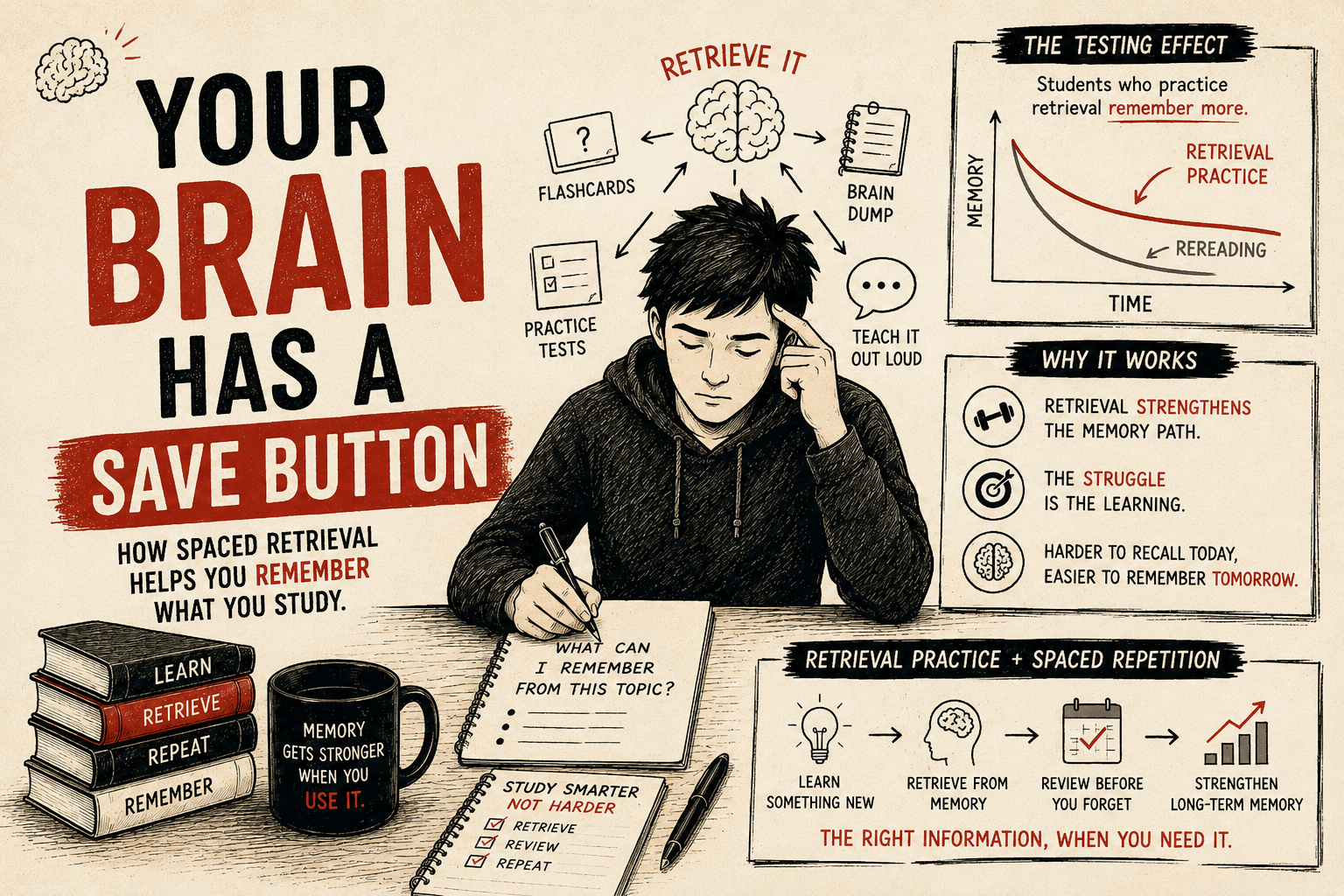
Most students keep pressing "Close Without Saving" every time they study.
Imagine spending three hours writing an important document. You finish the last sentence, smile, close your laptop... and realize you never hit Save. Hours of work disappear.
Ridiculous, right?
Yet millions of students do exactly this every single day. They study for hours, close their books, and assume the information is safely stored in their memory.
It isn't.
Learning Isn't Saving
Your brain doesn't automatically save information just because you spent time reading it.
Reading a chapter. Watching a lecture. Highlighting a textbook. Making beautiful notes.
These activities make you feel like you're learning.
Psychologists even have a name for this illusion—the familiarity effect. The material looks familiar, so your brain convinces you that you know it.
But familiarity isn't memory.
Memory has to be saved.
Your Brain Uses Auto-Save... But It's Terrible
Think of your brain like a computer.
When you first learn something, it's placed in temporary storage.
Without reinforcement, your brain assumes: "This probably isn't important." So it starts deleting it.
This is why you can confidently explain a concept today... and completely forget it next week. Not because you're bad at studying—because your brain is designed to forget. See why your brain deletes most of what you study for the science behind it.
Why Forgetting Exists
Imagine if your brain remembered every license plate you ever saw.
Every random conversation. Every advertisement. Every receipt.
It would be impossible to function.
Forgetting is actually one of your brain's greatest strengths.
It filters out information that doesn't seem useful.
The problem is that your brain doesn't know your chemistry exam is next month. It treats the Krebs Cycle the same way it treats yesterday's weather forecast.
Unless... you tell it otherwise.
The Save Button Is Revision
Every time you revisit information after a gap, you're sending your brain a powerful message:
"Keep this. I still need it."
Each revision strengthens the neural pathways storing that memory.
Instead of fading away, the memory becomes easier to access. This is why students who revise less often—but at the right time—can remember more than students who reread the same chapter every day.
It's not about studying more. It's about saving what you've already learned.
Timing Matters More Than Frequency
Here's where many students make a mistake.
They either revise too soon... or far too late.
Revise immediately after studying, and your brain hasn't had a chance to forget anything.
Wait three months, and you've forgotten almost everything.
The sweet spot is just before the memory disappears.
That moment is where revision becomes incredibly powerful.
This idea is known as spaced repetition. Instead of revising randomly, you review information at carefully increasing intervals. Each successful recall tells your brain: "This information is important."
Over time, the memory lasts longer and requires fewer revisions.
Why Cramming Feels Good (But Doesn't Last)
Ever noticed how confident you feel the night before an exam?
You've just read the same chapter three times. Everything feels crystal clear.
Then... a week later... it's gone.
Cramming loads information into short-term memory. Spaced repetition gradually moves it into long-term memory. One helps you survive tomorrow's test. The other helps you remember months—or even years—later. Read why cramming costs you more in the long run.
The Problem Isn't Motivation
Most students think they have a discipline problem.
"I need to study harder."
"I need to spend more hours."
"I need better focus."
Usually, none of those are the real issue.
The real issue is that they have no system for remembering.
Imagine trying to manage hundreds of topics, each needing revision at different times. No one can reliably track that in their head. Eventually, important topics get ignored simply because they're forgotten.
Ironically, you forget to revise because you forgot what needed revision.
Build a System, Not a Better Memory
The highest-performing students don't rely on memory to manage their memory. They use systems.
Calendars. Revision schedules. Flashcards. Spaced repetition apps.
Anything that tells them exactly what needs to be reviewed today.
Once the system handles the timing, they can focus entirely on learning. Pair that with retrieval practice and the idea that knowledge is a muscle, not a hard drive, and you have a complete approach to lasting memory.
Hit Save Every Time
The next time you finish studying, ask yourself one simple question:
Have I actually saved this?
If the answer is "I'll probably remember it..." you probably won't.
Knowledge isn't stored the moment you learn it. It's stored every time you come back to it.
Learning writes the file. Revision presses Save.
And every saved idea becomes something future-you can rely on.
Final Thought
Don't measure your study sessions by how many hours you spent reading.
Measure them by how much you'll still remember next month.
Because knowledge you can't recall isn't really knowledge.
It's just information waiting to be forgotten.