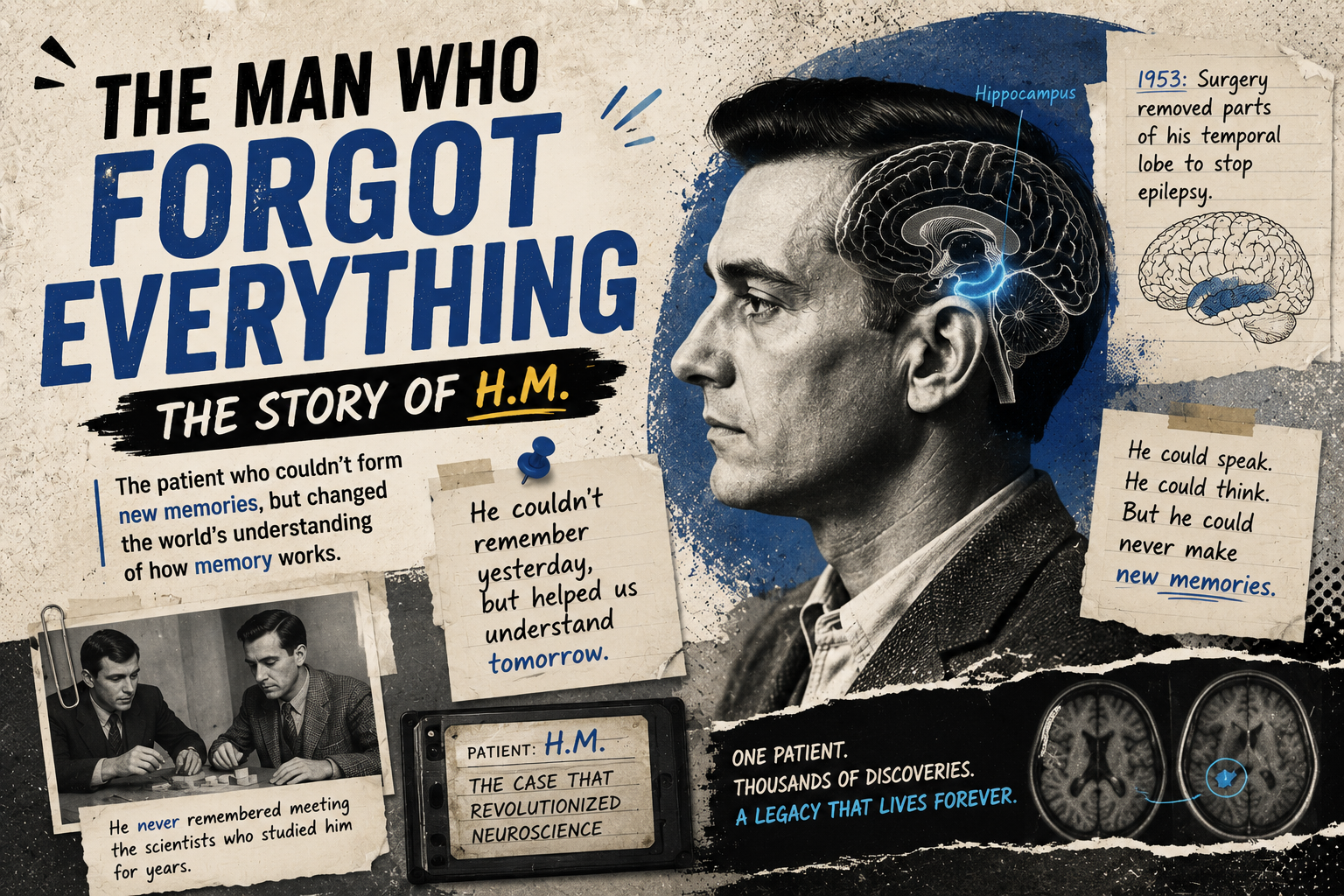
Imagine waking up every morning believing it's the same year. You meet someone, have a conversation, and five minutes later, you have no memory of ever meeting them.
You can remember your childhood, recognize your parents, and even ride a bicycle—but you can never create a new memory again.
It sounds like science fiction. But this was the real life of one of the most famous patients in the history of neuroscience.
His name wasn't publicly known for decades. Scientists simply called him H.M.
His extraordinary condition completely changed our understanding of how human memory works. Ironically, the man who couldn't create new memories helped the world remember one of the greatest discoveries in cognitive science.
A Life Changed by Surgery
Henry Molaison (known as H.M.) suffered from severe epilepsy from childhood.
By his twenties, his seizures had become so frequent that they made everyday life almost impossible. At the time, treatment options were limited.
In 1953, doctors performed an experimental brain surgery. They removed parts of both temporal lobes, including a small structure deep inside the brain called the hippocampus.
The surgery worked. His seizures became much less severe.
But something unexpected happened.
Henry could no longer form new long-term memories.
Living in the Present
After the operation, Henry could hold a normal conversation. He could solve simple problems. He could recognize objects.
But if someone left the room and returned a few minutes later, Henry would introduce himself again as though they had never met.
Every interaction felt new. Every day felt strangely disconnected from the one before.
It was as if his life's "Save" button had stopped working—the same idea we explore in your brain has a save button.
What He Could Remember
Surprisingly, Henry hadn't forgotten everything.
He still remembered his childhood. He remembered his family. He knew facts he had learned before the surgery.
This taught scientists something remarkable.
Old memories and new memories are stored differently.
The brain doesn't simply have one giant memory storage system. Instead, different kinds of memory rely on different brain regions.
The Hidden Role of the Hippocampus
Before H.M., scientists believed memory was spread evenly throughout the brain. Henry's condition challenged that idea.
Researchers discovered that the hippocampus acts like a temporary processing center.
It doesn't permanently store memories. Instead, it helps convert today's experiences into tomorrow's memories.
Without a functioning hippocampus, new experiences never become lasting memories.
It's similar to writing an essay but never pressing Save. The work exists for a moment. Then it's gone.
A Memory That Never Stayed
One of the strangest parts of Henry's condition was that he never remembered meeting the researchers who worked with him.
Some scientists spent years studying him. Every visit began the same way.
They introduced themselves. Henry smiled politely. To him, they were complete strangers.
Yet the researchers already knew him incredibly well.
The Mystery of Learning Without Remembering
Here's where the story becomes even more fascinating.
Researchers asked Henry to complete a mirror-drawing task.
Instead of looking directly at his hand, he had to trace a shape while watching only its reflection in a mirror. At first, he made many mistakes. Over several days, he became much better.
But every time he was asked to perform the task, Henry insisted he had never seen it before.
He couldn't remember practicing. Yet his performance kept improving.
This revealed another astonishing fact. The brain has multiple memory systems.
Even when conscious memory fails, the brain can still learn certain skills.
Different Types of Memory
Henry's case helped scientists distinguish between different forms of memory.
Episodic Memory
The memory of personal experiences, such as birthdays, vacations, or yesterday's lunch.
Semantic Memory
General knowledge and facts, such as knowing that Paris is the capital of France.
Procedural Memory
Skills that improve with practice, like riding a bicycle, typing, or playing the piano.
Henry struggled to create new episodic memories. But he could still develop procedural memories. His brain could learn. He simply couldn't remember learning.
Why H.M. Changed Neuroscience Forever
Henry participated in memory research for more than fifty years. Thousands of scientific papers have cited his case.
Because of him, researchers discovered that memory isn't a single ability. Instead, it is a collection of specialized systems working together.
His story shaped modern neuroscience, influenced treatments for memory disorders, and deepened our understanding of conditions like Alzheimer's disease and amnesia.
Few individuals have contributed more to science without ever realizing it.
What Students Can Learn from H.M.
Henry's story teaches us that memory isn't automatic. The brain has to actively convert information into long-term knowledge.
That's why simply reading something once rarely works.
To help the hippocampus strengthen memories, students should:
- Review information over multiple days.
- Practice active recall instead of passive reading.
- Use spaced repetition to revisit concepts before forgetting them.
- Connect new ideas with knowledge they already have.
- Sleep well, since memory consolidation happens during sleep—see why sleep might be your best study tool.
Learning isn't about seeing information once. It's about giving your brain enough opportunities to save it—before the forgetting curve takes over.
Final Thoughts
Henry Molaison spent most of his life unable to remember yesterday. Yet his story changed the future of memory research forever.
Today, whenever scientists talk about the hippocampus, memory consolidation, or different types of memory, they are building on lessons learned from H.M.
His greatest contribution wasn't something he remembered doing.
It was helping humanity understand one of the most extraordinary abilities the brain possesses: the power to create memories.
Sometimes, the people who teach us the most are the ones who can no longer remember teaching us.