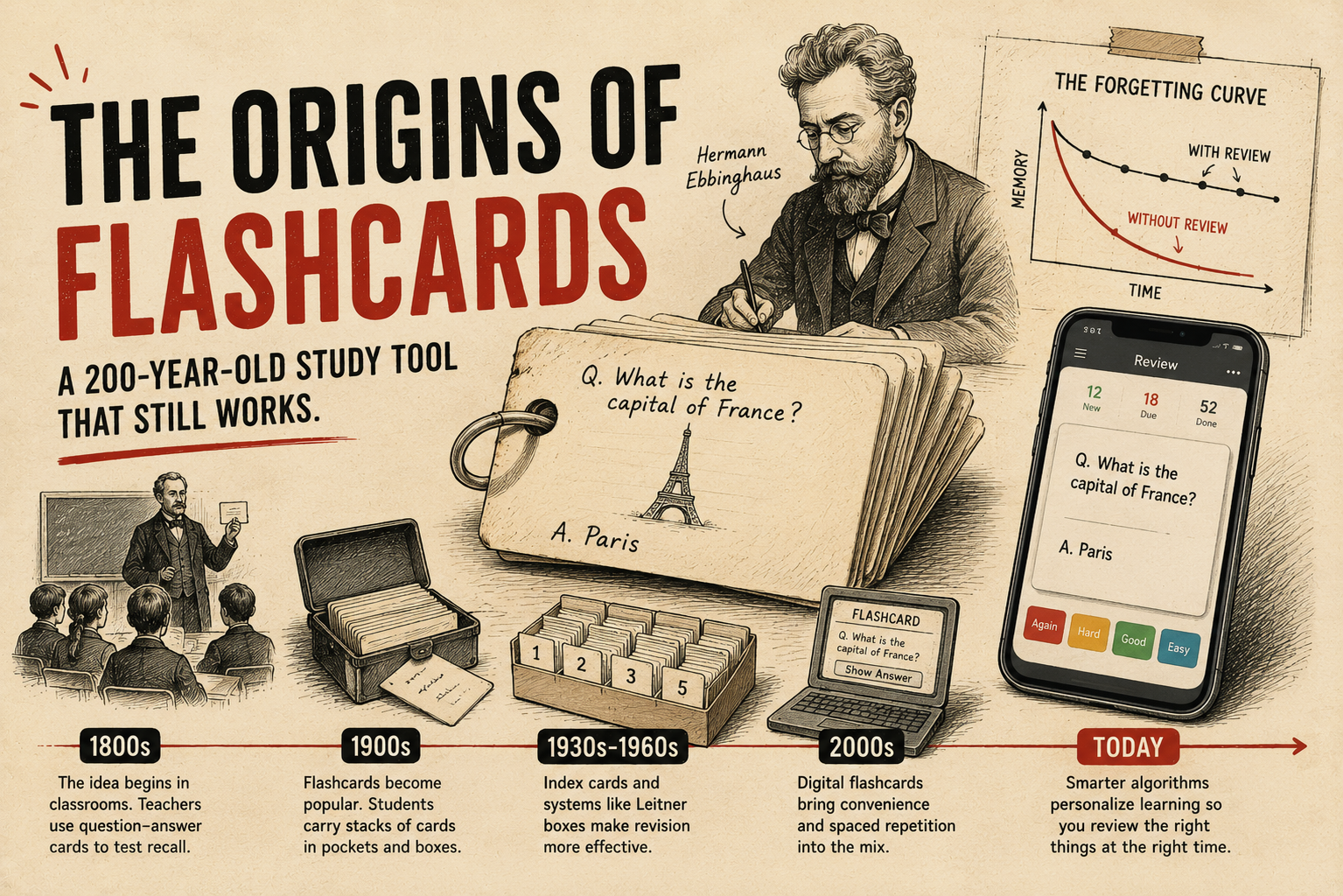
Long before smartphones... before laptops... before the internet... students were using flashcards.
Just small pieces of paper. A question on one side. An answer on the other. Simple. Yet incredibly effective.
Even today, millions of students preparing for medical school, GRE, language exams, and competitive tests still rely on the same idea.
Why has such a simple tool survived for over 200 years?
Because it works with your brain—not against it.
Before Flashcards, Students Mostly Read
For centuries, studying meant reading.
Teachers lectured. Students copied notes. Then they reread those notes before exams.
The assumption was simple: read something enough times and you'll remember it.
But students kept forgetting.
Reading felt productive. Memory said otherwise.
The Birth of Flashcards
In the early 1800s, teachers began experimenting with a different approach.
Instead of showing students information... they hid it.
A card might ask: "What is the capital of France?"
Only after trying to answer would the student flip the card.
It seems obvious today. Back then, it was revolutionary.
Students weren't just reading anymore. They were retrieving information from memory.
Why Flashcards Actually Work
Here's the interesting part.
Flashcards aren't effective because they're pieces of paper.
They're effective because they force your brain to recall information.
That small moment of struggle is doing all the work.
Every time you retrieve a memory, the connection becomes a little stronger. Psychologists call this retrieval practice. Most students simply call it "testing yourself."
Then Science Explained Why
In the late 1800s, German psychologist Hermann Ebbinghaus spent years studying memory.
His experiments revealed something surprising.
We forget most new information much faster than we think. In fact, forgetting begins within hours of learning.
But he also discovered something hopeful. Reviewing information before you completely forget it dramatically improves long-term retention. This became known as the forgetting curve.
Suddenly, flashcards weren't just useful. They had science behind them.
From Paper Cards to Digital Apps
For more than a century, flashcards barely changed.
Students carried stacks of index cards. Rubber bands held them together. Some even kept shoeboxes full of vocabulary cards.
Then computers arrived.
Digital flashcards solved a practical problem. You no longer needed hundreds of paper cards. Everything lived inside your phone or computer.
But the biggest improvement wasn't convenience. It was timing.
Apps could now remember which cards were difficult and show them more often. Easy cards appeared less frequently. This became known as spaced repetition—the same science behind tools like Anki.
But Flashcards Have One Problem
There's a catch. Someone has to make them.
Creating hundreds of flashcards takes time. Sometimes more time than actually studying.
For subjects like medicine or languages, the effort is often worth it. For many students, however, creating flashcards becomes another task on an already long to-do list.
That's why newer study systems focus less on creating cards and more on scheduling revisions. Different tools. Same science—as with your brain's save button for revision timing.
The Real Secret Isn't the Card
People often think the flashcard is the magic. It isn't.
The real magic is what happens before you flip it over.
That brief pause. That attempt to remember. That tiny struggle.
Your brain interprets that effort as a signal: "This information must be important."
So it strengthens the memory.
Whether it's written on paper, displayed on your phone, or generated by AI—the principle never changes.
A 200-Year-Old Idea That Refuses to Die
Technology has changed dramatically. Students now use AI, tablets, and smart study apps.
Yet the core idea behind flashcards remains exactly the same.
Don't just read. Recall.
Don't just recognize. Retrieve.
The tools may evolve. The science doesn't.
And that's why a study method invented over two centuries ago is still helping millions of students remember what they learn.
Sometimes the best ideas don't need replacing. They just need better timing.