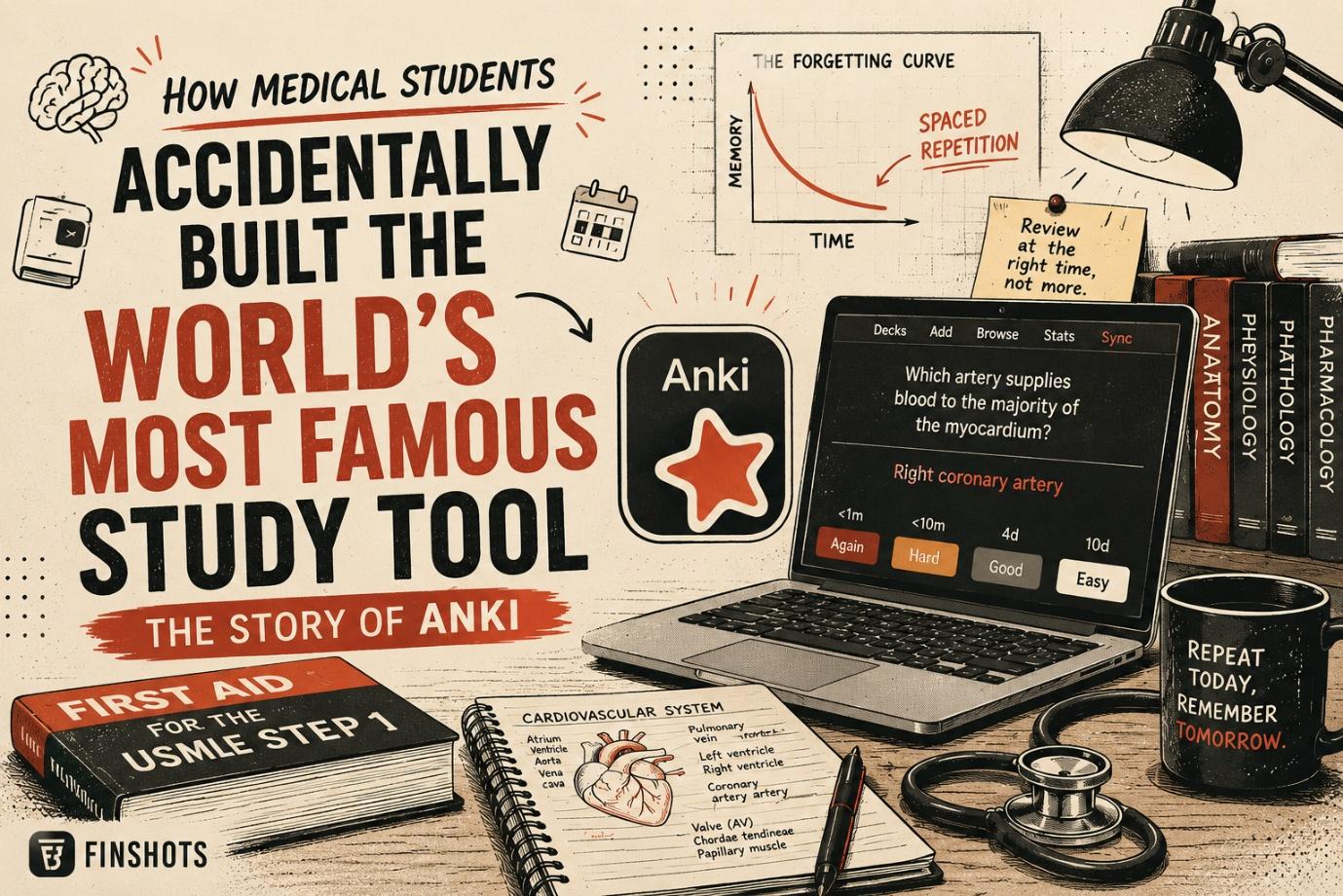
If you walk into any medical school library today, you'll probably see the same scene:
Students wearing headphones. Coffee cups everywhere. And on nearly every laptop screen — rows of digital flashcards flipping endlessly.
Question. Answer. Again tomorrow. Again next week. Again months later.
Behind this ritual is a simple app with an unusual name: Anki.
What started as a niche memory tool quietly became one of the most influential study systems in the world. It wasn't built by Silicon Valley founders chasing billion-dollar valuations. It wasn't marketed with flashy ads.
Instead, it spread through exhausted medical students trying not to forget everything they studied.
And somehow, they accidentally created an entire culture around learning itself.
The Problem Every Medical Student Faces
Medicine has a memory problem.
A normal university student might study a few hundred concepts per semester. A medical student studies thousands.
Drugs. Anatomy. Pathology. Microbiology. Symptoms. Treatments. Side effects. Latin names. Endless diagrams.
The real challenge isn't understanding something once.
It's remembering it six months later.
For decades, students used traditional flashcards. But paper cards came with a painful flaw:
You waste huge amounts of time reviewing things you already know.
A student might repeatedly review "easy" concepts while forgetting difficult ones entirely. The process was inefficient, exhausting, and impossible to scale.
Then came a psychological idea that would change everything.
The Science That Inspired It
In the late 1800s, German psychologist Hermann Ebbinghaus discovered something fascinating:
Humans forget information predictably.
This became known as the forgetting curve.
Right after learning something, memory is strong. But over time, recall drops rapidly unless the information is reviewed again.
The solution?
Review information right before you're about to forget it.
Not too early. Not too late.
This concept eventually became known as spaced repetition.
Years later, researchers and educators experimented with computerized systems that could schedule reviews intelligently. Instead of reviewing every flashcard equally, software could predict which facts you were likely to forget.
It sounded brilliant in theory.
But for years, these systems remained mostly academic experiments.
Until one programmer turned the idea into something practical.
A Programmer Named Damien Elmes
In 2006, an Australian programmer named Damien Elmes was struggling to learn Japanese.
He discovered spaced repetition systems online and became fascinated by them. Existing software felt clunky and restrictive, so he decided to build his own version.
He named it "Anki," derived from the Japanese word for "memorization."
The early version looked incredibly plain.
No social features.
No animations.
No gamified streaks.
No viral marketing.
Just cards.
But underneath was an unusually powerful algorithm that adapted to human memory.
Every time you answered a card, Anki adjusted when you would see it again.
Easy card? Review later.
Difficult card? Review sooner.
Over time, the system personalized itself to your brain.
What Damien built was not just a flashcard app.
It was a memory scheduling machine.
Why Medical Students Fell in Love With It
At first, Anki attracted language learners.
But then medical students discovered it.
And everything changed.
Medicine is one of the few fields where memorization volume is so overwhelming that small efficiency gains become life-changing.
Students realized something shocking:
Using spaced repetition consistently could dramatically reduce forgetting while studying fewer total hours.
Instead of re-reading entire textbooks repeatedly, they could focus only on concepts their brain was actually at risk of forgetting.
This created a strange effect.
Students using Anki often seemed calmer than everyone else.
Not because medical school became easy.
But because they trusted the system.
If a card disappeared for six months, they believed their brain truly knew it.
That confidence became addictive.
The Rise of "Anki Culture"
Over time, Anki became more than software.
It became a lifestyle.
Students started sharing enormous decks online — collections containing tens of thousands of cards covering entire medical curricula.
One of the most famous examples was the "Zanki" deck, created by medical students for medical students.
Soon, entire online communities formed around optimization:
- Best card formatting
- Best review limits
- Best add-ons
- Best study workflows
- Best memory strategies
People debated settings with the intensity of professional athletes discussing training routines. Some students reviewed 500 cards daily. Others crossed 1,000.
YouTube channels emerged showing "Anki study with me" sessions lasting 10 hours straight.
What made this especially unusual was that Anki never became a polished mainstream product. Even today, many new users think it looks outdated.
And yet, it became legendary precisely because it worked.
The Accidental Network Effect
Most successful apps grow through marketing.
Anki grew through survival.
A first-year student would ask a senior:
"How are you remembering all this?"
The answer was often the same:
"Use Anki."
Then the senior would share their deck.
That new student would eventually modify the deck, improve it, and pass it down again.
This created one of the most organic educational ecosystems on the internet.
No corporation controlled the curriculum.
Students collectively built it themselves.
In many ways, Anki succeeded because it was open-ended.
Users weren't passive consumers.
They became contributors.
The Hidden Cost Nobody Talks About
But Anki also changed how many students experience learning.
Critics argue that excessive flashcard use can turn education into pure memorization. Some students become obsessed with maintaining "review streaks," treating learning like an endless treadmill.
Others report burnout from massive daily review queues.
There's even a meme in medical communities:
"You don't own Anki. Anki owns you."
And honestly, there's some truth to that.
Spaced repetition is incredibly effective — but effectiveness can become addictive.
When students realize memory can be optimized, many begin optimizing everything.
Why Anki Became Bigger Than Medicine
Eventually, Anki spread beyond medical schools:
- Language learners
- Law students
- Competitive exam aspirants
- Programmers
- Musicians
- Pilots
Anyone dealing with large amounts of information discovered the same principle:
Memory is trainable.
Today, the influence of Anki can be seen everywhere — from modern learning apps to AI-powered education platforms.
Many apps now quietly use spaced repetition under the hood, even if users never notice it.
The core idea remains the same:
Don't study more.
Study at the right time.
The Most Interesting Part of the Story
The strange thing is that Anki never became a giant tech company.
It never chased social media virality.
It never turned into a billion-dollar startup dominating headlines.
And yet, millions of students trust it with something incredibly personal:
Their future.
That's rare.
Especially in education technology, where hype often matters more than results.
Anki spread because students proved its value to each other, year after year.
Not through advertising.
Through survival.
Final Thoughts
The story of Anki isn't really about flashcards.
It's about a deeper realization:
Human memory is not fixed.
For centuries, forgetting felt unavoidable. Then a small group of programmers, psychologists, and overwhelmed students discovered something powerful:
If you review information at the right moment, memory changes dramatically.
Medical students simply happened to be desperate enough to adopt it first.
And in doing so, they accidentally built one of the most influential learning movements of the digital age.