Imagine two people.
The first person spends six months reading books about fitness.
They watch YouTube videos.
Follow fitness influencers.
Highlight workout routines.
Save exercise plans.
Read articles about muscle growth.
The second person goes to the gym three times a week.
Who gets stronger?
The answer is obvious.
Yet when it comes to studying, millions of students do exactly what the first person does. They consume information. Collect notes. Highlight textbooks. Watch lectures. And somehow expect knowledge to become permanent.
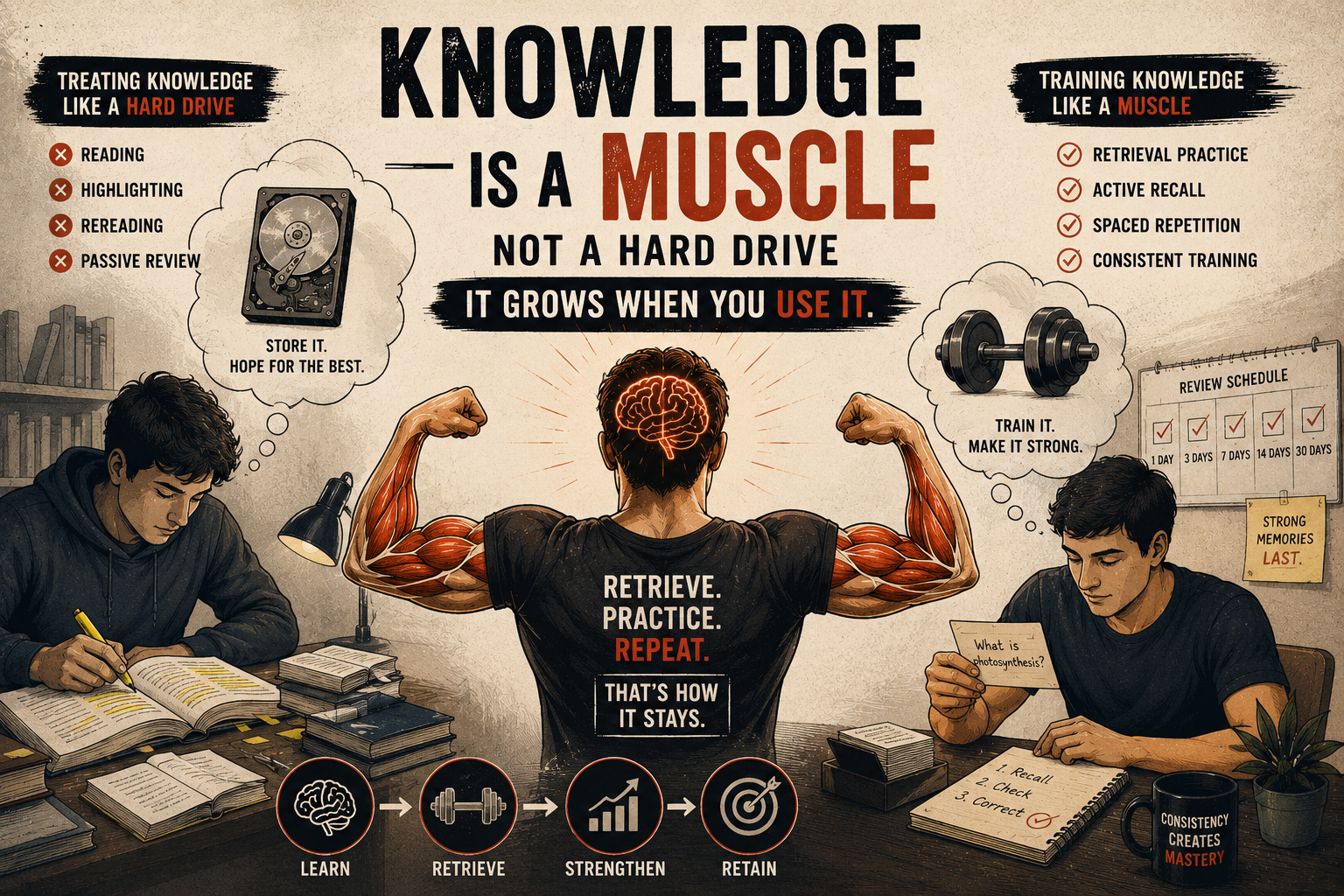
But knowledge doesn't work like a hard drive.
It works like a muscle.
And that's where most students go wrong.
The Great Learning Illusion
Let's try a quick experiment.
Think about your favorite song.
You probably know every line.
Now try writing the lyrics from memory.
Without looking. Without humming. Without cheating.
Suddenly it's harder than expected.
Why?
Because recognizing information and recalling information are completely different skills.
Most studying is recognition. Exams test recall.
And the gap between the two is where students lose marks. You don't fail exams because you never saw the information. You fail because the information wasn't strong enough to be pulled out when needed. That's the core idea behind active recall.
Your Brain Is More Like a Gym Than a Library
We often imagine learning as storing books in a library.
Read something. Store it. Retrieve it later. Simple.
Except that's not how memory works.
A better analogy is a gym.
Every fact you learn is like a muscle fiber.
If you never use it, it weakens.
If you challenge it repeatedly, it adapts.
If you stop training it, it shrinks.
The brain follows a surprisingly similar rule.
Neural pathways strengthen when they're used—not when they're merely observed.
Reading is exposure. Remembering is training.
The Most Productive-Looking Activity Is Often The Least Effective
Picture a student sitting at a desk.
Highlighter in hand. Textbook open. Pages glowing with yellow and pink markings.
It looks productive. It feels productive.
But from the brain's perspective, very little is happening.
The information is flowing in. Nothing is being demanded back out.
Now compare that with a student who closes the book and asks:
"Can I explain this chapter from memory?"
That feels harder. Messier. More frustrating.
And that's exactly why it works.
Learning happens when the brain is forced to retrieve—not when it's allowed to simply recognize.
The Muscle-Building Secret Nobody Talks About
Ask any athlete how muscles grow.
The answer isn't during the workout. It's after.
The workout sends a signal. Recovery builds the strength.
Memory works in a surprisingly similar way.
You learn something.
Forget part of it.
Recall it again.
Strengthen the connection.
Sleep.
Repeat.
The cycle of forgetting and remembering is not a flaw in the system. It's the system. Many students panic when they forget—the best learners expect it. Because forgetting creates the opportunity for strengthening.
Why Cramming Feels Good And Fails Later
Imagine trying to build muscle by doing 5,000 push-ups in one day.
You'd be exhausted. You'd probably hate exercise. And a week later, most of the benefit would be gone.
That's cramming.
It's a learning sprint pretending to be a learning strategy. It works just well enough to fool you. The information survives until the exam—then disappears shortly afterward. See why cramming costs you more than spaced review in the long run.
Strong muscles come from repeated training. Strong memories come from repeated retrieval.
The principle is identical.
What Spaced Repetition Really Is
People often think spaced repetition is a study technique.
It's actually a training schedule.
Imagine going to the gym.
Day 1. Day 3. Day 7. Day 14. Day 30.
You're revisiting the same muscle at carefully chosen intervals.
Spaced repetition does exactly this for memory. Each review arrives right before the memory becomes too weak. The brain receives a clear message: "This matters. Keep it."
Over time, recall becomes easier. Faster. More automatic. The knowledge becomes part of you.
The Question That Changes Everything
Most students sit down to study and ask:
"What should I read today?"
A better question is:
"What can I recall today?"
One focuses on consuming information. The other focuses on strengthening it.
One treats knowledge like a file. The other treats knowledge like a muscle.
And that tiny shift changes everything.
The Real Goal Of Learning
The goal isn't to finish chapters.
The goal isn't to highlight pages.
The goal isn't even to understand something once.
The goal is to build knowledge that survives—knowledge you can access during exams, explain to others, and still remember months later.
Because learning isn't about what enters your brain.
It's about what stays.
And what stays is what gets trained.
Just like a muscle.
The next time you study, remember: you don't get stronger by looking at dumbbells. And you don't get smarter by looking at notes. Growth happens when you do the reps—for muscles, and for memory.