Imagine trying to pour ten litres of water into a one-litre bottle.
No matter how hard you try, most of it spills out.
Your brain works in a surprisingly similar way.
Many students assume that learning problems come from a lack of intelligence, motivation, or effort. But often, the real problem is much simpler: your brain is overloaded.
This idea sits at the heart of Cognitive Load Theory, one of the most influential theories in educational psychology. Understanding it can completely change how you study, teach, and learn.
Your Brain Has a Bandwidth Limit
Think about the last time you tried to:
- Learn a new concept
- Watch a lecture
- Take notes
- Read slides
- Answer questions
All at the same time.
It felt exhausting.
Not because the topic was impossible. Because your brain has limited processing capacity.
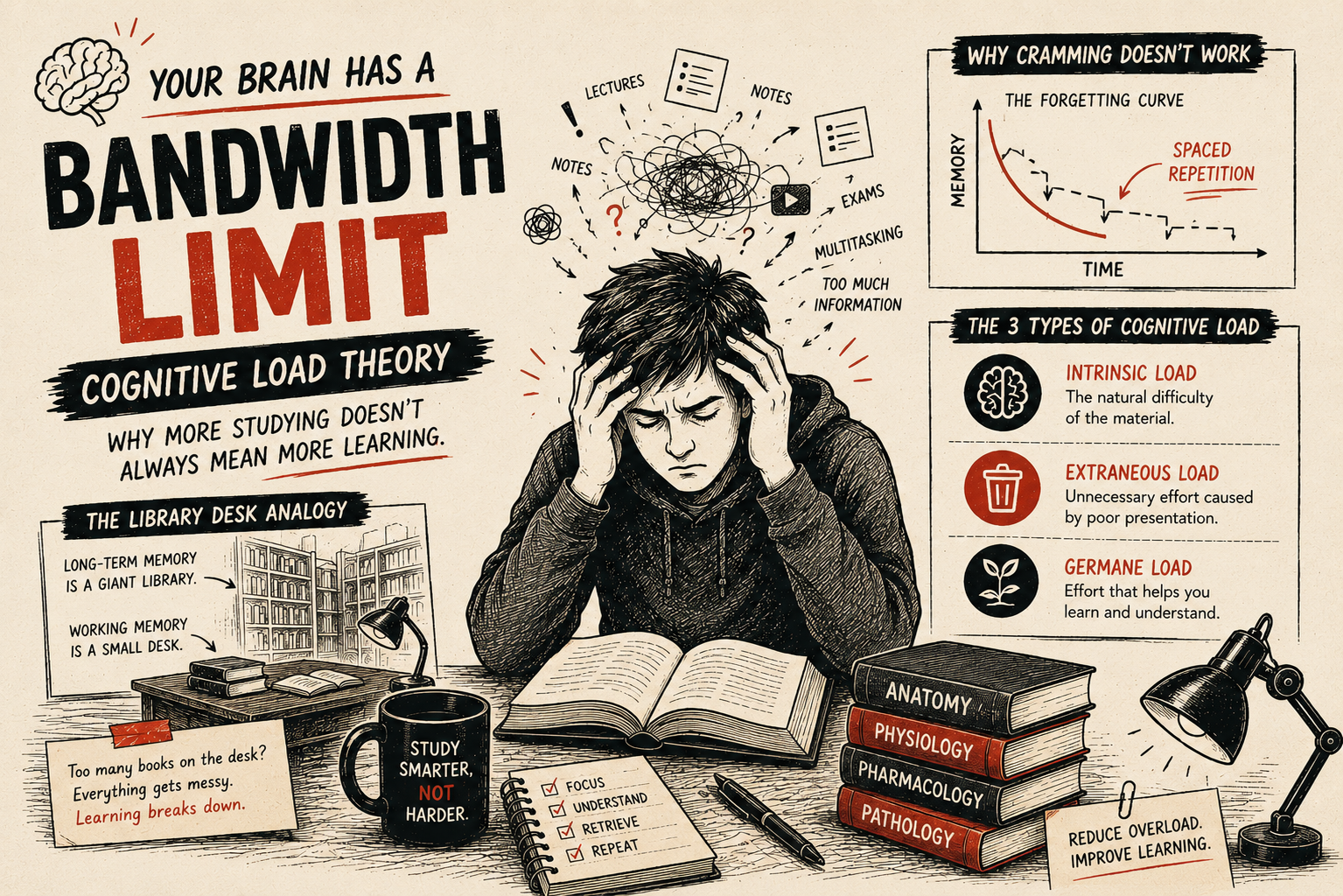
Psychologists refer to this temporary mental workspace as working memory. Working memory is where learning happens—but it's surprisingly small. When too much information enters at once, learning slows down or stops altogether.
The result? Confusion. Mental fatigue. And the frustrating feeling that you're studying hard without making progress—the same pattern behind why your brain deletes most of what you study when overload meets the forgetting curve.
The Library Desk Analogy
Imagine your brain is a giant library.
The bookshelves represent your long-term memory. They're enormous—you can store an incredible amount of knowledge there.
But in the middle of the library sits a small desk. That's your working memory.
Only a few books fit on the desk at once.
If someone dumps twenty books onto it, everything becomes messy. You lose track of what you're reading. You forget information. You struggle to connect ideas.
Learning isn't about making the library bigger. It's about managing the desk more effectively.
The Three Types of Cognitive Load
Not all mental effort is bad. Cognitive Load Theory divides mental effort into three categories.
1. Intrinsic Load
This is the natural difficulty of the material itself.
Some topics are simply more complex than others.
Learning basic multiplication has low intrinsic load. Calculus has higher intrinsic load. Organic chemistry has even higher intrinsic load.
You can't eliminate intrinsic load. But you can manage it by breaking complex topics into smaller pieces. Trying to learn everything at once often overwhelms working memory.
2. Extraneous Load
This is the unnecessary mental effort created by poor presentation.
Imagine trying to learn from:
- Cluttered slides
- Distracting animations
- Dense textbooks
- Overcomplicated explanations
- Endless highlighting
Your brain wastes energy processing irrelevant information.
The problem isn't the content. The problem is the way it's presented.
Good learning reduces extraneous load. Great teachers aren't just knowledgeable—they make information easier to process.
3. Germane Load
This is the mental effort that actually helps learning.
It's what happens when you:
- Solve problems
- Explain concepts
- Make connections
- Retrieve information from memory
- Apply knowledge
This effort feels challenging. But it's productive. Germane load is where understanding grows.
The goal isn't to make learning effortless. The goal is to remove unnecessary effort so your brain can spend energy on useful effort.
Practical Ways to Reduce Cognitive Load
Focus on One Concept at a Time
Avoid multitasking. Your brain processes information more effectively when attention is concentrated.
Break Topics Into Smaller Chunks
Large topics become easier when divided into manageable pieces. Learn one idea. Understand it. Then move on.
Use Simple Explanations
The simpler the explanation, the less mental energy required to understand it. This is one reason the Feynman Technique works so well.
Practice Retrieval
Instead of rereading notes, try recalling information from memory. Retrieval strengthens learning while helping identify gaps in understanding—see active recall for the full approach.
Review Over Time
Spaced repetition prevents overload by distributing learning across multiple sessions. Your brain prefers repeated exposure over massive one-time effort.
What Cognitive Load Theory Means for Students
The biggest lesson from Cognitive Load Theory is surprisingly reassuring.
Struggling doesn't always mean you're incapable. Sometimes it simply means your working memory is overloaded.
Learning isn't a test of how much information you can force into your brain at once. It's a process of gradually building knowledge in a way your brain can handle.
The best learners aren't necessarily the ones who study the longest. They're the ones who manage their mental resources effectively.
The Real Goal
Many students try to increase effort. A better approach is to reduce friction.
Remove distractions. Simplify explanations. Break information into chunks. Review at the right time.
Because effective learning isn't about overwhelming your brain.
It's about working with the way your brain was designed to learn.
And when you do that, studying starts to feel less like a struggle—and more like progress.
Final Thought
Your brain isn't a bucket that can be endlessly filled.
It's a system with limits.
Respect those limits, and learning becomes easier.
Ignore them, and even simple topics can feel overwhelming.
Study smarter, not heavier. Your brain will thank you for it.