You studied.
You made notes.
You highlighted half the textbook.
You even solved past papers.
Then the exam arrives.
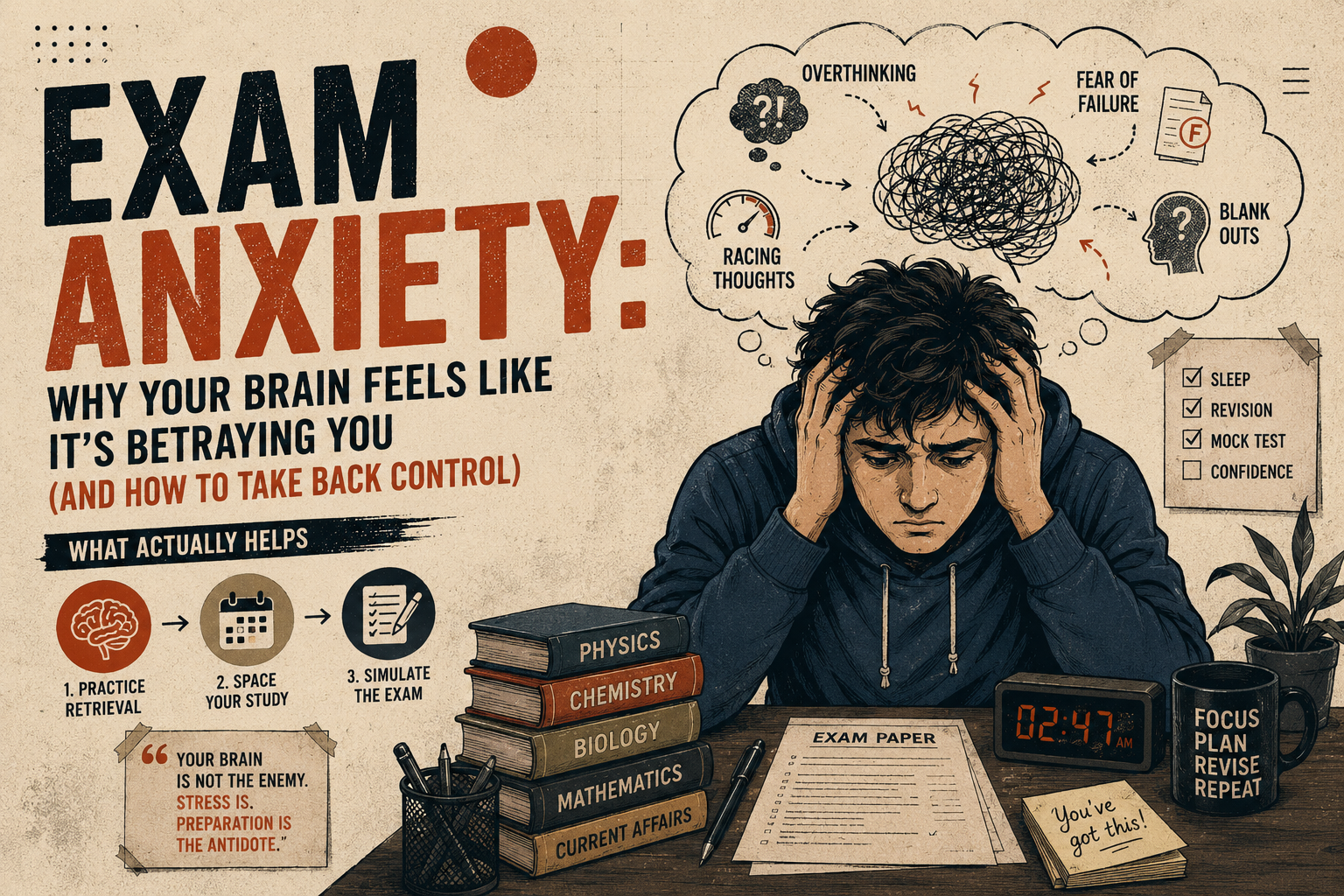
Suddenly your heart races. Your palms sweat. The answer you knew yesterday seems impossible to remember.
You stare at the question paper and wonder:
"Did I forget everything?"
If this sounds familiar, you're not alone.
Exam anxiety affects millions of students every year. And contrary to what many people believe, it's not a sign that you're unprepared or incapable.
In fact, exam anxiety is often the result of your brain trying too hard to help.
Let's understand why.
Your Brain Thinks You're in Danger
Thousands of years ago, stress helped humans survive.
When our ancestors encountered a threat, their brains released stress hormones that prepared the body for action.
Heart rate increased.
Breathing became faster.
Attention narrowed.
The body prepared to fight or flee.
The problem?
Your brain doesn't always distinguish between a tiger and a test paper.
When an exam feels high-stakes, your brain can interpret it as a threat.
The same survival system activates.
And while this can increase alertness, too much stress begins to interfere with thinking and memory.
That's why students often experience the frustrating phenomenon of "blanking out" during exams. The information may still be stored in memory—but stress makes it harder to retrieve. See why your brain deletes most of what you study and how the forgetting curve interacts with exam-day pressure.
What Actually Reduces Exam Anxiety?
Many students search for ways to become less nervous.
But the goal isn't to eliminate anxiety completely.
A small amount of stress is normal.
The goal is to build enough trust in your preparation that anxiety loses its power.
Here are three evidence-based approaches:
1. Practice Retrieval, Not Recognition
Close your notes.
Try to recall concepts from memory.
Use flashcards.
Answer questions before checking solutions.
The struggle to remember is where learning happens. This is the core of active recall—and it's what exams actually test.
2. Use Spaced Repetition
Don't wait until the week before the exam.
Review information periodically over time.
Small reviews today prevent panic tomorrow. Learn how spaced repetition schedules reviews before you forget—so exam day feels like retrieval, not rescue.
3. Simulate the Exam
Many students prepare for the content but not the environment.
Practice under timed conditions.
Remove distractions.
Sit with uncertainty.
The more familiar the experience becomes, the less threatening it feels.
The Real Goal
Most students think studying is about putting information into their brain.
But exams reveal a different truth.
Success depends on getting information back out.
That's why effective learning isn't just about exposure.
It's about retrieval.
It's about spacing.
It's about building memories strong enough to survive stress.
Because on exam day, the goal isn't to remember everything you've ever studied.
The goal is to trust that your preparation has already done the work.
And trust grows from evidence.
Not hope.
Not luck.
Not last-minute cramming.
Just consistent practice.
One review at a time.
Anxiety isn't always a sign that you're unprepared. Sometimes it's a sign that your brain cares about the outcome.
The solution isn't to study endlessly.
The solution is to study in a way that builds confidence.
Because confidence isn't the absence of anxiety.
It's knowing you can perform despite it.