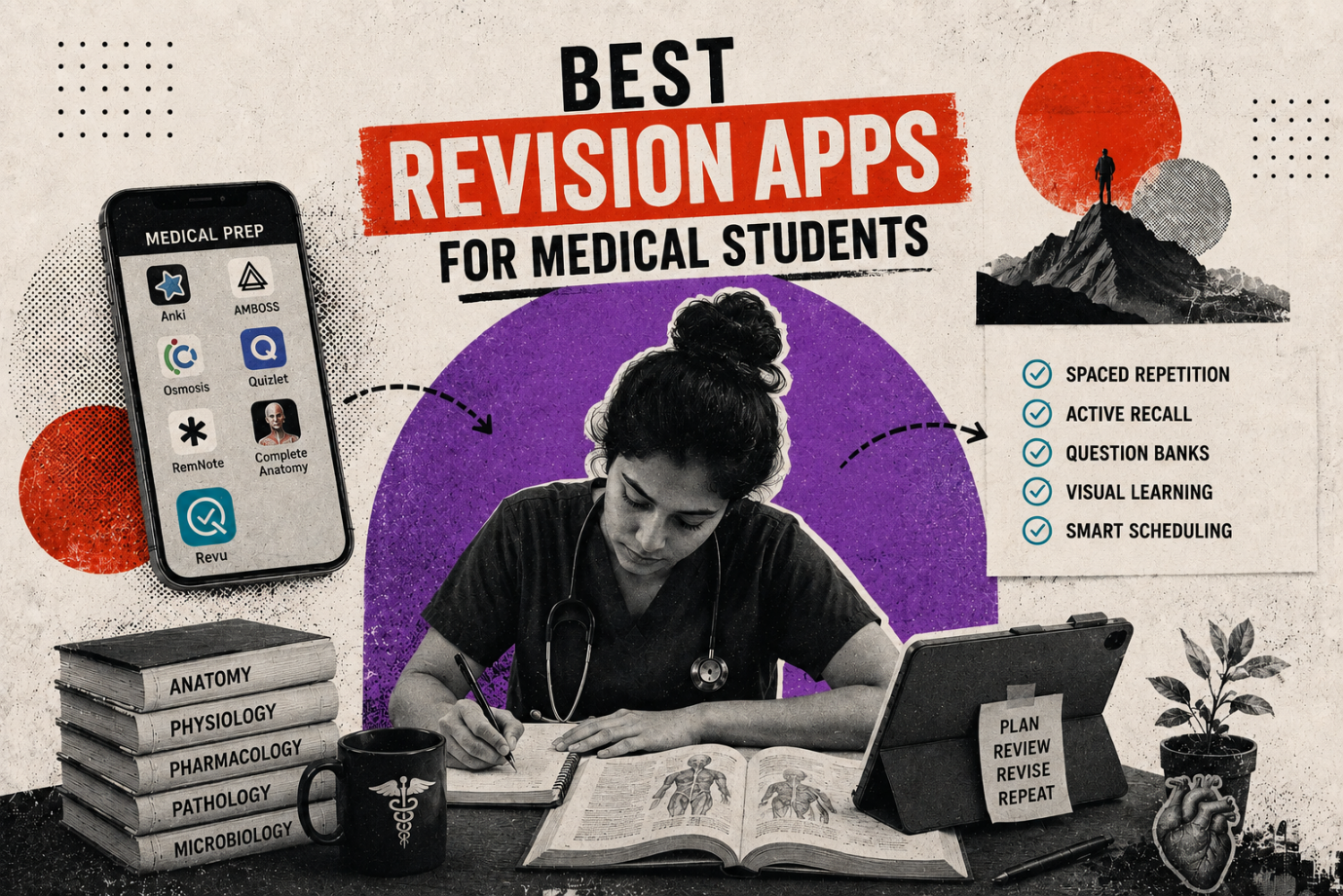
Medical school is a memory marathon. One week you're memorizing cranial nerves, the next you're drowning in pharmacology mechanisms, pathology slides, and clinical case prep.
The real challenge isn't just understanding concepts — it's remembering thousands of facts months later when exams arrive.
That's why top-performing medical students increasingly rely on revision apps that combine:
- Spaced repetition → review topics right before you forget them
- Active recall → test yourself instead of rereading notes
- Question banks → simulate real exam pressure
- Visual learning tools → simplify anatomy and complex systems
- Organization tools → keep revision schedules manageable
If you're preparing for MBBS exams, NEET PG, USMLE, PLAB, MRCP, or nursing exams, here are the best revision apps worth using.
1) Anki — Best for Long-Term Memory Retention
Ask any medical student what app they swear by, and there's a high chance they'll say Anki.
Anki uses spaced repetition, meaning cards appear more frequently when you struggle with them and less often when you've mastered them.
This makes it ideal for:
- Anatomy
- Pharmacology
- Microbiology
- Biochemistry
- Drug side effects
- Medical terminology
One of Anki's biggest strengths is access to massive pre-made decks like AnKing, widely used for USMLE prep.
Pros:
- Extremely effective for long-term retention
- Huge medical student community
- Custom flashcards with images/audio
- Free on desktop and Android
Cons:
- Steep learning curve
- Interface feels outdated
- iOS app is paid
Best for: Students preparing for high-volume memory-heavy exams like USMLE Step 1 or NEET PG.
2) AMBOSS — Best for Clinical Revision
AMBOSS is more than a flashcard app.
It combines:
- Qbanks
- Medical library
- Clinical explanations
- Exam prep tools
Its integration with Anki is especially useful—you can hover over medical terms inside Anki and instantly access explanations from AMBOSS.
Pros:
- Excellent for clinical years
- Great explanations
- Strong for USMLE prep
- Saves time searching references
Cons:
- Expensive subscription
Best for: Clinical reasoning + board prep.
3) Osmosis — Best for Understanding Complex Concepts
Sometimes the problem isn't memorization—it's understanding.
Osmosis helps simplify difficult topics with:
- Animated videos
- Study notes
- Flashcards
- Practice questions
It's especially helpful for:
- Physiology
- Pathology
- Pharmacology
- Clinical concepts
Their app highlights built-in spaced repetition flashcards and offline access.
Pros:
- Visual learning
- Easy explanations
- Great for difficult subjects
Cons:
- Subscription cost
Best for: Visual learners.
4) Quizlet — Best for Quick Revision
Need quick revision before viva exams or class tests?
Quizlet is excellent for fast flashcard review.
You can:
- Use pre-made decks
- Create custom cards
- Practice with games and quizzes
Pros:
- Very beginner-friendly
- Fast setup
- Huge library
Cons:
- Less powerful spaced repetition compared to Anki
Best for: Last-minute revision.
5) RemNote — Best for Notes + Revision in One Place
Many med students hate creating notes separately and then making flashcards later.
RemNote solves that problem.
You can:
- Write notes
- Highlight key facts
- Turn notes into flashcards instantly
- Use spaced repetition
It's a strong alternative for students who find Anki too complicated.
6) Complete Anatomy — Best for Anatomy Revision
If anatomy feels impossible through textbooks alone, this app helps visualize structures in 3D.
Great for:
- Muscles
- Nerves
- Organs
- Surgical anatomy
Medical students often use it alongside flashcard apps for better retention.
7) Revu — Best for Planning Your Revision Schedule
Most med students know what to revise.
The bigger issue?
Knowing when to revise everything.
Revu helps by automatically scheduling your revisions using spaced repetition principles.
Instead of manually deciding:
- What to revise today
- What's overdue
- What should be reviewed next week
The app organizes your revision timeline automatically.
This can be especially helpful for medical students juggling lectures, practicals, clinics, and entrance exam prep—without rebuilding your entire revision timetable every week.
Which App Should You Choose?
| If you need… | Best app |
|---|---|
| Long-term memorization | Anki |
| Clinical prep | AMBOSS |
| Concept clarity | Osmosis |
| Quick revision | Quizlet |
| Notes + flashcards | RemNote |
| Anatomy | Complete Anatomy |
| Revision scheduling | Revu |
Final Thoughts
No single app can do everything.
The smartest medical students often combine tools:
- Anki for memorization
- AMBOSS for clinical prep
- Osmosis for understanding
- Revu for staying consistent
Medical school success is less about studying harder—and more about building a system that helps you remember what matters. Pair your apps with active recall and compare options in our spaced repetition apps roundup if you're still choosing your core stack.