In 2026, student time management is less about stacking more hours on the clock and more about using a system that respects attention and recovery. Between lectures, assignments, and life outside class, these five time management hacks for students help you reclaim your schedule without constant guilt. Pair them with a real revision rhythm—see our revision timetable guide—and with tools from the best study planner apps when you want software backup.
1. The “three-box” rule (study, self, social)
Instead of one endless to-do list, split the day into three intentional boxes: Study, Self, and Social.
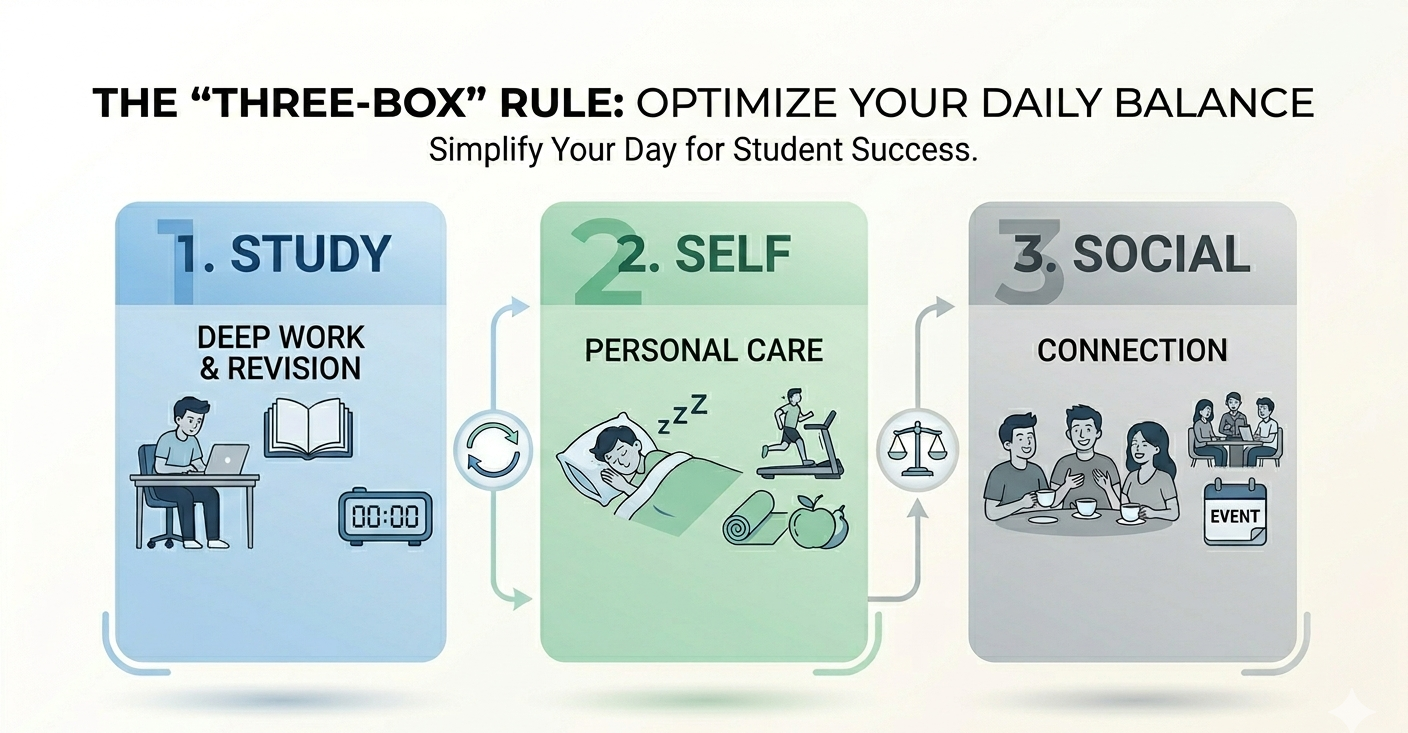
- Study: Deep work, classes, and revision—protected blocks where distraction stays off-limits.
- Self: Sleep, movement, meals, and mental recharge—treated as non-negotiable, not “leftover” time.
- Social: Friends, family, clubs—planned so connection does not constantly collide with guilt.
Why it works: When the Study box is honestly full for the day, you can step into Social time without the nagging feeling you “should” still be at your desk—reducing burnout and all-or-nothing thinking.
2. Time blocking with buffer zones
Strong planners do not only list tasks—they assign real clock time. Replace vague “study Biology” with something concrete, for example: Tuesday 10:00–11:30 a.m.: Chapter 4 active recall.
- Pro move: Add a 15-minute buffer between blocks. Classes run long, messages arrive, lines happen—buffers stop one slip from collapsing the whole afternoon.
This matches the same “do not schedule 100% of your week” idea we use in exam prep: slack is not wasted time; it is shock absorption.
3. The 2-minute rule (for micro-tasks)
Procrastination often grows from tiny friction: If a task takes under two minutes, do it now (reply to a short email, download a syllabus, file one receipt).
- Starter version: For intimidating work, commit to only two minutes of real effort. Starting breaks the psychological seal; continuing is far easier once motion exists.
4. The Eisenhower matrix (priority filtering)
Not every “urgent” ping deserves your best hours. Use a simple 2×2 grid to sort tasks by urgency and importance—one of the fastest ways to beat busywork disguised as productivity.
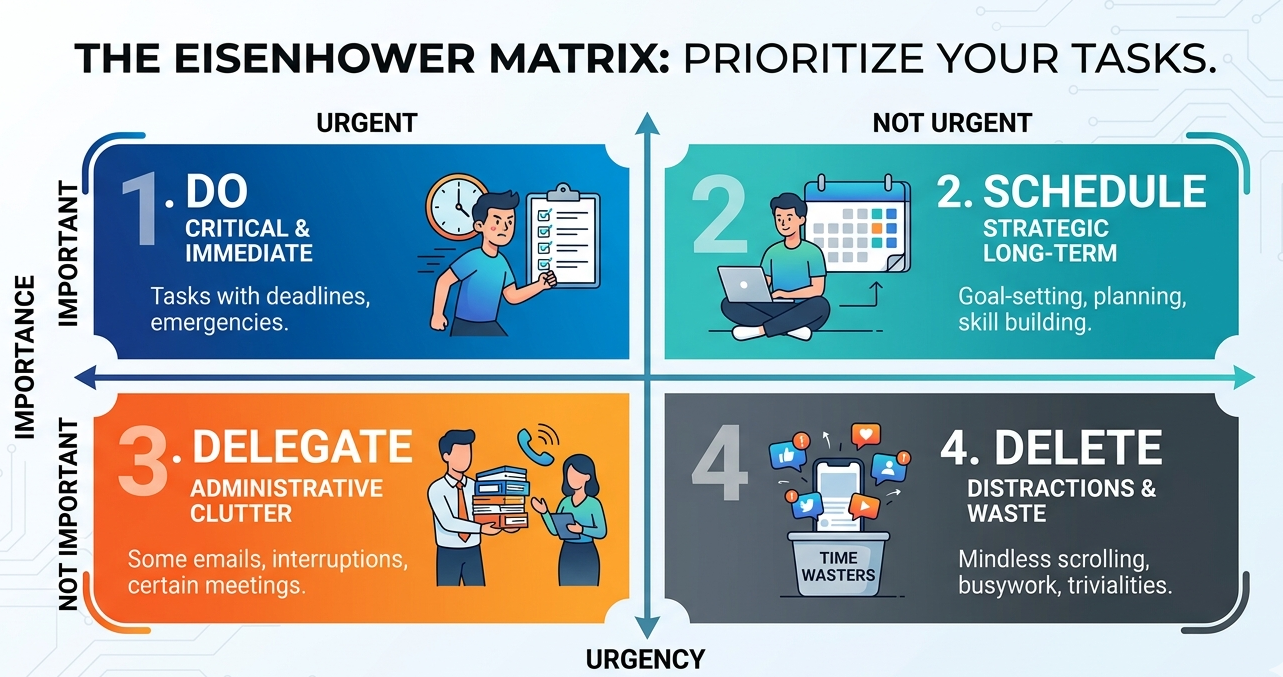
- Quadrant 1 (urgent & important): Do now—e.g. assignment due tomorrow.
- Quadrant 2 (not urgent & important): Schedule protected time—e.g. start an essay due in two weeks.
- Quadrant 3 (urgent & not important): Delegate or shrink—e.g. optional meetings.
- Quadrant 4 (neither): Delete or strictly limit—e.g. mindless scrolling.
5. Structured Pomodoro (25 / 5 sprints)
The Pomodoro Technique stays popular because it matches real attention spans: 25 minutes of focused work, then a 5-minute break—phone away, timer visible.
- 2026-friendly twist: Use device Focus modes that start with your timer. After four rounds, take a 30-minute true break away from all screens so shallow recovery does not stack into mental fatigue.
How these techniques compare
Pick one primary system, then layer others where you leak time or energy.
| Technique | Best for | Effort level |
|---|---|---|
| Three-box rule | General life balance across study, health, and relationships | Low |
| Time blocking | Busy calendars with many deadlines and fixed classes | High |
| 2-minute rule | Clearing admin clutter before it becomes a mental pile | Low |
| Eisenhower matrix | Decision-making and prioritization under overload | Medium |
| Pomodoro | Starting and sustaining focus on large or scary tasks | Medium |
Bottom line
Better student productivity usually comes from clearer boundaries—not from heroic all-nighters. Mix three-box balance, buffered time blocking, quick 2-minute clears, Eisenhower triage, and Pomodoro sprints, and your calendar starts working for your brain instead of against it.