A student spends three hours “studying.”
They highlight notes.
Re-read textbooks.
Watch lectures at 1.5x speed.
Everything feels productive.
Until exam day arrives.
And suddenly…
they can’t remember anything.
Sound familiar?
That frustration led students to obsess over two learning techniques that dominate productivity YouTube:
Spaced Repetition
and
Active Recall
You’ve probably heard claims like:
“Spaced repetition changed my life.”
Or
“Active recall is the only study technique that works.”
Some students swear by flashcards.
Others spend hours solving practice questions.
And somehow the internet has turned this into a rivalry.
But asking which one works better is a bit like asking:
Which matters more for fitness—exercise or recovery?
Wrong question.
Let’s explain.
First, what is Active Recall?
Active recall is simple.
Instead of re-reading information… you force your brain to retrieve it.
For example:
Reading notes = passive
Closing your notebook and trying to explain the topic from memory = active recall
Examples include:
- practice tests
- flashcards
- solving questions
- teaching someone else
- blurting method
- self-quizzing
Why does this work?
Because memory strengthens when retrieval feels difficult.
Psychologists call this the testing effect.
The act of pulling information from memory strengthens neural pathways.
In simple words:
Your brain remembers what it repeatedly retrieves.
Not what it repeatedly sees.
Then what is Spaced Repetition?
Spaced repetition answers a different question:
When should you review information?
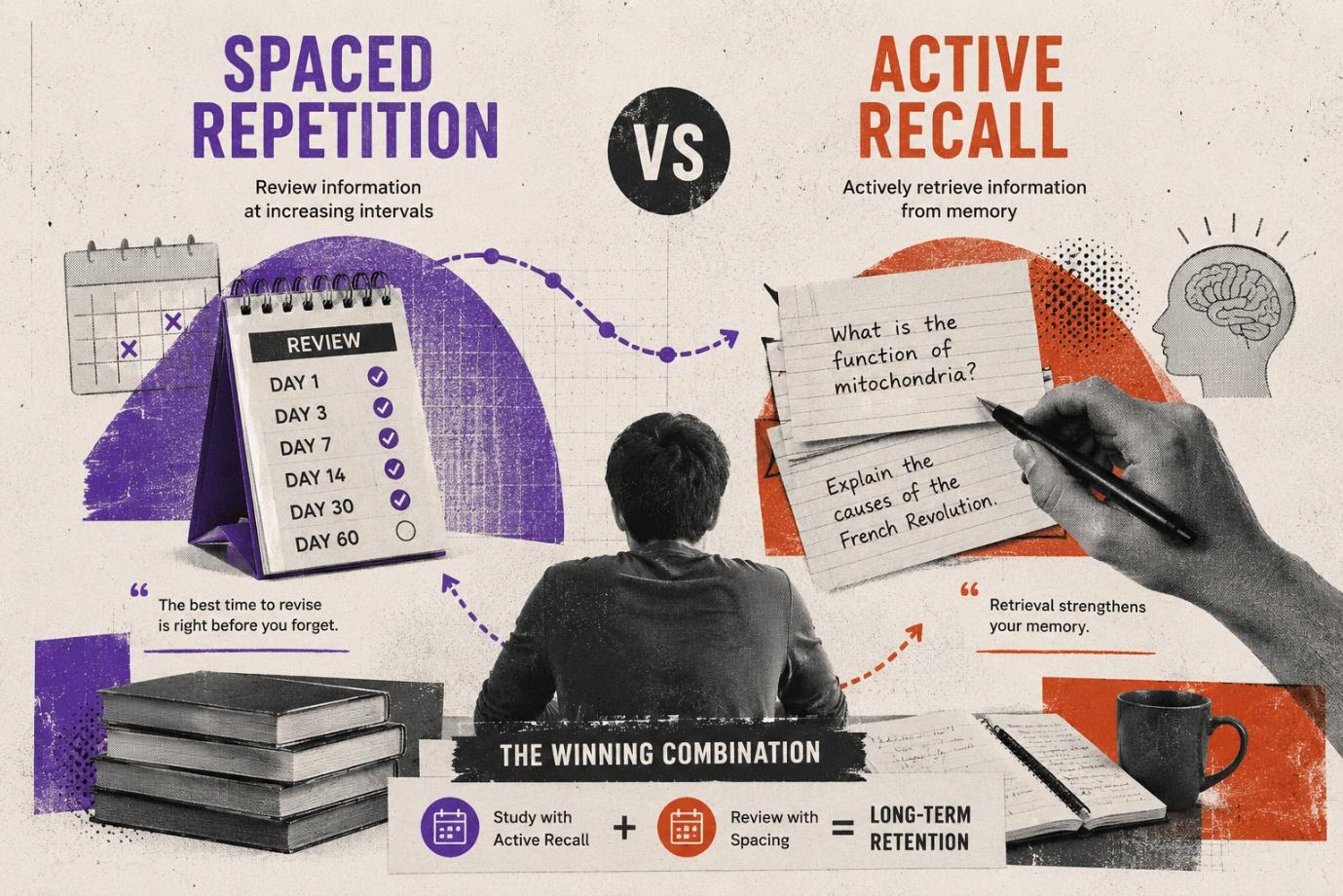
Instead of revising randomly… you review at increasing intervals.
For example:
Day 1
Day 3
Day 7
Day 21
Day 60
This works because of the forgetting curve discovered by Hermann Ebbinghaus.
Your memory naturally declines over time.
Spaced repetition interrupts forgetting before memories disappear completely.
That’s why apps like Anki became popular.
And it’s also why revision planning tools like Revu exist.
Here’s where students get confused
They think this is a battle.
It isn’t.
Active recall solves:
How should I study?
Spaced repetition solves:
When should I revise?
Very different problems.
Active recall without spaced repetition looks like this:
You solve 100 questions today.
You feel amazing.
Then you never revisit the topic.
Three months later?
Gone.
Spaced repetition without active recall looks like this:
You revise on Day 1.
Day 7.
Day 21.
But all you do is re-read notes.
That creates familiarity.
Not mastery.
You recognize concepts.
But struggle to retrieve them.
The best students combine both
This is where things get powerful.
Imagine learning biology today.
Day 1:
Use active recall through practice questions.
Day 3:
Review using flashcards.
Day 7:
Take a quiz.
Day 21:
Solve previous mistakes.
That’s active recall + spacing.
And that combination is incredibly effective.
Why schools accidentally train bad study habits
Most schools reward short-term cramming.
Study today.
Write exam tomorrow.
Forget everything next month.
That system encourages:
- re-reading
- highlighting
- binge studying
Not long-term retention.
That’s why students often discover these methods online.
Why this became a huge internet debate
Because productivity creators love simple answers.
“THIS ONE TECHNIQUE WILL CHANGE YOUR LIFE”
Performs better than:
“You need a combination of systems.”
Nuance rarely goes viral.
But it tends to work better.
So which one works better?
If you only choose one:
Active recall may produce faster immediate gains.
Because retrieval is incredibly powerful.
But for long-term retention?
You need spacing.
The real winner is combining both.
Think of it this way:
Active recall helps you learn deeply.
Spaced repetition helps you remember longer.
And most students need both.
The bigger lesson
Students often search for the perfect study hack.
But learning rarely depends on one magical technique.
It usually comes down to:
learning actively
reviewing consistently
forgetting less over time
And that combination tends to beat cramming every single time.