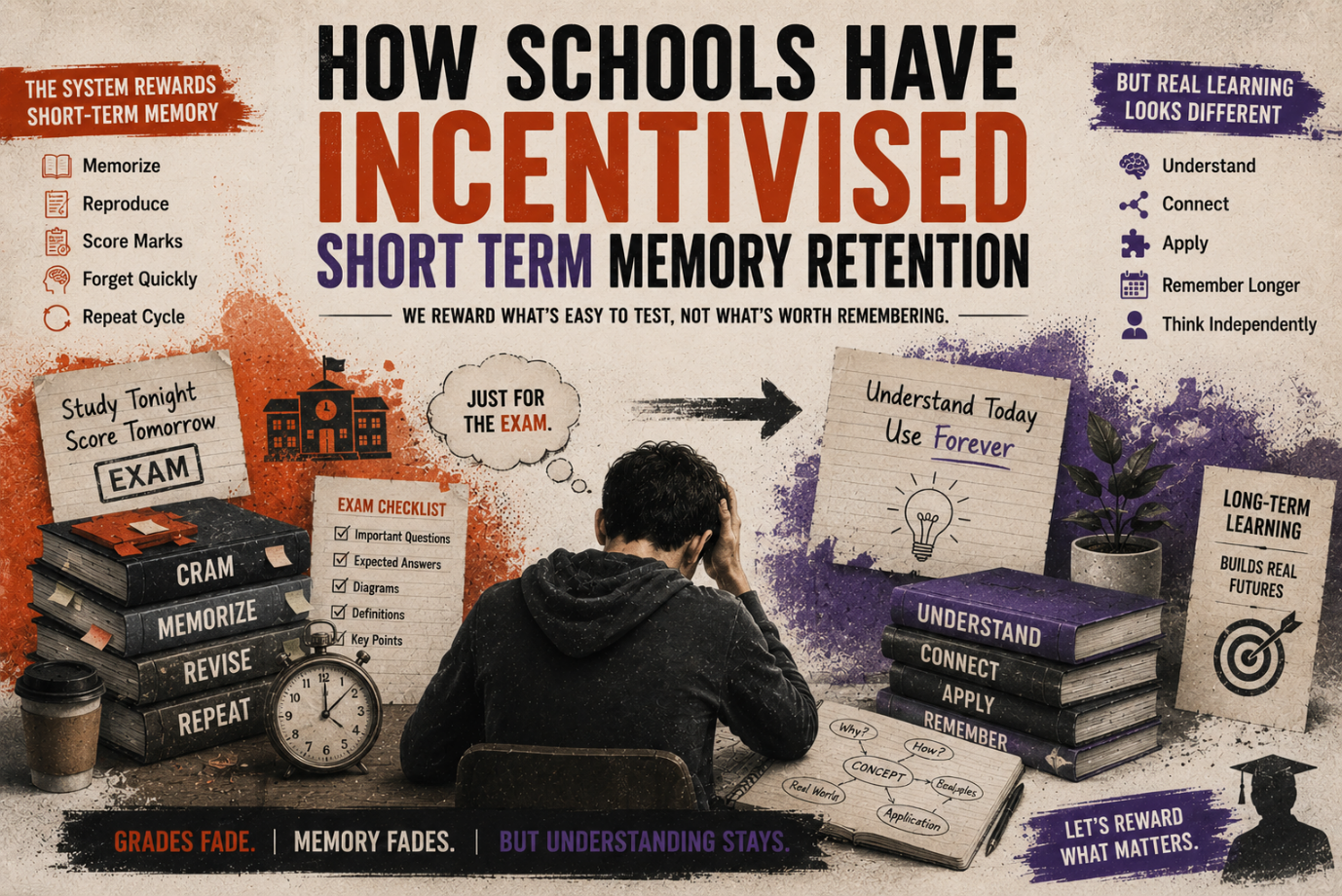
Most students don’t actually learn for understanding.
They learn for the exam.
Memorize the chapter.
Write the answers.
Score marks.
Forget everything two weeks later.
Then repeat the cycle again.
For decades, education systems around the world have rewarded one specific skill above almost everything else:
short-term memory retention.
Not curiosity.
Not deep understanding.
Not long-term learning.
Just the ability to temporarily store information long enough to reproduce it during an exam.
And students have adapted exactly the way the system trained them to.
The Hidden Incentive Structure of Schools
Students respond to incentives.
If schools reward memorization, students memorize.
If schools reward grades, students optimize for grades.
If schools reward speed over depth, students prioritize speed.
The problem is not that students are lazy.
The problem is that the system often measures performance instead of learning.
A student who remembers information for three days and scores 95% is treated as more successful than a student who deeply understands concepts but performs worse under exam pressure.
Naturally, students begin studying for survival rather than mastery.
Why Cramming Works So Well
Cramming is one of the clearest examples of short-term memory optimization.
Students study huge amounts of information right before an exam because the brain can temporarily hold that information in working memory.
For a short period, recall becomes possible.
But after the exam, most of that information disappears rapidly.
Psychologists call this the “forgetting curve.”
Without repeated retrieval and reinforcement, memory fades surprisingly fast.
Yet schools unintentionally reward this behavior because exams are often designed around immediate performance rather than long-term retention.
As long as the student can reproduce answers during the test window, the system considers the learning successful.
Even if the knowledge vanishes days later.
Marks Became More Important Than Memory
Many students no longer ask:
“Do I truly understand this?”
Instead, they ask:
“Will this come in the exam?”
That single question reveals how education incentives shape behaviour.
When marks become the primary goal, learning becomes transactional.
Students begin:
- memorizing expected answers,
- optimizing for predictable patterns,
- studying only “important questions,”
- and forgetting subjects immediately after exams end.
The objective quietly shifts from education to performance management.
The Cost of Surface-Level Learning
Short-term learning creates short-term results.
Students may score highly while struggling to:
- apply concepts practically,
- connect ideas deeply,
- retain knowledge years later,
- or think independently.
This becomes especially visible in subjects requiring cumulative understanding like mathematics, medicine, science, or language learning.
Knowledge built only for exams creates weak foundations.
And weak foundations eventually collapse under complexity.
That’s why many students experience a strange feeling after exams:
they studied for hundreds of hours, yet remember very little months later.
Schools Optimized for Standardization
Part of this problem comes from scale.
It is easier to measure memorization than deep understanding.
Standardized testing allows schools to:
- evaluate thousands of students quickly,
- assign numerical scores,
- compare performance,
- and maintain structured systems.
But what is easy to measure is not always what matters most.
Deep learning is slower.
Messier.
Harder to quantify.
Real understanding often appears through:
- discussion,
- experimentation,
- application,
- teaching others,
- and long-term recall.
These are far more difficult to standardize than multiple-choice exams.
So education systems naturally drift toward measurable short-term outputs.
The Brain Learns Differently Than Schools Teach
Modern neuroscience shows that long-term memory requires reinforcement over time.
The brain remembers information better when learning includes:
- spaced repetition,
- active recall,
- emotional relevance,
- sleep,
- and repeated retrieval.
But many school systems still rely heavily on:
- passive rereading,
- information overload,
- lecture-heavy teaching,
- and high-pressure testing cycles.
Students are often taught in ways that maximize syllabus completion rather than memory retention.
What Real Learning Looks Like
Real learning is slower than memorization.
It requires revisiting ideas repeatedly.
Making mistakes.
Connecting concepts.
Applying knowledge in different situations.
A student who remembers something years later has truly learned it.
And ironically, the students who focus on long-term understanding often perform better eventually anyway — because durable memory creates stronger thinking.
The future increasingly rewards people who can:
- think deeply,
- adapt knowledge,
- solve problems creatively,
- and continue learning independently.
Not just people who can temporarily memorize information.
Final Thought
Schools did not intentionally try to weaken long-term learning.
But systems shape behavior.
And for decades, many education systems have unintentionally incentivized short-term memory performance over durable understanding.
Students adapted accordingly.
But the world is changing.
In an age where information is instantly available online, the real advantage is no longer memorizing everything temporarily.
It is building knowledge that actually stays with you.
If you want your learning to last, pair active recall with spaced repetition instead of exam-week cramming.