The Forgotten Memory Technique Called the Method of Loci
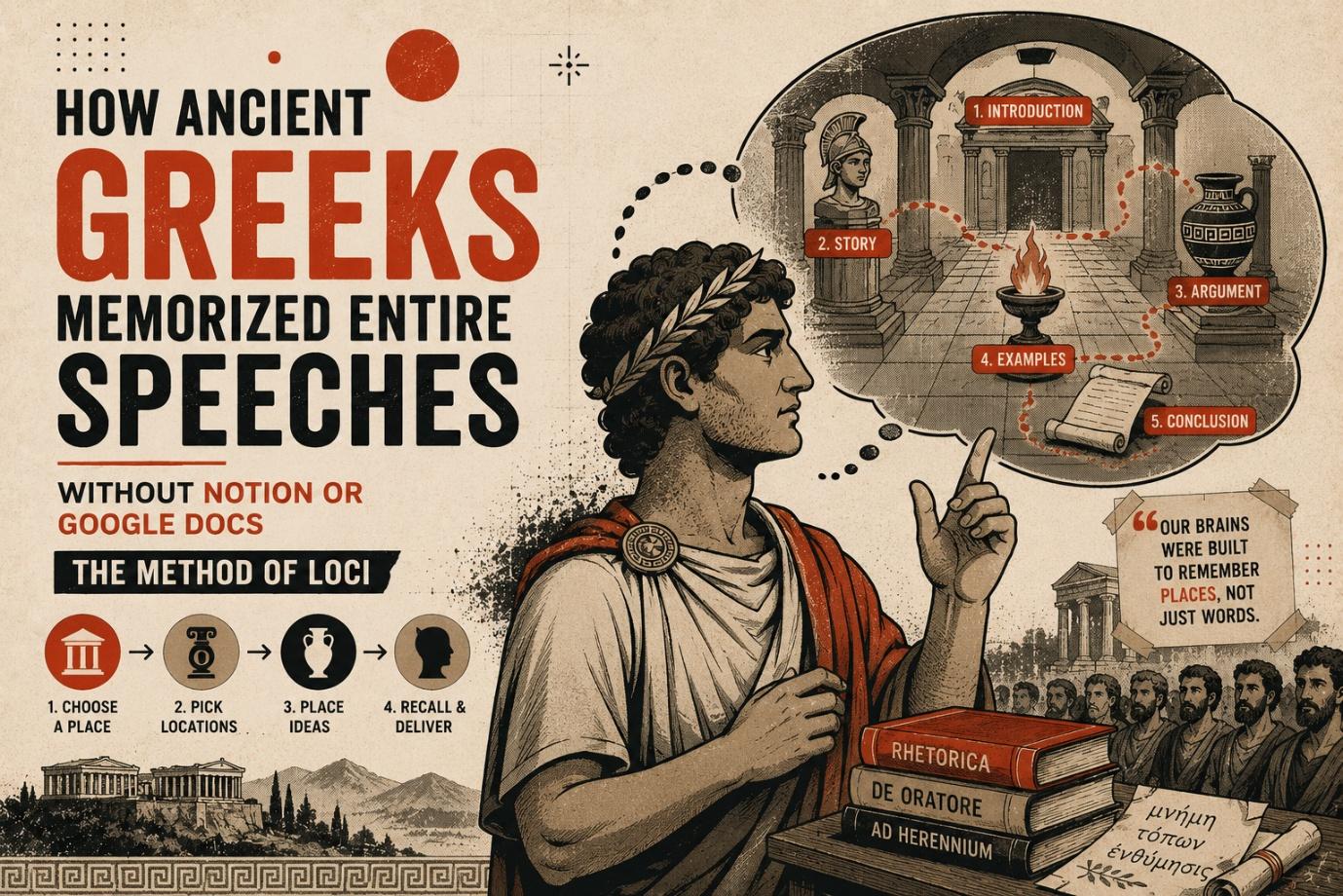
Imagine standing in front of thousands of people in ancient Greece.
No phone in your pocket.
No paper notes in your hand.
No teleprompter.
No Google Docs.
And yet somehow, you're expected to deliver a speech lasting hours — flawlessly.
Not just a few talking points.
Entire arguments. Stories. Philosophical ideas. Names. Numbers. Sequences.
Word for word.
To modern students, this sounds impossible.
But for ancient Greek and Roman speakers, it was normal.
Because they used one of the most powerful memory techniques ever discovered:
The Method of Loci.
Today it's called a "memory palace."
And despite being over 2,000 years old, it still outperforms many modern study methods.
Before Writing, Memory Was Survival
Today, we outsource memory constantly.
Phone numbers live in our contacts.
Ideas live in Notion.
Reminders live in apps.
Facts live in Google.
But in the ancient world, memory wasn't optional.
It was infrastructure.
If you were a politician, philosopher, lawyer, poet, or teacher, your reputation depended on your ability to remember enormous amounts of information accurately.
In fact, many ancient cultures viewed strong memory almost like a superpower.
The Greeks especially admired skilled orators — people who could speak continuously with clarity and precision.
And this created a problem:
How do humans remember massive amounts of information without writing everything down?
The answer emerged from a strange observation.
The Story That Started It All
According to legend, the technique began with a Greek poet named Simonides of Ceos.
One evening, Simonides attended a banquet and performed a poem for wealthy guests.
Shortly after he stepped outside, disaster struck.
The banquet hall collapsed.
The bodies were crushed so badly that families could no longer identify who was who.
But Simonides realized something extraordinary:
He could remember exactly where every person had been sitting.
By mentally walking through the room, he reconstructed the identities of the dead.
This insight changed memory forever.
Humans are surprisingly bad at remembering abstract information.
But we are exceptionally good at remembering places.
Your Brain Is Built for Locations
Think about your childhood home.
You can probably visualize:
- Where the kitchen was
- Which side the bed faced
- Where the TV sat
- Which drawer held random batteries
Even after years, spatial memory stays remarkably strong.
Ancient thinkers realized they could exploit this.
Instead of memorizing information directly, they attached ideas to physical locations inside an imagined space.
Then, during a speech, they mentally walked through that space and "picked up" each idea in order.
This became known as the Method of Loci.
"Loci" simply means "places."
How the Method of Loci Actually Works
The process is surprisingly simple.
Step 1: Choose a Familiar Place
Usually:
- Your home
- A road you walk often
- A school building
- A temple
- A palace
The location must be deeply familiar.
Step 2: Create Specific Locations
For example:
- Front door
- Sofa
- Kitchen sink
- Staircase
- Bedroom window
These become "memory slots."
Step 3: Attach Information to Each Location
Here's where things get weird.
The human brain remembers unusual imagery far better than ordinary facts.
So instead of placing plain information in your palace, you turn ideas into bizarre mental scenes.
Imagine you need to remember:
- Democracy
- War
- Philosophy
You might visualize:
- A voting box exploding at your front door
- Soldiers fighting in your kitchen
- Socrates sitting on your sofa drinking coffee
The stranger the image, the stronger the memory.
Step 4: Mentally Walk Through the Palace
When delivering the speech, you simply walk through the building in your imagination.
Front door → democracy
Kitchen → war
Sofa → philosophy
The locations naturally preserve order.
This solved one of the hardest problems in memorization:
Sequence.
Why This Technique Works So Well
Modern neuroscience suggests the Method of Loci works because it combines multiple powerful memory systems simultaneously:
- Spatial memory
- Visual memory
- Emotional imagery
- Story association
Instead of storing information as isolated text, the brain stores it as an experience.
And experiences are easier to recall.
This is also why you remember movie scenes more easily than textbook paragraphs.
Your brain evolved for environments, movement, and imagery — not bullet points on a screen.
The Greeks accidentally discovered this centuries before neuroscience existed.
Pair this with spaced repetition and active recall for a full memory system: vivid encoding now, strategic review later.