Imagine being asked to memorize the following sequence:
1492177619472025
At first glance, it looks like a random collection of numbers. Most people would struggle to remember it after a few seconds.
Now look at it differently:
1492 | 1776 | 1947 | 2025
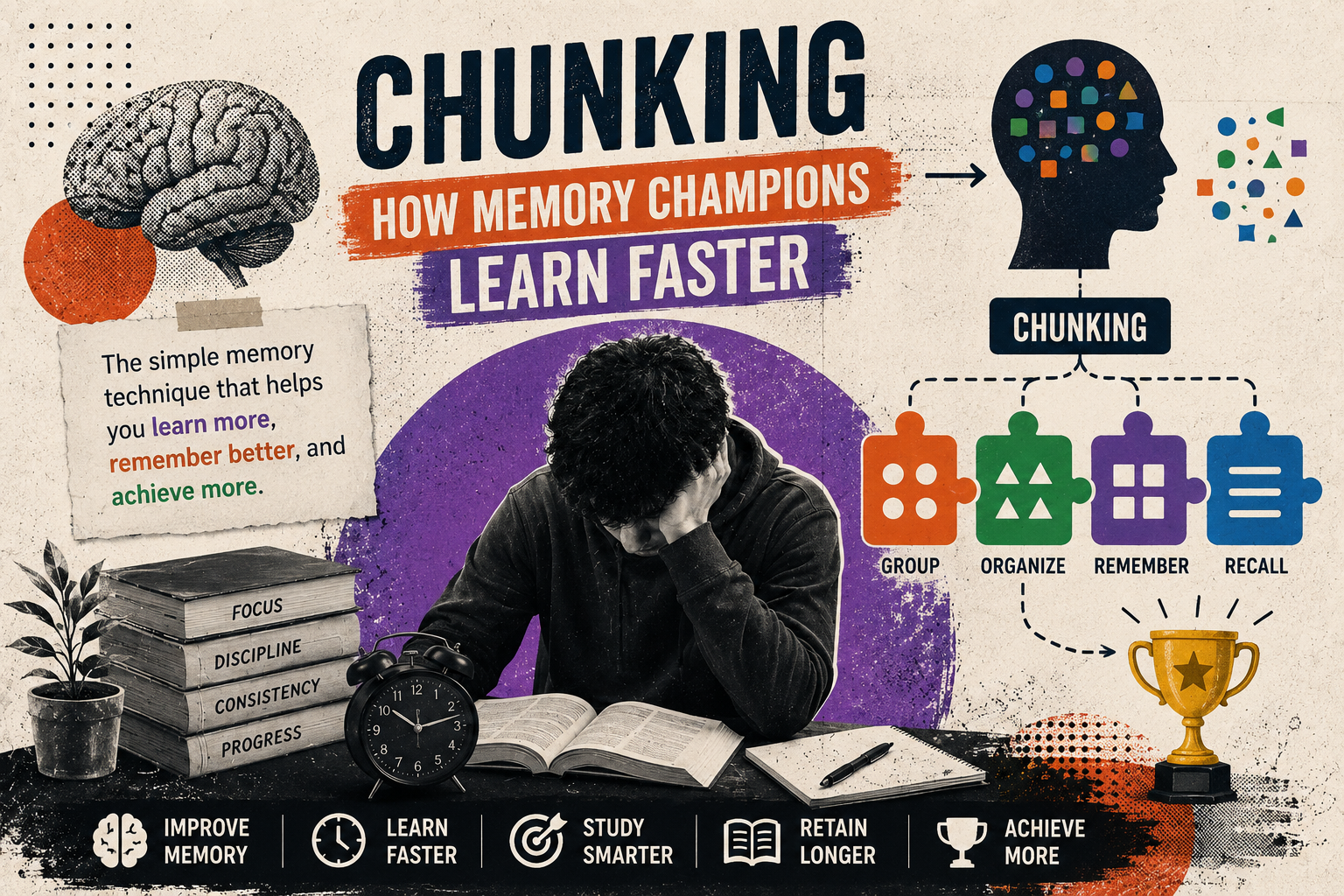
Suddenly, it feels much easier. Instead of remembering sixteen separate digits, you're remembering four meaningful groups. This simple shift is called chunking, one of the most effective memory techniques known to cognitive science.
Chunking is used by memory champions to memorize decks of cards, long strings of numbers, and vast amounts of information in remarkably short periods of time. But here's the surprising part: it isn't a skill reserved for elite performers. It's a technique that anyone can use to learn faster, study more effectively, and retain information for longer.
Whether you're preparing for exams, learning a new language, or trying to remember important concepts at work, understanding chunking can transform the way you learn.
What Is Chunking?
Chunking is the process of organizing individual pieces of information into larger, meaningful units called "chunks."
Our brains can only hold a limited amount of information in working memory at any given moment. When information is presented as many separate pieces, it quickly becomes overwhelming—the same limit described in cognitive load theory.
For example, consider a phone number:
9876593210
It can be difficult to remember as ten separate digits. However, when written as:
98765-93210
it becomes much easier because the brain treats each group as a single unit.
We use chunking naturally in everyday life. We recognize words instead of individual letters, remember dates as years rather than separate numbers, and organize information into categories to make sense of it.
Why Chunking Works
The effectiveness of chunking lies in the way human memory operates.
Working memory acts like a temporary mental workspace where information is processed before being stored in long-term memory. Chunking helps overcome this limitation by combining smaller pieces of information into meaningful groups.
Imagine trying to memorize the following list:
- Dog
- Cat
- Lion
- Tiger
- Apple
- Mango
You could attempt to remember all six items individually. Or you could organize them into two chunks:
Animals: Dog, Cat, Lion, Tiger
Fruits: Apple, Mango
Instead of managing six unrelated pieces of information, your brain now handles just two organized categories.
Another reason chunking works is that the brain naturally seeks patterns and meaning. Information that is connected, structured, and familiar is easier to remember than information that appears random.
How Memory Champions Use Chunking
Many people assume memory champions possess extraordinary brains. Research suggests otherwise.
What separates memory experts from the average person is not necessarily superior memory capacity, but superior memory strategies. Chunking is one of their most powerful tools—alongside techniques like the method of loci.
When a beginner looks at a shuffled deck of cards, they see fifty-two separate pieces of information. A memory champion, however, sees recognizable patterns and groups.
Through practice, they transform multiple cards into meaningful images, stories, or associations.
The same principle applies when memorizing numbers. Rather than remembering a long sequence digit by digit, memory experts group digits into dates, ages, years, or other familiar patterns.
For example, the sequence:
194719912025
may be remembered as:
- 1947 (India's Independence)
- 1991 (Economic Reforms)
- 2025 (Current Year)
The brain processes these as meaningful chunks rather than twelve individual digits. This dramatically reduces mental effort and allows memory champions to learn and recall information much faster than most people.
Real-Life Applications of Chunking
Chunking isn't limited to memory competitions—it can make everyday learning much easier.
Learning Languages
Instead of memorizing individual vocabulary words in isolation, group them by theme—food, travel, emotions—or by grammar pattern. Your brain stores one category as a single chunk rather than dozens of disconnected terms.
Studying Science
Complex formulas and processes become manageable when broken into steps or stages. The Krebs cycle, for example, is far easier to recall as a sequence of named stages than as a wall of chemical notation.
Learning History
Dates and events stick better when grouped by era, cause, or theme. Remembering "the independence movements of the 1940s" as one chunk beats memorizing each date in isolation.
Learning Programming
Code is naturally chunked—functions, classes, and modules each represent a single unit of meaning. Beginners who learn to think in blocks of logic rather than line by line progress much faster.
How Students Can Use Chunking
Group Similar Information
Before you start memorizing, sort your notes into categories. Topics that belong together should be studied together—your brain will treat each group as one chunk.
Break Topics Into Smaller Parts
A full chapter is overwhelming. A section on "three types of chemical bonds" is a chunk. Break large topics into named sub-units before trying to remember them.
Use Visual Tools
Mind maps, diagrams, and tables turn scattered facts into organized visual chunks. What looks like twenty separate points on a page becomes three or four clear groups on a diagram.
Test Yourself
After chunking information, close your notes and try to recall each group from memory. This combines chunking with retrieval practice—the two techniques reinforce each other.
Review Regularly
Chunks fade without reinforcement. Schedule spaced reviews so each group stays strong over time—see what spaced repetition is and how tools like flashcards pair naturally with chunked study material.
Final Thought
Memory champions aren't successful because they have photographic memories or extraordinary intelligence. They succeed because they understand how the brain processes information.
Chunking transforms large amounts of information into manageable, meaningful groups, making learning faster, easier, and more effective.
The next time you encounter a difficult chapter, a lengthy list of facts, or a complex topic, resist the urge to memorize everything at once. Instead, look for patterns, create categories, and break information into chunks.
Sometimes, learning more isn't about working harder—it's about organizing information in a way your brain naturally understands.