Best way to revise for CA exams in 2026: a smart revision blueprint
Whether you are preparing for CA Foundation, Inter, or Final, the ICAI syllabus can feel overwhelming—like drinking from a firehose. That is why CA exam revision, not only first-time coverage, often decides the result.
CA papers do not only test how much you have studied. They test how reliably you can retrieve information quickly and present it accurately under time pressure. In 2026, clearing levels is less about endless desk hours and more about smart revision strategies that improve retention per hour. For the science behind testing yourself, see active recall vs passive learning; for timetable design, see revision timetable for exams.

1. Prepare for the 1.5-day revision window
Between many CA papers you typically get only about 1.5 days of preparation leave. Your study system should therefore aim at one concrete outcome:
Can you revise an entire subject in roughly 36 hours using compact materials—not scattered stacks you have to hunt through?
If revision resources are split across too many books, loose notes, and random PDFs, you lose time searching.
Build a compact revision kit per subject:
- Summary notes
- Formula sheets
- Important amendments list
- Frequently tested adjustments (exam-style)
- Key case laws and sections
- Marked ICAI questions you have already attempted
Final revision should feel like reviewing highlights—not restarting the full syllabus from page one.
2. Use ABC analysis to prioritize topics
Not every chapter carries equal weight. Use ABC analysis to maximize marks per hour.
A category: high weightage + high scoring
Examples often include topics such as:
- Consolidation (Financial Reporting)
- Standard costing
- GST adjustments
- Important Accounting Standards
Schedule these for multiple passes across your revision cycle.
B category: medium weightage
These chapters support your aggregate and should stay in rotation—do not let “not favorite” become “never revised.”
C category: low weightage or low ROI
Highly complex or rarely examined areas still need a baseline: enough for MCQs or direct short questions—without swallowing disproportionate time. The goal is marks per hour, not perfect coverage of every page.
3. Combine practical and theory blocks
Two dense theory papers back-to-back can drain focus. Alternate practical and theory subjects to manage mental energy.
Morning (high energy): Accounts, Costing, Tax, Financial Management—computation-heavy work.
Afternoon or evening: Audit, Law, SCMPE, and other theory-heavy papers.
Smart revision is partly cognitive load management, not only total hours logged.
4. Practice active recall (stop passive re-reading)
Re-highlighting the ICAI module builds familiarity, not exam-ready recall. CA papers reward reproduction under pressure. For a full breakdown of the method, read what active recall is and how to revise effectively.
Recreate formats from memory
For Accounts or Costing, use a blank sheet first, then check the solution:
- Ledger formats
- Financial statements
- Cost sheets
- Working note layouts
Teach the concept
Explain company law provisions, audit procedures, or tax concepts in simple language. If you cannot explain it cleanly, the gap is understanding—not more highlighting.
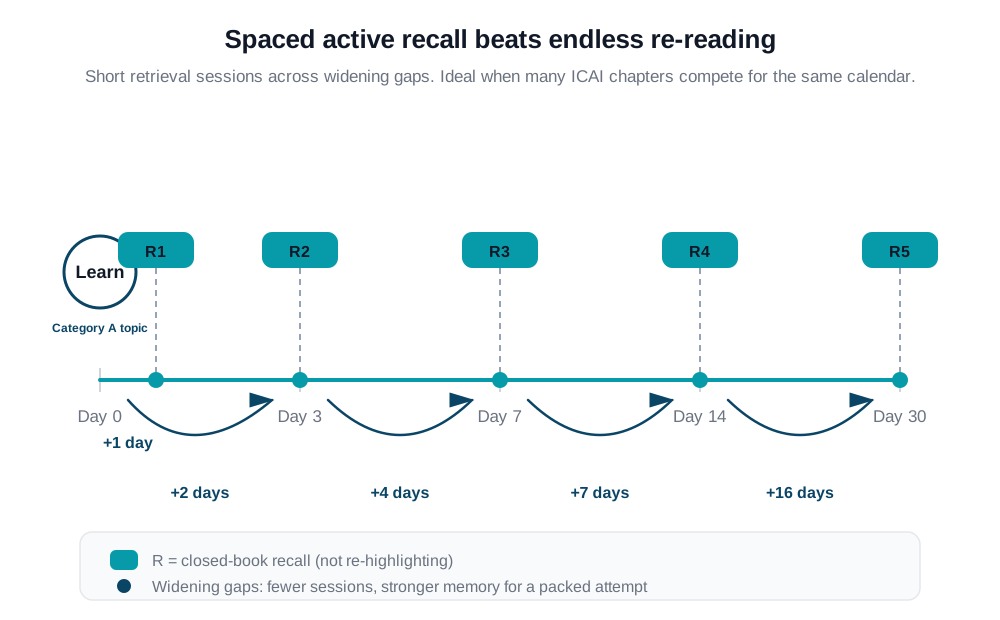
Tools like Revu help you stick to a review rhythm across many chapters—so spaced passes on Category A topics do not fall off the calendar when the attempt gets busy.
5. Build a “last day revision” (LDR) list
From your first full revisions onward, maintain an LDR list (last day revision)—a shortlist of what actually moves marks when time is almost gone.
- Difficult adjustments
- Frequently repeated ICAI questions
- High-value practical sums
- High-value theory questions
- Common mistakes you personally repeat
Aim for roughly 5–10 high-quality questions per chapter that cover most concepts. The day before the exam, working through this list beats racing through dozens of easy questions for false confidence.
6. Learn to write in ICAI language
Knowing the answer is only half the battle—presentation and keywords matter.
Audit and Law: Use proper technical and legal terminology; many marking patterns reward specific phrases.
AS, Ind AS, and SAs: Reference standards explicitly—for example:
- “As per the provisions of Ind AS ___ …”
- “According to SA ___ …”
You do not need perfect prose—but structured, standard-aware answers read as professional and complete.
7. Do not skip RTPs and MTPs
One of the most expensive mistakes is skipping Revision Test Papers (RTPs) and Mock Test Papers (MTPs). They often surface latest amendments, new patterns, and repeated adjustment styles—especially important for:
- Direct tax
- Indirect tax
- Law-heavy papers
Also attempt at least one full three-hour mock per subject. Struggling with time and stamina at home is far cheaper than discovering the problem in the hall.
Final thought
Many CA students believe they need to “study more.” Often they need to revise better—with prioritization, recall practice, compact notes, and exam-realistic practice. The students who clear consistently are not always those with the longest raw hours; they are usually the ones who can revise, recall, and reproduce when the attempt is on the line. Smart revision often beats endless passive repetition.